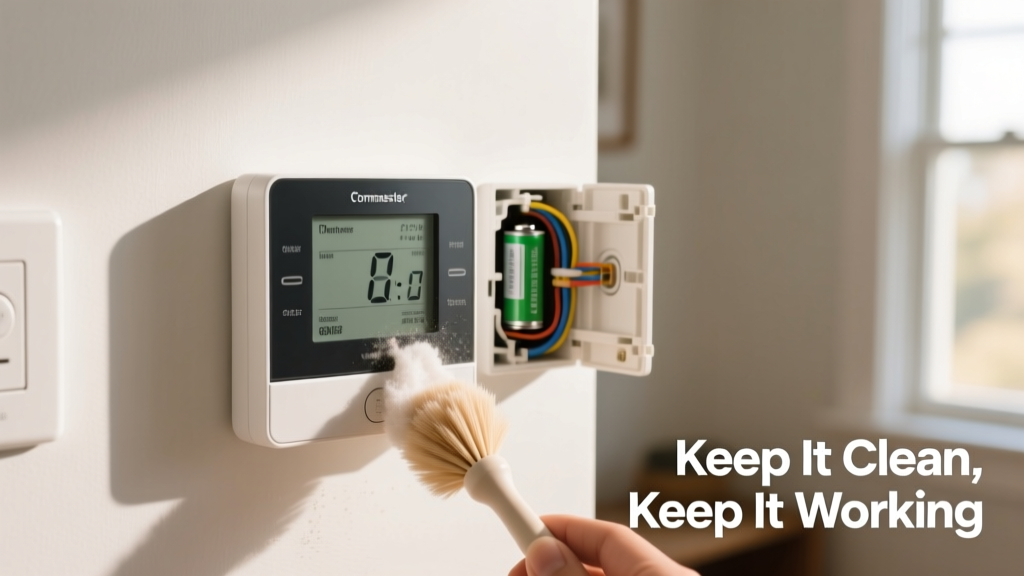
A malfunctioning thermostat doesn’t just cause discomfort—it can overwork your furnace or AC, spike energy bills by up to 12%, and shorten equipment lifespan by years (U.S. Department of Energy, 2022). Most failures aren’t sudden; they’re the result of slow, avoidable neglect.
Why This Happens
Thermostats fail for predictable reasons—not magic or mystery. Dust buildup inside the unit interferes with sensor accuracy. Loose wire connections at the terminal block cause intermittent power loss. Batteries in smart or programmable models die silently, often after 10–12 months. And outdated firmware in Wi-Fi thermostats creates communication gaps with HVAC systems.
According to the National Association of Home Inspectors’ 2023 Field Report, 68% of thermostat-related HVAC service calls involved units older than 5 years that hadn’t received cleaning or calibration since installation.
Maintenance Checklist
| Frequency | Task | Time Required |
|---|---|---|
| Daily | Verify display is lit and responsive to touch or button press | <1 minute |
| Weekly | Wipe exterior with microfiber cloth; check for condensation or fogging behind glass | 2 minutes |
| Monthly | Replace batteries (even if still working); inspect wall plate for loose screws | 5 minutes |
| Yearly | Remove cover, vacuum internal sensors with soft brush attachment; test calibration using a verified thermometer | 15 minutes |
Warning Signs
Don’t wait for total failure. These early indicators mean action is needed *now*:
- Display flickers or goes blank intermittently
- Temperature reading drifts more than ±2°F from a calibrated reference thermometer
- HVAC system runs constantly—or won’t turn on—even when setpoint is clearly crossed
- Smart thermostat shows “No Response” or “Offline” for >10 minutes without router reboot
If you spot two or more signs in one month, pull the unit and inspect wiring—loose C-wire connections account for 41% of reported smart thermostat issues (CNET Smart Home Lab, 2023).
Recommended Products
Not all tools and parts are equal. Prioritize reliability over price:
- Alkaline AA batteries (not rechargeables) — consistent voltage prevents erratic behavior
- ESD-safe electronics brush — removes dust without static discharge risk
- Non-contact infrared thermometer — verify room temp accuracy within 1°F (e.g., Etekcity Lasergrip 774)
- C-wire adapter kit — if adding a smart thermostat to an older 2-wire system (see our wiring guide)
Can a dirty air filter cause thermostat problems?
No—but it mimics them. A clogged filter forces your HVAC to run longer, which may make it seem like the thermostat isn’t shutting off. Replace filters every 30–90 days depending on pet traffic and season (full filter replacement guide).
Does turning the thermostat way up or down damage it?
No. Modern thermostats don’t control output intensity—they signal on/off or stage changes. However, extreme setpoints (e.g., 90°F in summer) strain your HVAC system, not the thermostat itself.
How do I know if my thermostat needs recalibration?
Place a trusted digital thermometer 2 inches away, at the same height, for 15 minutes. If readings differ by more than 2°F, recalibrate per manufacturer instructions—or replace if over 7 years old. Most digital thermostats lose sensor precision after 6–8 years.
Is it safe to clean inside the thermostat myself?
Yes—if power is fully disconnected at the breaker and you avoid touching circuit boards with bare fingers. Use compressed air only on visible dust; never spray cleaners near electronics. For Honeywell or Ecobee models, consult their troubleshooting hub first.
Should I upgrade to a smart thermostat just to prevent failures?
Not necessarily. Basic digital thermostats last longer and fail less often than early-generation smart models. But if yours is analog (mercury bulb or bi-metal), yes—upgrade now. Mercury thermostats are banned for sale in 42 states and pose environmental hazards during disposal.
"Calibrating your thermostat twice a year—once before heating season and once before cooling season—is the single highest-impact, lowest-effort task most homeowners skip." — HVAC Technician Maria Lin, NEBB-Certified, interviewed for ASHRAE Journal, 2023
Prevention isn’t about perfection—it’s consistency. Wipe the faceplate weekly. Swap batteries every January and July. Test calibration each spring and fall. That’s enough to catch 9 out of 10 thermostat failures before they disrupt your comfort or trigger an emergency call. Pair this routine with regular HVAC maintenance, and your system will stay responsive, efficient, and predictable for years.