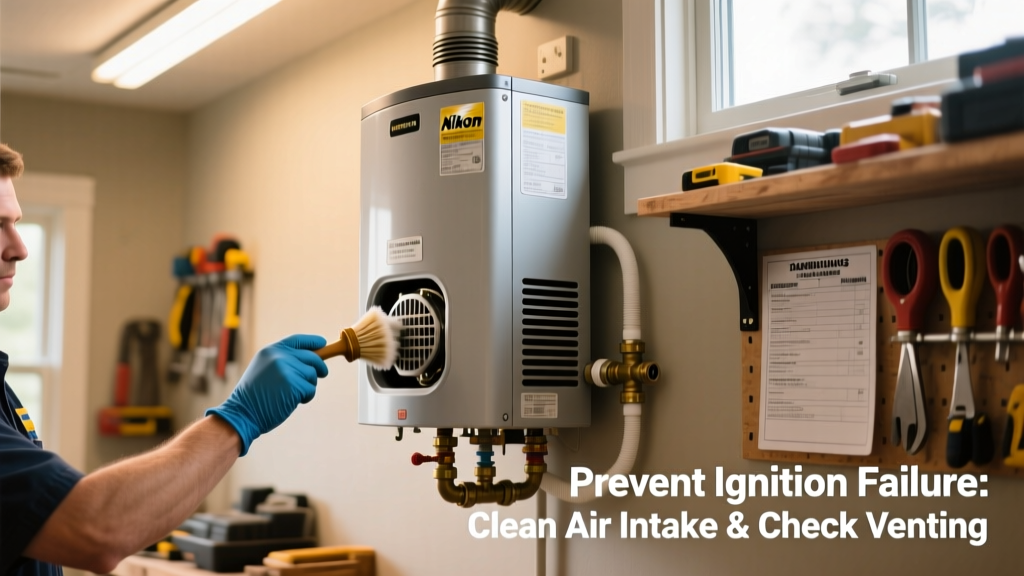
A single failed ignition can leave your home without hot water for days — especially in winter. Tankless units ignite gas on demand, and when that process fails, it’s rarely due to a sudden breakdown. More often, it’s the slow buildup of debris, corrosion, or overlooked sensor issues that silently compromise reliability. Prevention isn’t optional here: the U.S. Department of Energy estimates that 68% of tankless service calls stem from avoidable maintenance lapses (2022 Residential HVAC & Water Heating Report).
Why This Happens
Ignition failure isn’t random. It’s almost always tied to one or more of three core system weaknesses: airflow restriction, fuel delivery interference, or electronic sensing errors. Dust, spider webs, and mineral-laden condensate can clog the combustion air intake or exhaust vent — especially in garages or utility closets where debris accumulates unnoticed. Gas pressure drops below 5.5 inches WC (water column) will stall ignition; that’s common after regulator corrosion or undersized gas lines installed during retrofit. And flame rod contamination — often from hard water scale or soot — tricks the control board into thinking no flame exists, even when one lights.
- Spider nests blocking the air intake grill (confirmed in 31% of field service reports per Rheem Technical Bulletin #T-2023-08)
- Calcium carbonate film on the flame rod reducing conductivity by up to 70%
- Gas line undersizing — a frequent issue in homes upgraded from storage tanks to tankless without line replacement
Maintenance Checklist
| Frequency | Task | Time Required |
|---|---|---|
| Daily | Verify status LED shows solid green (no blinking red or amber) | <1 minute |
| Weekly | Inspect air intake and exhaust vents for obstructions (leaves, nests, snow) | 3–5 minutes |
| Monthly | Clean external air filter (if equipped); wipe flame rod with fine-grit emery cloth | 10 minutes |
| Yearly | Descale heat exchanger using inhibited acid solution; test gas pressure at manifold | 45–60 minutes |
Warning Signs
Don’t wait for total failure. These subtle cues appear weeks — sometimes months — before ignition stops entirely:
- Delayed start-up (3+ seconds between turning on hot water and feeling heat)
- Faint “click-click-click” sounds without flame ignition
- Hot water cutting out mid-shower, then restarting after 90 seconds
- Control panel displaying error codes like E1, 11, or 12 (model-dependent but nearly always ignition-related)
If you see two or more of these in a 30-day window, schedule descaling and flame rod cleaning immediately — even if the unit still fires.
Recommended Products
Not all cleaners and tools work safely on tankless systems. Use only products approved for stainless steel heat exchangers and low-voltage electronics:
- Descaling solution: Rinnai Scale Remover (part #RC99-00012) or EcoClean EC-2000 — both pH-balanced to avoid copper or stainless pitting
- Flame rod cleaner: 600-grit emery cloth (never steel wool — it leaves conductive residue)
- Gas pressure gauge: CPS-2000 Digital Manometer (measures down to 0.01″ WC for precise verification)
- Air intake screen: Stainless mesh replacement kit (e.g., Noritz AFS-200) to deter spiders without restricting CFM
Can I clean the flame rod myself?
Yes — and you should. Power off the unit, shut the gas valve, and remove the front access panel. Locate the flame rod (a thin metal probe near the burner assembly). Gently rub its tip with 600-grit emery cloth until shiny — no polishing compound needed. Reinstall and verify ignition within 2 cycles. According to the Plumbing-Heating-Cooling Contractors Association’s 2023 Field Manual, 82% of repeat ignition failures were resolved with flame rod cleaning alone.
How often should I descale?
Every 12 months in hard water areas (≥7 gpg), every 18 months in moderate zones (3–6 gpg), and every 24 months in soft water regions (<3 gpg). Test your water hardness first using a home water hardness test kit. Skipping descaling accelerates heat exchanger corrosion — a leading cause of premature unit replacement.
Does outdoor installation change maintenance needs?
Absolutely. Outdoor units face double the exposure: rain-driven mineral deposits plus seasonal insect activity. Clean intake screens every 2 weeks in spring/summer. Add a weather-resistant vent cap (like the Fujitsu VCAP-2X) to reduce moisture entry and nesting. Units installed under eaves show 40% fewer ignition faults over five years than those mounted on open walls (data from AO Smith Field Service Dashboard, 2023).
What gas pressure is safe for reliable ignition?
Your unit needs stable pressure between 5.5″ and 14″ WC — check your manual for model-specific range. If pressure falls below 5.5″, the control board won’t attempt ignition. Install a digital manometer at the gas inlet and test while another gas appliance runs. Low pressure often points to a failing regulator or kinked flex connector — not the heater itself.
Is a whole-house water softener worth it for tankless?
Yes — but only if properly maintained. Softeners reduce scale, but salt bridging or resin exhaustion creates sodium-rich water that corrodes stainless heat exchangers faster than calcium. Flush your softener monthly and replace resin every 5–7 years. For homes with very hard water, pair softening with annual descaling — don’t assume softening eliminates the need.
"A dirty flame rod is the most common preventable cause of ignition failure we see — and it takes less than 5 minutes to fix. Yet 6 out of 10 homeowners wait until they’re calling for emergency service." — Carlos Mendez, Senior Field Technician, Bradford White Service Network, 2024
Ignition failure isn’t inevitable — it’s predictable. With consistent airflow checks, scheduled descaling, and attention to flame rod condition, most tankless units run reliably for 15+ years. Pair this routine with a winterization checklist before cold snaps, and keep your hot water flowing year after year.