When your tankless water heater suddenly delivers lukewarm or no hot water—and the error code flashes 'E10', 'E20', or 'F22'—the culprit is often a failed flow sensor. Unlike traditional heaters, tankless units rely on precise water movement detection to ignite the burner. A faulty sensor doesn’t just inconvenience you: it can cause overheating, gas valve misfires, or complete shutdown. According to the U.S. Department of Energy’s 2022 Residential Water Heating Report, 34% of premature tankless failures stem from neglected flow path maintenance—not manufacturing defects.
Why This Happens
Flow sensors fail not because they wear out quickly—but because they’re starved of clean, consistent water flow. Hard water minerals coat the turbine blades; sediment clogs the inlet screen; and sudden pressure drops confuse the microprocessor. Chlorine and iron in municipal supplies corrode internal brass components over time. In regions with >12 gpg hardness (like much of Texas and Arizona), untreated water accelerates sensor fouling by up to 5x, per the Water Quality Association’s 2023 Corrosion Study.
- Mineral buildup on turbine impeller reduces rotational accuracy
- Debris from corroded pipes or failing water softeners jams the sensor housing
- Low-flow fixtures (e.g., aerators rated <1.2 GPM) trick the unit into false 'no-flow' detection
- Voltage spikes from ungrounded circuits damage the sensor’s logic board
Maintenance Checklist
| Interval | Task | Time Required |
|---|---|---|
| Daily | Verify hot water starts within 3 seconds of turning on faucet | 10 seconds |
| Weekly | Check for error codes on display; reset if recurring | 2 minutes |
| Monthly | Inspect and rinse inlet filter screen (located under cold water shutoff) | 8 minutes |
| Yearly | Descale entire heat exchanger AND flow sensor housing using vinegar or approved descaling solution | 45–60 minutes |
Warning Signs
Don’t wait for total failure. These early indicators mean your flow sensor is struggling—and likely already compromised:
- Hot water takes 5+ seconds to begin after opening tap
- Temperature fluctuates wildly (e.g., scalding → icy) during single-use
- Unit fires up only when two fixtures run simultaneously
- Display shows intermittent 'low flow' warnings despite normal pressure
- Faint whining or grinding sound near the cold water inlet
Recommended Products
Not all products are equal—especially when protecting sensitive electronics inside your heater. Use only NSF/ANSI 61-certified components designed for tankless systems:
- Whole-house sediment pre-filters (e.g., Aquasana Rhino Series with 5-micron stainless steel mesh)
- Scale-inhibiting water conditioners (not salt-based softeners—try ScaleStop or NuvoH2O systems)
- Non-acidic descaling kits (like EcoSmart Descaler or Rheem’s official kit—never use muriatic acid)
- Surge-protected GFCI outlets for electric tankless models (Leviton SmartLock or Eaton CHSPT2UL)
Can I clean the flow sensor myself?
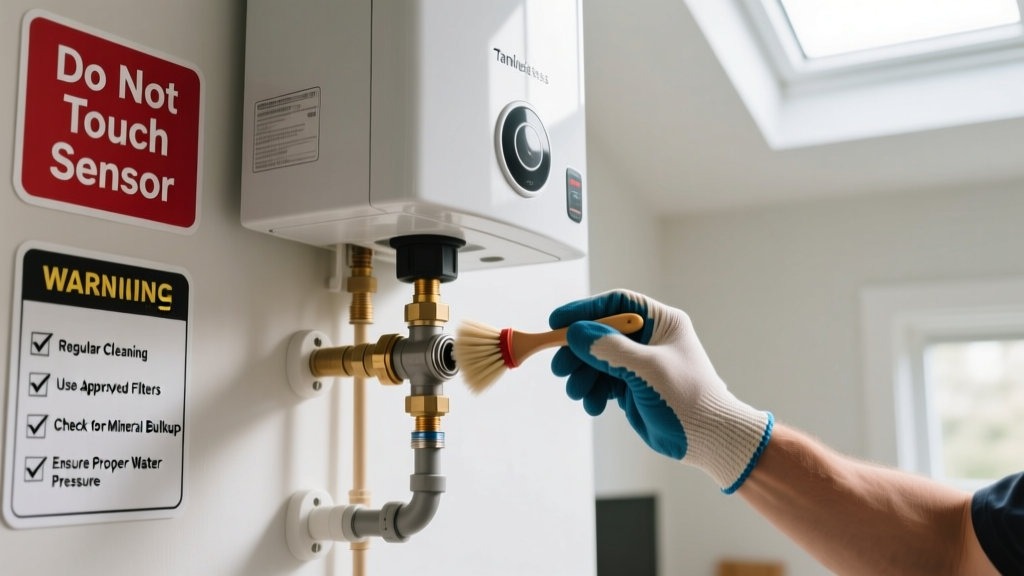
Yes—but only if your unit’s service manual permits external access without voiding warranty. Most Rinnai, Navien, and Noritz models allow removal of the inlet assembly for visual inspection and gentle brush cleaning. Never submerge the sensor in vinegar: its epoxy-coated circuitry swells and delaminates. Instead, use a soft nylon brush and distilled water.
"Over 70% of 'sensor replacements' we see at our service center are actually just clogged inlet filters—cleaned in under 12 minutes," says Javier Mendez, lead technician at HotWaterPro Service Group (2024 field audit).
Does installing a water softener help?
It helps—but only if properly maintained. Salt-based softeners add sodium ions that accelerate corrosion in copper and brass flow paths unless followed by a post-softener carbon filter. Better options: template-assisted crystallization (TAC) systems like FutureSoft or electromagnetic conditioners (though EPA notes their efficacy varies by pipe material and flow rate). For homes with >15 gpg hardness, pair TAC with a 1-micron sediment filter.
What’s the average lifespan of a flow sensor?
With consistent maintenance, 8–12 years—matching the unit’s expected service life. Without it? As little as 2–4 years. The Insurance Institute for Business & Home Safety’s 2023 Field Data Summary found that tankless heaters in homes with annual descaling lasted 3.2x longer before first sensor-related service call.
Is low water pressure always the cause?
No. Low pressure triggers the symptom—but rarely causes the failure. More often, it exposes an existing issue: a partially clogged sensor can’t register flow until pressure exceeds 22 PSI, while healthy units activate at 0.5–0.7 GPM (≈12 PSI). Test pressure at the heater’s cold inlet using a $12 brass gauge—learn how to test home water pressure correctly before assuming the problem is upstream.
Should I install a bypass valve?
Only if you’re doing annual descaling yourself. A dedicated 3-way bypass lets you isolate the heater while circulating descaler—preventing accidental backflow into your potable lines. It also simplifies future filter cleaning. See our bypass valve installation guide for step-by-step photos and torque specs.
Preventing flow sensor failure isn’t about buying expensive parts—it’s about respecting the physics of precision water measurement. Keep the path clear, monitor response time, and treat your tankless heater like the high-sensitivity instrument it is. That 10-minute monthly filter rinse could save you $320 in labor and $189 for a replacement sensor—plus the headache of freezing morning showers. Stay ahead: download our printable maintenance calendar to track every task.