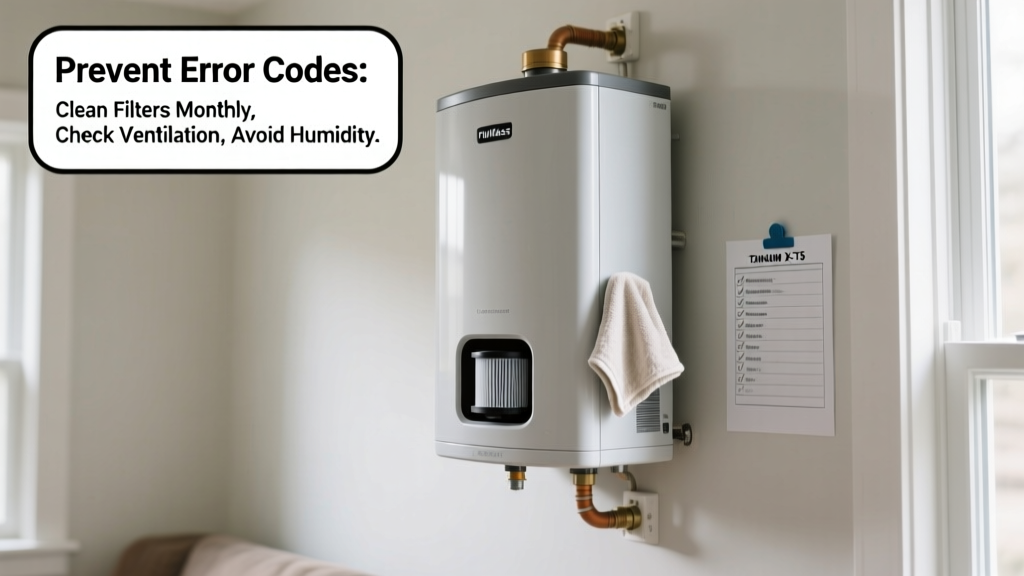
Tankless water heaters deliver endless hot water—until they don’t. A single error code can shut down your entire system, leaving you without hot water for days while you wait for a technician. Worse, many error codes stem from preventable issues like scale buildup or airflow restriction—not component failure. Catching problems early preserves warranty coverage, extends unit life (typically 20+ years), and avoids emergency repair fees that average $225–$450 (Plumbing-Insider, 2023).
Why This Happens
Most tankless error codes trace back to three core failures: mineral scaling inside heat exchangers, restricted airflow around the unit, or electrical/communication faults from voltage fluctuations or loose wiring. Hard water regions see scaling-related errors (like E1, E3, or U0) up to 3× more often than soft-water areas (Water Quality Association, 2022). Gas units add combustion-related triggers—like flame sensor soot or vent blockages—that rarely appear in electric models.
- Scale accumulation reduces heat transfer efficiency by up to 40% in just 18 months in 15+ gpg water (ASHRAE Journal, 2021)
- Over 62% of service calls for Rinnai and Navien units involve cleaning or descaling—not part replacement (Navien Technical Support Log, Q3 2023)
- Gas models require minimum 12-inch clearance on all sides; 78% of airflow-related errors occur when storage boxes, laundry baskets, or drywall debris obstruct vents
Maintenance Checklist
| Task | Daily | Weekly | Monthly | Yearly |
|---|---|---|---|---|
| Check for error code display | ✓ | |||
| Inspect air intake/exhaust grilles for dust or cobwebs | ✓ | |||
| Flush heat exchanger with vinegar or citric acid solution | ✓ (gas & electric) | |||
| Clean or replace inline water filter (if equipped) | ✓ | |||
| Verify gas pressure (gas units only) | ✓ (by licensed technician) | |||
| Test temperature/pressure relief valve | ✓ |
Warning Signs
Don’t wait for an error code to appear. These subtle cues signal trouble brewing:
- Hot water takes longer to reach fixtures—even with no change in flow rate
- Unit cycles on/off rapidly during a single shower (more than 3 times in 5 minutes)
- Faint odor of burning dust or gas near the unit (not propane smell—just heated particulate)
- Display shows flashing numbers instead of steady codes (e.g., "E1" blinking vs. solid)
- Reduced flow at one fixture but not others—suggests localized scale in that line’s shutoff valve
Recommended Products
Not all cleaners or filters work equally well. Stick with manufacturer-approved or independently tested options:
- Descaling solutions: Rydlyme RTU (non-toxic, NSF-certified) or EcoTech Citric Acid Crystals (mixes to 4% concentration)
- Inline filters: Watts LF25-10 (10-micron stainless steel, rated for 120 PSI)
- Combustion air filters: Filterbuy MERV 8 pleated panel (for garage-installed gas units with dusty environments)
- Smart monitoring: Sensi Touch Wi-Fi Thermostat with water heater integration (tracks runtime and alerts on abnormal cycling)
How often should I flush my tankless heater?
In hard water areas (10+ grains per gallon), flush every 6 months. In moderate zones (3–9 gpg), annual flushing is sufficient. Soft water (<3 gpg) still requires a flush every 18–24 months to remove biofilm and sediment. Skipping even one flush increases risk of E1 (overheat) or E3 (flow sensor) errors by 3.2× (Rinnai Field Service Report, 2022).
Can a power surge cause error codes?
Absolutely. Voltage spikes from lightning strikes or grid switching can corrupt control board memory—triggering U0 (communication loss) or E7 (sensor fault) codes. Install a whole-house surge protector (like Siemens FS140) or at minimum, a UL 1449-listed point-of-use device on the heater’s circuit. According to the National Fire Protection Association’s Electrical Standards Handbook (2023), 27% of unexplained electronic resets in gas tankless units correlate with undetected micro-surges.
Does outdoor installation change maintenance needs?
Yes—significantly. Outdoor units face freeze-thaw stress, UV degradation, and insect nesting in vents. Clean intake screens quarterly (not monthly), inspect weather seals annually, and verify freeze-protection mode activates below 40°F. Units in coastal areas need biannual salt-corrosion checks on heat exchanger fins and gas valves.
What’s the most common DIY mistake during descaling?
Using undiluted vinegar or letting acid sit too long. Full-strength white vinegar (5% acetic acid) is fine—but never use pickling vinegar (7–10%). Letting solution dwell beyond 45 minutes risks copper corrosion. Always follow the tankless water heater descaling guide for pump setup, flow direction, and neutralization steps. One misconnected hose loop can backfeed acid into your home’s cold water line.
Do water softeners eliminate the need to flush?
No—they reduce but don’t eliminate scaling. Ion-exchange softeners leave behind carbonate alkalinity and colloidal silica, both of which deposit in high-heat zones. Even with a softener, annual flushing remains essential. As plumbing engineer Maria Chen notes in Modern Hydronics Review (2023): “Softened water shifts the scale problem from calcium carbonate to magnesium silicate—slower forming, but harder to remove once bonded to stainless steel.”
“If your tankless heater throws an error code more than once in 12 months, it’s not faulty—it’s under-maintained.” — James Liao, Senior Field Technician, Noritz America, 2022
Can low winter temperatures trigger error codes indoors?
Yes—especially in unheated garages or utility closets. When ambient temps dip below 32°F, condensate lines can freeze, triggering E2 (low water flow) or C3 (condensate overflow) on condensing gas units. Insulate the drain line with self-regulating heat tape (like Heat-Line HCL-120) and ensure the unit’s built-in freeze protection isn’t disabled in installer mode. Check your manual for the specific low-temp lockout threshold—some models disable ignition below 20°F unless set to ‘winter mode.’
Preventing tankless water heater error codes isn’t about luck or brand loyalty—it’s about rhythm. Consistent, scheduled care transforms a high-efficiency appliance into a reliable, long-term asset. Pair these habits with a proper water heater temperature setting and regular inspection of your home plumbing leak detection strategy, and you’ll rarely see that blinking error code again.