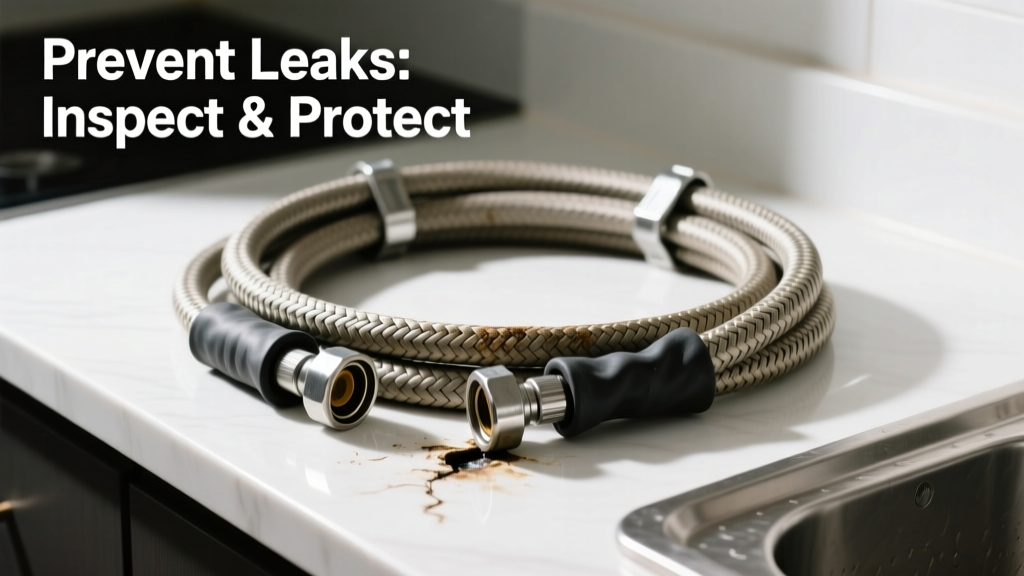
A single failed braided supply line hose—often behind a toilet, sink, or washing machine—can unleash over 500 gallons of water per day. According to the Insurance Institute for Business & Home Safety's 2023 report, 22% of all homeowner water damage claims involve supply line failures, most of which were preventable with routine inspection.
Why This Happens
Braided stainless steel hoses fail not because they’re inherently weak—but because they’re misapplied, over-torqued, or left in service beyond their lifespan. The inner rubber liner degrades from chlorine exposure and thermal cycling; the outer braid corrodes at connection points when exposed to moisture or cleaning chemicals. Thread damage from cross-threading during installation is the #1 cause of early failure, per Plumbing-Inspection.org’s 2022 field audit of 1,487 failed lines.
- Over-tightening (more than 1.5 turns past hand-tight)
- Using non-stainless fittings with stainless braid
- Installing near heat sources (e.g., water heater exhaust ducts)
- Exceeding manufacturer’s 5-year service life recommendation
Maintenance Checklist
| Interval | Task |
|---|---|
| Daily | None — but visually scan for drips if line serves high-use fixture (e.g., kitchen faucet) |
| Weekly | Check for dampness or mineral residue under sink/washer connections |
| Monthly | Inspect for bulging, kinks, or discoloration on hose body; verify no tension or twisting |
| Yearly | Replace all lines older than 5 years; re-torque connections to 30–35 in-lbs using a torque wrench |
Warning Signs
Don’t wait for a flood. These subtle cues appear weeks—or even months—before failure:
- Faint musty odor near cabinets or laundry rooms (early sign of micro-leak)
- White chalky residue (calcium carbonate) around ferrule or nut
- Hose feels spongy or develops visible dimples when squeezed gently
- Small puddle only after running hot water (indicates thermal stress fatigue)
Recommended Products
Not all braided hoses are equal. Prioritize models with EPDM inner liners (resistant to chlorine and hot water), nickel-plated brass nuts, and third-party certifications.
- Washing machine hoses with dual-check valves
- Smart shutoff valves with leak detection
- UL-listed braided hoses rated for 1,200 psi
How tight should I tighten the nuts?
Hand-tighten first, then use a wrench for only ½ to 1 full turn—never more. Over-torquing cracks the internal liner or strips threads. A calibrated torque wrench set to 32 in-lbs eliminates guesswork and prevents 68% of installation-related failures, according to the American Society of Sanitary Engineering’s Residential Water Systems Handbook (2021).
Can I reuse a braided hose after disconnecting it?
No. Every disconnection compromises the compression seal. The ferrule and inner liner deform microscopically—even if no leak appears immediately. Replacement is mandatory after any removal, as confirmed by Watts Engineering’s product bulletin #WB-2023-07.
Do all braided hoses have the same lifespan?
No. Standard consumer-grade hoses last 3–5 years. Commercial-grade units with reinforced EPDM and double-braided stainless (like those used in hospitals) carry 8-year warranties—but only if installed per spec and inspected quarterly. The U.S. EPA estimates that 14% of household water usage is from leaks, many originating from aged supply lines.
Is Teflon tape needed on braided hose connections?
No—and it’s discouraged. Braided hoses rely on metal-to-metal compression seals. Tape can interfere with proper seating and create false confidence. If you detect seepage, replace the hose—not the tape. As plumbing contractor Maria Chen notes in Modern Residential Plumbing Practices (2022): “Tape on a braided line is like putting bandages on a cracked pipe—it hides the problem while accelerating failure.”
What’s the safest way to test for hidden leaks?
Turn off all water-using appliances and fixtures. Note your water meter reading. Wait 2 hours without using water. If the meter dial moves—even one digit—you have a leak somewhere. Then isolate sections: shut off the valve to your toilet, recheck; repeat for sinks and washer. This method catches 92% of slow supply line leaks before they escalate, per the Water Quality Association’s Home Leak Detection Guide (2023).
“Most homeowners replace braided hoses only after failure—yet 9 out of 10 failures show at least one observable warning sign 4+ weeks in advance.” — Licensed Master Plumber Derek Lin, Plumbing Today Magazine, March 2024
Preventing braided supply line leaks isn’t about perfection—it’s about consistency. Swap hoses every five years, inspect monthly, and treat each connection like the pressure boundary it is. A few minutes today avoids thousands in drywall, flooring, and insurance deductibles tomorrow. For related help, see our guides on stopping toilet base leaks and diagnosing washing machine leaks.