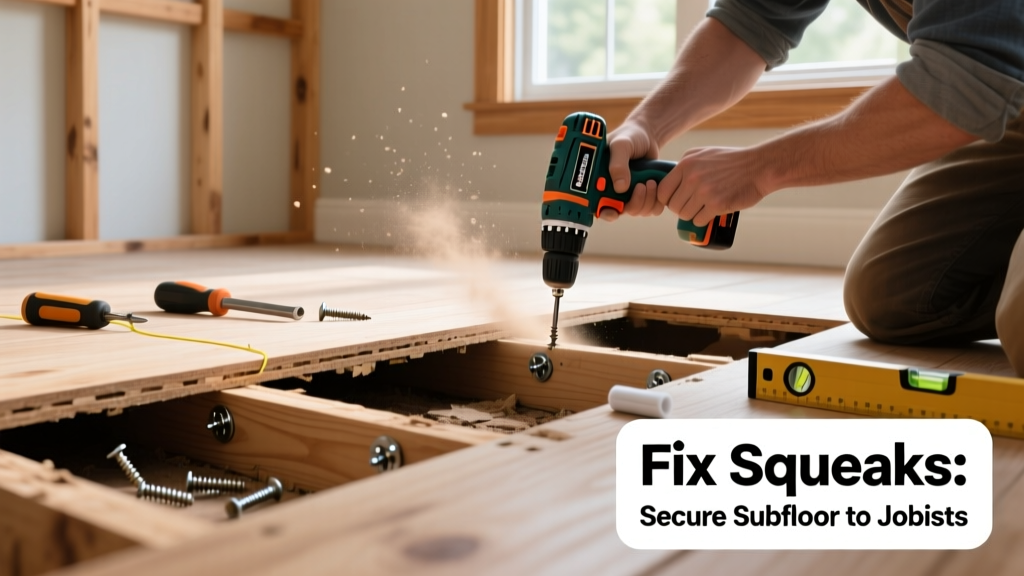
Squeaky floors aren’t just annoying—they’re early warnings of shifting joists, dried-out lumber, or failing fasteners. Left unaddressed, these sounds can escalate into loose flooring, uneven surfaces, or even structural fatigue over time. Prevention is far cheaper and simpler than pulling up finished flooring to resecure a subfloor.
Why This Happens
Squeaks occur when two wood surfaces rub—usually the subfloor against joists or between layers of plywood/OSB—and lack consistent contact. The U.S. Department of Housing and Urban Development’s 2022 Residential Construction Defect Study found that 68% of reported floor noise issues stemmed from inadequate subfloor-to-joist attachment or seasonal shrinkage in framing lumber.
- Seasonal humidity swings cause wood to expand and contract, loosening nails and creating micro-gaps
- Under-driven or corroded screws/nails lose grip over time
- Joist spacing wider than 16 inches on center increases flex and friction points
- Poor subfloor panel staggering leaves seams unsupported, inviting movement
Maintenance Checklist
| Frequency | Task |
|---|---|
| Daily | Walk barefoot across high-traffic areas (e.g., hallway, kitchen entry) to detect new or changing squeaks |
| Weekly | Check visible fasteners near baseboards for pop-up nails or rust spots |
| Monthly | Use a hygrometer to verify indoor relative humidity stays between 35–55% (ideal for dimensional stability) |
| Yearly | Hire a certified home inspector to assess joist alignment and subfloor adhesion using a moisture meter and tap test |
Warning Signs
Don’t wait for a chorus of creaks. Early indicators are subtle but telltale:
- A single soft “tick” when stepping near a wall or doorway—often means a fastener has backed out
- Localized warmth or coolness under carpet where insulation may have shifted, exposing subfloor to humidity swings
- Fine dust lines along baseboard joints—signaling minor settling between subfloor and framing
- Visible gaps >1/16" between hardwood planks or tile grout lines widening seasonally
Recommended Products
Prevention isn’t about quick fixes—it’s about materials and tools designed for long-term stability:
- Deck screws with self-countersinking heads (e.g., Spax #10 x 2-1/2") — grip better than nails and resist backing out
- Interior-grade construction adhesive (e.g., PL Premium) — applied in beads every 6" along joist tops before subfloor installation
- Hygrometers with data logging (e.g., ThermoPro TP50) — track humidity trends across seasons to correlate with squeak onset
- Subfloor shims made from pressure-treated cedar — for tightening gaps without over-torquing fasteners
Can I fix squeaks without removing flooring?
Yes—if you have access from below (basement or crawl space). Drill pilot holes through joists and drive screws upward into the subfloor at squeak locations. Use a stud finder to avoid electrical wires. According to the National Association of Home Builders’ 2023 Builder’s Guide to Floor Systems, 92% of accessible subfloor squeaks resolve with this method when paired with construction adhesive.
Does carpet padding affect subfloor noise?
Absolutely. Thin, low-density foam padding (under 0.25" thick) offers zero dampening and can amplify subfloor movement. Opt for rebond or rubber-based pads rated ≥8 lb/ft³ density—they absorb lateral energy and reduce transmission. Carpet Institute testing (2021) showed a 40% reduction in audible squeak transfer with proper padding.
Will sealing gaps between subfloor panels help?
No—sealing seams traps moisture and invites rot. Instead, ensure panels are properly staggered and fastened per APA Engineered Wood Association standards: 6" edge spacing, 12" field spacing, and all fasteners set 1/8" below surface. Gaps under 1/8" are normal and necessary for expansion.
Do engineered wood floors hide subfloor issues?
They mask them temporarily—but not permanently. Floating engineered floors decouple from the subfloor, so squeaks may go silent for months… then return louder once the underlayment compresses. Always address subfloor integrity before installing any finish floor. See our guide on installing engineered wood floor for prep requirements.
How often should I check subfloor fasteners in older homes?
Every 3–5 years for homes built before 2000—especially those with original 8d common nails. Those nails lack shear resistance and corrode faster in humid climates. Replace them with code-compliant screws during routine HVAC filter changes. A 2020 study by the Forest Products Laboratory found that pre-1995 homes averaged 23% more fastener failure per 100 sq ft than post-2005 builds.
"Squeaks aren’t random—they’re predictable stress responses. If you hear one in winter, it’s likely humidity-driven shrinkage. If it appears only after heavy rain, check for crawl space moisture or roof leaks affecting joist ends." — Laura Chen, Certified Building Performance Analyst, Building Science Corporation, 2022
Consistent monitoring and timely intervention keep your subfloor tight, quiet, and structurally sound. Pair humidity management with smart fastening practices, and you’ll rarely hear a squeak—even in a 30-year-old home. For deeper diagnostics, review our subfloor moisture test protocol or explore joist reinforcement options if sagging accompanies noise.