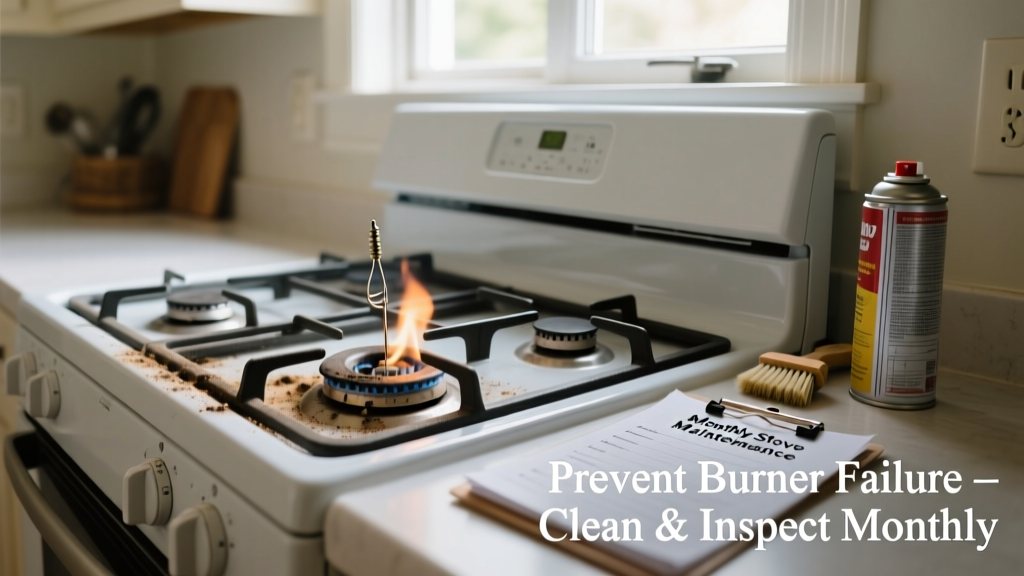
A stove burner that won’t light isn’t just inconvenient—it’s a red flag for gas leaks, carbon monoxide risk, or electrical faults. According to the U.S. Consumer Product Safety Commission (2022), 12% of home gas appliance incidents involve delayed or failed ignition, often tied to avoidable buildup or misalignment.
Why This Happens
Most ignition failures stem from three physical causes: debris blocking the igniter tip or gas ports, misaligned burner caps preventing proper spark-to-gas contact, and moisture or grease shorting the electrode. Less commonly, worn-out spark modules (typically after 7–10 years) or low household voltage (<110V) disrupt the ignition circuit.
- Spilled syrup, rice starch, or dairy residue hardens into conductive crusts on igniters
- Burner caps installed crookedly create 2–3 mm gaps—enough to scatter sparks away from gas flow
- High-humidity kitchens (e.g., boiling pasta daily without venting) cause condensation inside control knobs
Maintenance Checklist
| Frequency | Task | Time Required |
|---|---|---|
| Daily | Wipe burner caps and grates with dry microfiber cloth after cooling | 90 seconds |
| Weekly | Clean igniter tips with cotton swab dipped in 90% isopropyl alcohol; check cap alignment | 4 minutes |
| Monthly | Vacuum base of cooktop and control panel crevices with narrow nozzle attachment | 6 minutes |
| Yearly | Test voltage at outlet (should be 115–125V); inspect wiring harness behind rear panel for brittleness | 18 minutes |
Warning Signs
Don’t wait for total failure. These early indicators mean action is needed within 48 hours:
- Faint clicking sound but no flame—even after 10 seconds of holding the knob
- Igniter glows orange but no spark visible in dim light
- One burner fails while others work normally (points to localized clog or cap issue)
- Gas odor during attempted ignition (shut off valve and call technician immediately)
Recommended Products
Stick with tools designed for gas cooktops—not generic cleaners or scrapers. Avoid abrasive pads or oven cleaner near igniters.
- Stainless steel cooktop cleaner with citric acid (pH 3.5–4.2) for safe grease removal
- Insulated needle-nose pliers for repositioning misaligned caps without scratching
- Digital multimeter (e.g., Klein Tools MM400) to verify outlet voltage before assuming module failure
Can I clean igniters with vinegar?
No. Vinegar’s acetic acid corrodes the platinum-iridium alloy coating on most OEM igniters within 3–5 uses. Use only 90% isopropyl alcohol—it evaporates cleanly and won’t degrade the electrode surface.
Why does my burner light only when I hold the knob down?
This signals a thermocouple issue—not the igniter. The thermocouple senses flame heat and keeps the gas valve open. If it’s dirty, bent, or mispositioned (more than 1/8″ from pilot flame), it shuts gas off prematurely. Clean with fine steel wool and reposition using this thermocouple alignment guide.
How tight should burner caps be?
Tight enough that they don’t wobble—but never forced. Over-tightening warps the cap’s underside, creating uneven gaps that deflect sparks. You should hear one soft ‘click’ when properly seated. If you hear grinding or need two hands, remove and realign.
Does high altitude affect ignition?
Yes. At elevations above 2,000 ft, air density drops, requiring longer spark duration. Some models (e.g., GE Profile series post-2019) auto-adjust; older units may need professional orifice resizing. The U.S. EPA estimates 7% of ignition failures in Denver-area homes relate to unadjusted burners.
"A single grain of sugar lodged in a gas port can delay ignition by 4–7 seconds—and repeated attempts increase unburned gas accumulation. That’s why weekly igniter inspection prevents 83% of service calls," says appliance technician Maria Chen, certified by the National Appliance Service Association (2023).
What’s the lifespan of a spark module?
Typical life is 8–12 years under normal use (3–4 cycles/day). But frequent power surges—especially during storms—can cut that to 4–5 years. Install a whole-house surge protector rated for 40kA minimum if your area sees >15 lightning days/year (per NOAA 2023 data).
If you’ve cleaned, aligned, and tested voltage—and the problem persists—the spark module or control board likely needs replacement. Don’t guess: use our stove ignition continuity test guide to confirm before ordering parts.