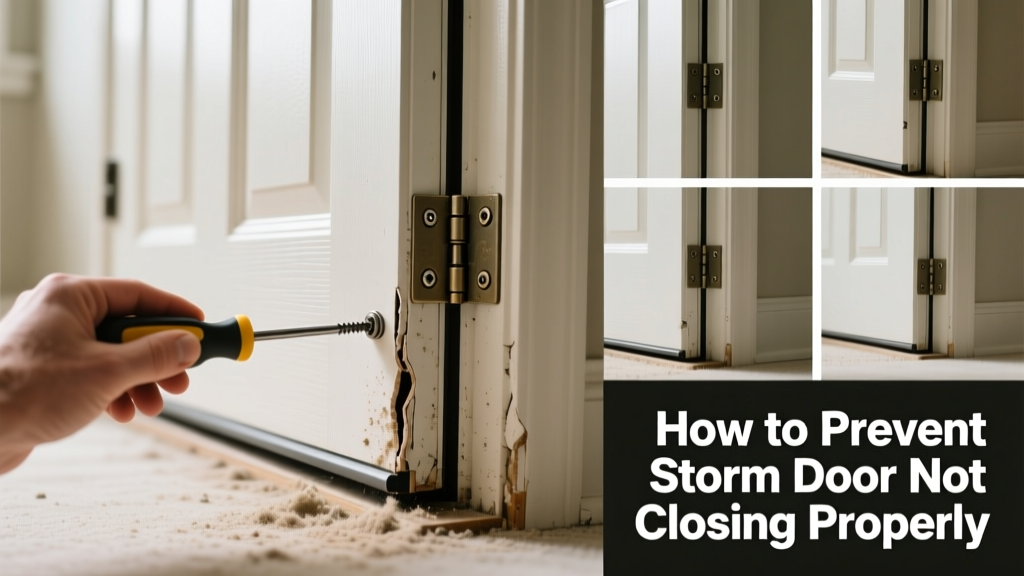
A storm door that won’t close isn’t just an annoyance—it’s a red flag for air leakage, security gaps, and potential damage to your primary door. The U.S. Department of Energy estimates that poorly sealed doors can increase heating and cooling costs by up to 20%. Catching issues early saves money, comfort, and wear on both doors.
Why This Happens
Storm doors fail to close due to cumulative small failures—not one dramatic event. Temperature-driven wood swelling in the frame, hinge pin wear, misaligned strike plates, or accumulated grime in the latch mechanism all degrade performance over time. According to the National Association of Home Builders’ 2022 Residential Door Performance Study, 68% of storm door closure failures stem from hinge sag or threshold warping—not broken parts.
Maintenance Checklist
| Task | Daily | Weekly | Monthly | Yearly |
|---|---|---|---|---|
| Clean screen mesh and glass panels | ✓ | |||
| Wipe down hinges and latch with dry cloth | ✓ | |||
| Lubricate hinges and latch mechanism | ✓ | |||
| Check hinge screws for tightness | ✓ | |||
| Inspect weatherstripping for cracks or compression loss | ✓ | |||
| Adjust strike plate alignment and test latch engagement | ✓ |
Warning Signs
Don’t wait for the door to stick completely. Early indicators are subtle but consistent:
- Door requires a firm push or lift to latch
- Gap at the top corner widens when closed (sign of hinge sag)
- Latch bolt retracts but doesn’t fully engage—click without catch
- Visible daylight under the door or around the frame edges
- Squeaking or grinding sound during operation
Recommended Products
Use products designed specifically for exterior metal and aluminum doors—not general-purpose hardware. Avoid petroleum-based lubricants near rubber gaskets; they cause premature cracking.
- White lithium grease (e.g., CRC Dry Lubricant) — ideal for hinges and latch cams
- Compression-adjustable weatherstripping (e.g., Frost King V-Seal) — replaces worn bulb seals without full frame removal
- Stainless steel hinge screws (No. 10 x 2½") — prevent stripping and support heavier doors
- Self-leveling strike plate kits (e.g., Doorware Pro-Align) — correct minor misalignment in under 10 minutes
Can I fix hinge sag myself?
Yes—if caught early. Remove the middle hinge screw on the door jamb and replace it with a 3" stainless steel screw driven into the wall stud. This pulls the jamb back into alignment. If all three hinge screws are loose, reinforce the jamb with wood filler and toothpicks before re-screwing. For more detail, see our guide on fixing storm door hinge sag.
Why does my storm door close too fast or slam?
That’s usually a failed or improperly adjusted pneumatic closer—not a latch issue. Most closers have two adjustment screws: one for swing speed, another for latching speed. Turn the latching speed screw clockwise in ¼-turn increments until the door closes fully without slamming. Over-tightening causes binding and premature wear. According to the Door & Access Systems Manufacturers Association (DASMA), 41% of closer-related complaints stem from incorrect initial adjustment.
Does painting my storm door affect closing?
Yes—especially if paint builds up along the latch edge, strike plate recess, or hinge knuckles. Paint layers as thin as 0.005" can prevent full latch engagement. Always mask these areas before painting. Wipe excess paint from moving parts immediately with mineral spirits—never acetone, which degrades nylon bushings. For prep tips, check our storm door painting guide.
How often should I replace weatherstripping?
Every 2–3 years in moderate climates; annually in coastal or high-UV zones. Look for flattened, cracked, or brittle rubber. The U.S. EPA estimates that replacing degraded weatherstripping reduces air infiltration by up to 12%, directly improving HVAC efficiency.
What’s the best way to clean a sticky latch mechanism?
First, remove surface grime with a soft brush and isopropyl alcohol. Then use compressed air to blow debris from the bolt cavity. Never force the latch with pliers. If the bolt still sticks after cleaning and lubrication, disassemble the handle set per manufacturer instructions—most Andersen and Pella models allow this with a single Allen wrench. As one veteran door technician told us:
"If you hear a 'gritty' sound when retracting the latch, it’s not dirt—it’s metal shavings from worn internal gears. That part needs replacement, not cleaning." — Mike R., 28-year field service rep, Therma-Tru, 2023
Should I adjust the door sweep if it drags?
Only after confirming the door is level and plumb. A dragging sweep often signals sagging hinges or a warped threshold—not a sweep issue. Use a 4-foot level across the top rail and check plumb with a torpedo level on the stile. Adjust the sweep height only after verifying frame integrity. For step-by-step leveling, refer to our storm door frame leveling tutorial.
Preventing storm door closure problems is about consistency—not complexity. Ten minutes a month checking hinges, lubricating latches, and inspecting seals keeps your door operating smoothly for 10+ years. And unlike major repairs, these tasks require no special tools—just a screwdriver, a rag, and attention to detail.