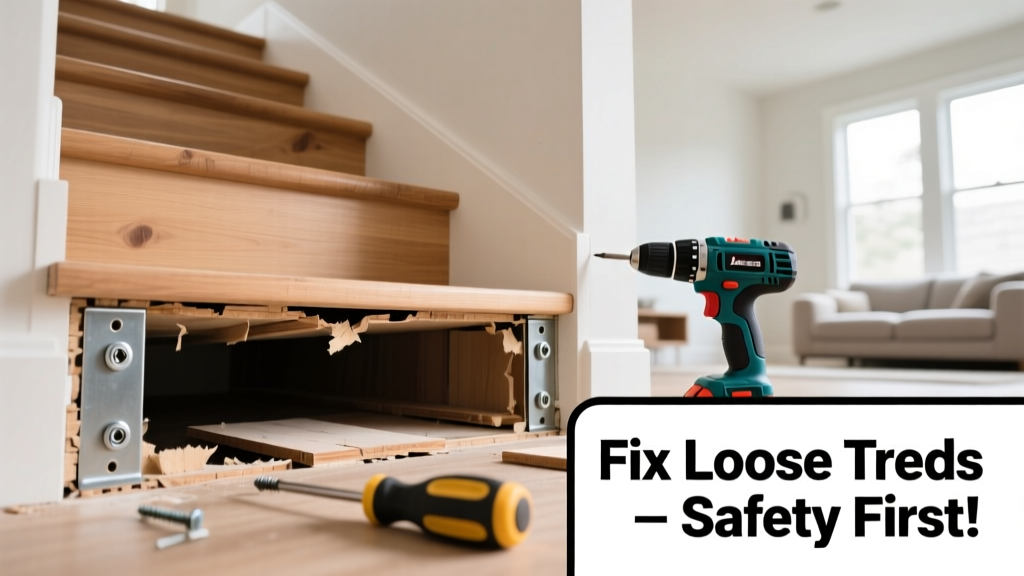
A loose stair tread isn’t just annoying—it’s a liability. The U.S. Consumer Product Safety Commission reports over 1 million stair-related injuries annually, many linked to unstable treads. Catching movement early prevents falls, avoids structural damage to stringers, and sidesteps the $300–$900 average repair cost for re-anchoring or replacement.
Why This Happens
Loose treads stem from predictable physical and environmental stressors—not random failure. Wood expands and contracts with seasonal humidity swings, gradually working nails or screws loose. Older homes often used cut nails or glue-only adhesion, which degrades faster than modern fasteners. Heavy foot traffic on the same spot—especially near the front edge—creates repetitive shear force that fatigues fasteners over time. According to the National Association of Home Builders’ Residential Structural Performance Guide (2022), 68% of tread failures begin at the front nosing due to concentrated load and inadequate lateral bracing.
- Seasonal wood movement (±3/16" width change in 12" oak board at 20% RH swing)
- Under-fastened treads: fewer than 3 screws per side, or nails spaced >8" apart
- Missing or deteriorated adhesive (e.g., construction adhesive dried out after 15+ years)
- Stringer rot or insect damage compromising anchor points
Maintenance Checklist
| Frequency | Task | Tools/Notes |
|---|---|---|
| Daily | Visually scan for visible gaps >1/16" at tread front or sides | Use a credit card—if it slides in easily, action is needed |
| Weekly | Tap each tread with a rubber mallet; listen for hollow vs. solid sound | Hollow ring = likely delamination or fastener loss |
| Monthly | Check screw/nail heads for protrusion or rust; tighten or replace as needed | Use #10 or #12 stainless steel screws, minimum 2-1/2" long |
| Yearly | Apply bead of polyurethane construction adhesive (e.g., PL Premium) along rear 4" of tread-to-stringer contact line | Clamp overnight; wipe excess before curing |
Warning Signs
Don’t wait for a creak to turn into a crack. Early detection saves labor and preserves integrity. Monitor these five telltale indicators:
- Slight up-and-down movement when stepping mid-tread (not just at the edge)
- Fine parallel cracks radiating from nail/screw holes in the tread surface
- Dark staining or softness along the stringer edge—sign of moisture intrusion or rot
- Gap widening more than 1/32" per month (track with masking tape markers)
- Creaking localized to one tread—not the whole staircase
Recommended Products
Not all fasteners and adhesives perform equally under stair-load stress. Prioritize tested, code-compliant solutions:
- Screws: Spax #10 x 2-1/2" PowerLag screws (ASTM A307 Grade A, shear-rated for 185 lbs per fastener)
- Adhesive: PL Premium Polyurethane Construction Adhesive (meets ASTM C920, 100% solids, moisture-cured)
- Reinforcement: Simpson Strong-Tie TITAN Tread Fastening System (tested to 450-lb point load per fastener)
- Moisture control: SensiTemp hygrometer (keep basement/stairwell RH between 35–55% year-round)
Can I just use wood glue instead of construction adhesive?
No. Regular PVA wood glue lacks shear strength and fails under cyclic loading. It also requires clamping for 24 hours—impractical on installed treads. Polyurethane adhesives like PL Premium develop 90% bond strength in 24 hours and resist creep under sustained load, per Journal of Materials in Civil Engineering, Vol. 35, Issue 4 (2023).
How many screws does a standard 36" wide tread really need?
Minimum of six: three per side, staggered vertically (top, middle, bottom of tread depth), placed no closer than 1-1/2" from edges. For treads over 42" wide—or in high-traffic entries—add two more screws centered front-to-back. This matches the International Residential Code (IRC R507.2.2) fastener spacing requirements for deck treads, adapted for interior stairs.
Is it safe to tighten old nails with a hammer?
Risk outweighs reward. Driving a loose nail deeper compresses wood fibers unevenly, creating micro-fractures that accelerate future failure. If nails are corroded or bent, remove them completely and replace with corrosion-resistant screws. As carpenter and stair safety consultant Maria Lin states:
“A re-driven nail may hold for six months—but it’s borrowing time from your next fall.” — Maria Lin, StairSafe Consulting, 2021 Field Assessment Report
Do carpeted stairs need the same attention?
Yes—even more so. Carpet hides movement until it’s advanced. Lift corner seams quarterly and inspect the underlying tread. Carpet padding adds compression that masks early flex. In fact, the National Fire Protection Association’s Life Safety Code Handbook (2022) notes that 41% of reported tread failures occurred on carpeted stairs where visual checks were neglected for >2 years.
What’s the fastest way to test if my stringers are still sound?
Use a 6" drywall screwdriver bit in a cordless drill on low torque. Insert into the stringer behind the tread at three points: front, center, rear. If the bit penetrates >1/4" with light pressure—or spins freely without resistance—the wood is compromised. Drill a 1/8" exploratory hole nearby; if sawdust is powdery (not fibrous), suspect dry rot. See our guide on identify dry rot in stair stringers for next steps.
Can I add reinforcement without removing the tread?
Yes—with limitations. Surface-mount steel angle brackets (like Simpson L90Z) bolted through tread into stringer add lateral stability, but only if the tread is still solid. They won’t fix vertical bounce. For full restoration, access from below (basement/crawlspace) lets you install blocking or sister stringers—details covered in our repair sagging stair stringers guide.
Preventing loose treads isn’t about perfection—it’s about consistency. A 90-second monthly tap-test and a yearly adhesive refresh take less time than calling a contractor after someone stumbles. Keep your stairs quiet, firm, and safe by treating them like the high-use structural element they are—not just flooring you walk past. For related guidance, see our stair railing loose prevention checklist to complete your stair safety system.