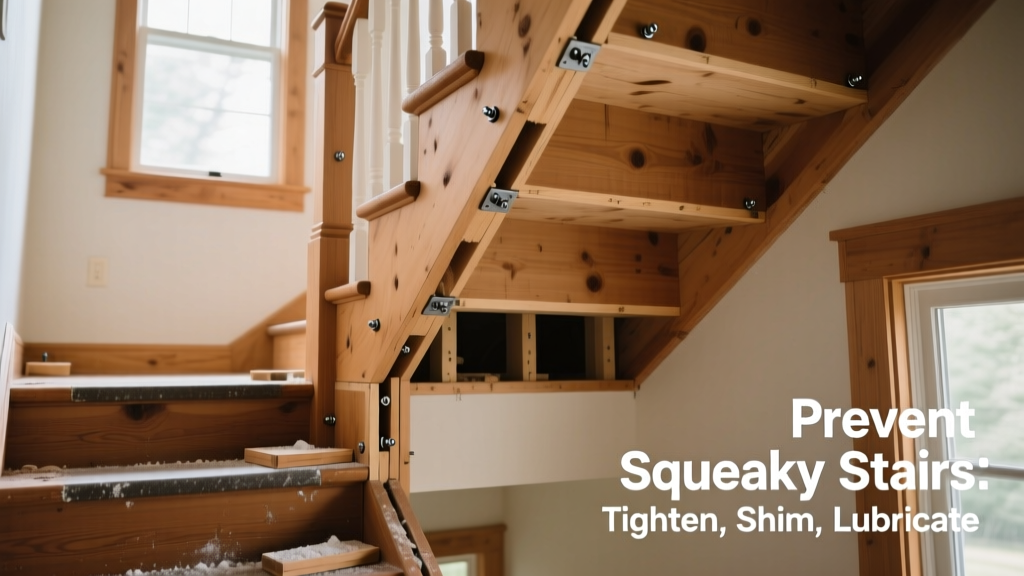
Squeaky stairs aren’t just annoying—they’re early warnings of shifting joints, drying wood, or loosening fasteners that can compromise structural integrity over time. According to the National Association of Home Builders’ 2022 Remodeling Impact Report, 68% of homeowners who ignored minor stair noises later needed $450–$1,200 in corrective carpentry work within 3 years.
Why This Happens
Squeaks occur when wood components rub against each other due to movement caused by shrinkage, humidity swings, or inadequate fastening. The most common culprits are:
- Seasonal wood shrinkage (especially in pine or fir treads with moisture content below 8%)
- Loose nails pulling out of stringers or risers
- Gaps forming between treads and risers due to glue failure
- Subfloor movement transferring vibration up through stair framing
Stair systems built without construction adhesive—or using only nails instead of screws—are especially prone to this issue.
Maintenance Checklist
| Frequency | Task |
|---|---|
| Daily | Wipe spills immediately; avoid standing water near stair nosings |
| Weekly | Inspect for loose carpet tack strips or worn runner padding |
| Monthly | Check for visible gaps >1/16" between tread and riser; tap treads lightly with a rubber mallet to detect hollow spots |
| Yearly | Apply wood-safe humidity control: maintain 35–45% RH using a whole-house humidifier in winter |
Warning Signs
Don’t wait until the squeak echoes through the house. Catch these subtle indicators early:
- A faint ‘creak’ only on the third step—often the first to show stress
- Visible separation (even hairline) where tread meets riser or stringer
- Loose baluster base or wobble in the handrail post
- Localized dust buildup in joint seams—sign of micro-movement
If you hear rhythmic squeaking synchronized with footfall—not random creaks—it means fasteners are working loose under repeated load.
Recommended Products
Use purpose-built solutions—not quick fixes. These products address root causes:
- Construction-grade polyurethane glue (e.g., PL Premium): fills gaps while bonding wood fibers permanently
- #10 x 3" deck screws with trim-head design: stronger hold than nails, countersunk for finish
- Shim kits with tapered cedar shims: for tightening tread-to-stringer contact without disassembly
- Low-VOC wood conditioner (e.g., Minwax Pre-Stain): reduces uneven absorption that leads to warping
Can I fix squeaks without removing the carpet?
Yes—if the carpet is stretched tight and padding is intact. Drill pilot holes at a 30° angle through the tread’s front edge into the riser behind it, then drive screws with washers. Cover screw heads with matching wood filler. Test with a stud finder first to avoid hitting electrical conduit.
Does humidity really affect stair noise?
Absolutely. Wood expands at ~0.2% per 10% RH increase. In homes with winter RH below 25%, treads shrink away from risers—creating the gap where friction begins. The U.S. Department of Energy recommends maintaining 30–50% relative humidity year-round to minimize dimensional change in framing lumber.
Are floating stairs more or less likely to squeak?
Floating stairs (with hidden steel supports) are actually more sensitive to movement. Their lack of traditional stringer support means even minor subfloor deflection transmits directly to treads. They require precise torque specs on anchor bolts—and annual re-torquing per manufacturer guidelines (e.g., 2021 ICC-ES AC137 requires 45 ft-lb minimum for 3/8" stainless anchors).
What’s the best time of year to inspect stairs?
Mid-spring (April–May) and mid-fall (October–November). That’s when indoor humidity stabilizes after seasonal extremes—making gaps and looseness easiest to spot before expansion or contraction masks them again.
Do engineered wood treads squeak less than solid hardwood?
Not inherently—but engineered treads with cross-banded plywood cores resist cupping better than rift-sawn oak. However, poor installation (e.g., skipping adhesive between tread and substrate) negates any advantage. Always follow the National Wood Flooring Association’s NWFA F143 Standard for stair applications.
"Most stair squeaks begin as a 0.003-inch gap—smaller than a human hair. By the time you hear it, the joint has moved over 2,000 times under load." — Master Carpenter Luis Rivera, NAHB Certified Graduate Builder, 2023
Prevention isn’t about perfection—it’s about consistency. Tighten one loose screw today, check humidity tomorrow, and re-torque anchor points every 18 months. That rhythm keeps your stairs silent, safe, and structurally sound for decades. For deeper issues like sagging stringers or rot, consult a licensed structural inspector before attempting DIY reinforcement.