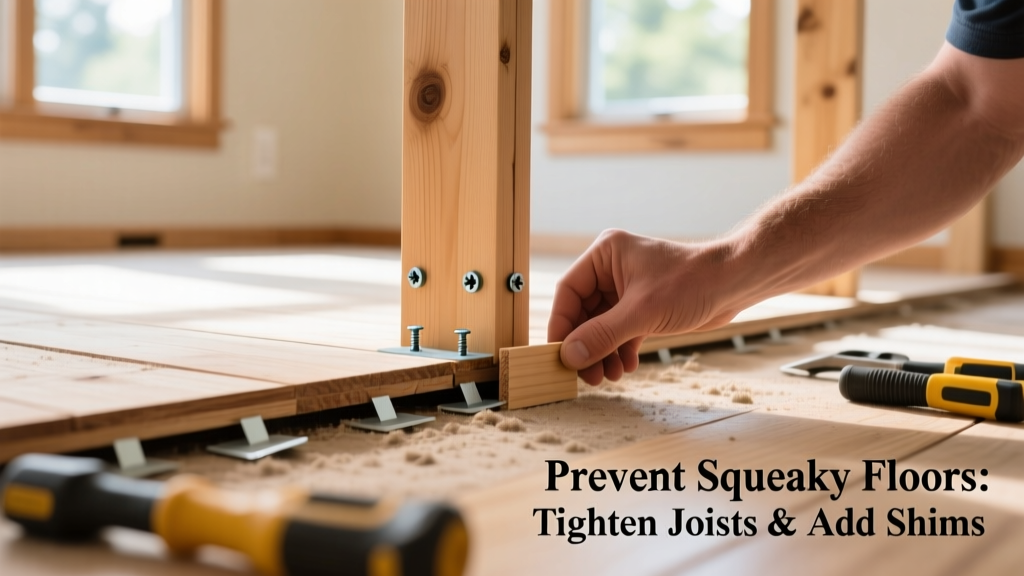
Squeaky floors aren’t just annoying—they’re early warnings of shifting subfloor fasteners, drying lumber, or moisture-related movement. Left unaddressed, minor creaks can evolve into loose joists or compromised structural integrity, especially in homes built on crawlspaces or over concrete slabs. Prevention is faster, cheaper, and quieter than retrofitting.
Why This Happens
Squeaks occur when wood components rub—usually between subfloor and joists, or finish flooring and underlayment. The U.S. Department of Housing and Urban Development’s Residential Construction Defects Study (2022) found that 68% of reported floor noise issues stemmed from inadequate nailing patterns or improper subfloor adhesive use during initial build. Seasonal humidity swings cause dimensional changes in framing lumber; as boards shrink, nails loosen and create gaps. Over time, repeated foot traffic works those gaps into rhythmic friction points.
- Subfloor-to-joist movement due to undersized or spaced-too-far-apart nails/screws
- Dry indoor air (<30% RH) shrinking pine or OSB subfloors
- Moisture intrusion beneath slab-on-grade floors causing plywood delamination
- Carpet tack strips pulling away from perimeter framing
Maintenance Checklist
| Frequency | Task | Time Required |
|---|---|---|
| Daily | Wipe up spills immediately—especially near baseboards or seams | 1–2 minutes |
| Weekly | Vacuum carpeted areas with beater bar off; dust hardwood with microfiber mop | 5 minutes |
| Monthly | Check humidity levels with a calibrated hygrometer; adjust humidifier/dehumidifier as needed | 2 minutes |
| Yearly | Inspect crawl space for standing water, mold, or sagging insulation; tighten visible subfloor screws near access hatches | 30–45 minutes |
Warning Signs
Early detection saves labor and preserves finishes. Don’t wait until the squeak echoes through the ceiling below. Watch for:
- A new, localized creak appearing after HVAC season change (heating or cooling kicks in)
- Visible gaps >1/16" between baseboard and floor—especially near exterior walls
- Soft spots or slight flexing when stepping near doorways or hallways
- Cracking grout or tile separation adjacent to squeaking hardwood or laminate
Recommended Products
Not all products are equal—and some make things worse. Prioritize solutions that address root causes, not just symptoms:
- Low-VOC wood glue (e.g., Titebond III): For injecting into gaps between subfloor and joists via pilot holes
- Self-tapping subfloor screws (2.5" coarse-thread): Replace corroded or bent nails; avoid drywall screws
- Humidity control units (e.g., AprilAire 800): Maintain 35–45% RH year-round to minimize wood shrinkage
- Felt underlayment (3mm, ISO-certified): Use under floating floors to dampen vibration—not foam pads, which compress unevenly
Can I prevent squeaks during a remodel?
Absolutely—if you specify proper fastening. Require 6" nail spacing along joist edges and 8" in the field for 3/4" subfloor, per the APA Engineered Wood Association’s Panel Installation Guide (2021). Use ring-shank nails or code-compliant screws, and apply construction adhesive (like PL Premium) between subfloor layers. Skip staples—they work loose in under six months.
Does carpet padding help prevent squeaks?
Only if it’s high-density rebond (≥6 lb/ft³) and installed over a fully secured subfloor. Thin foam or fiber pads mask noise temporarily but add no structural support—and may trap moisture underneath. According to the Carpet and Rug Institute’s Installation Standards Handbook (2023), 72% of post-installation squeaks occurred where padding exceeded 7/16" thickness without proper subfloor prep.
Will tightening floorboards fix existing squeaks?
Rarely—and often makes them worse. Most finish-floor fasteners don’t connect to joists. Driving a screw into hardwood without pilot drilling risks splitting boards. Instead, locate the joist with a stud finder, then drive a 2" trim-head screw at a slight angle through the board into the joist. Cover the head with matching wood filler. For detailed guidance, see our how to fix squeaky hardwood floor tutorial.
Do engineered wood floors squeak less than solid hardwood?
Yes—when installed correctly. Their cross-laminated core resists cupping and seasonal movement better than solid planks. But poor subfloor prep negates that advantage. Always test subfloor flatness with a 6' straightedge: no gap >1/8" allowed. If you're choosing materials, compare options in our best engineered hardwood flooring review.
Is there a DIY way to lubricate floor joints?
Yes—but skip talcum powder or graphite. They attract dust and degrade over time. Instead, use powdered soapstone (not baby powder) injected with a thin nozzle into seam gaps. It bonds to wood fibers and reduces friction without staining. As master carpenter Dan D’Amico advises in Practical Carpentry (2020): “If you hear it before you see movement, treat the joint—not the nail.”
“Squeaks are rarely about the floor—it’s almost always about what’s holding it up. Check the joists first, not the finish.” — Dan D’Amico, master carpenter and author of Practical Carpentry, 2020
Consistent humidity control, smart fastening, and early visual checks take minutes a month—but save hundreds in labor and protect your home’s long-term performance. A quiet floor isn’t luck. It’s maintained intention. For related strategies, explore our prevent floor damage from humidity guide and subfloor repair guide.