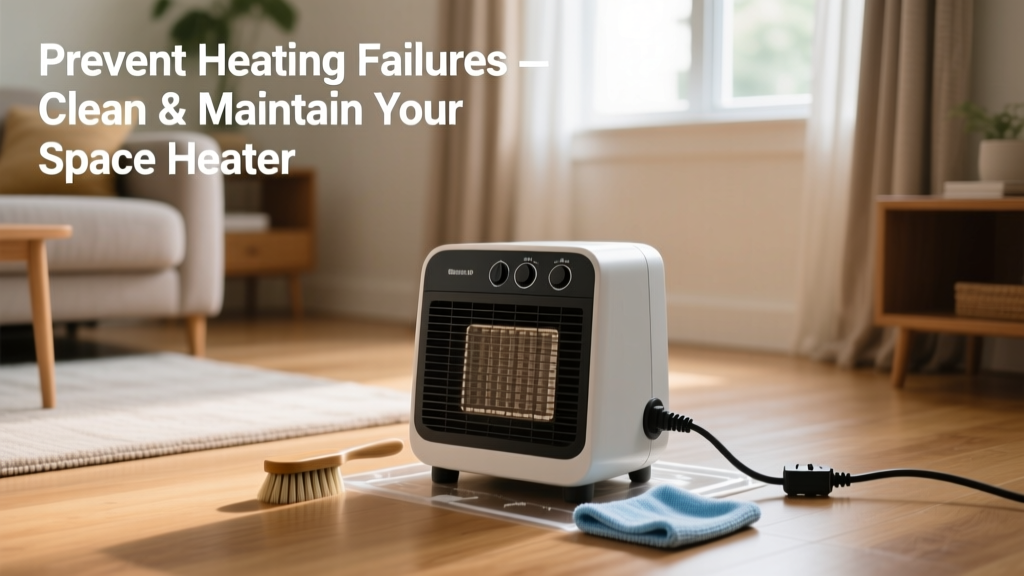
A space heater that suddenly stops heating isn’t just inconvenient—it’s a sign of avoidable neglect. In homes where supplemental heat is critical—especially in older apartments or drafty bedrooms—a failed unit can mean unsafe indoor temperatures, higher furnace runtime, or even emergency replacements at triple the cost. According to the U.S. Consumer Product Safety Commission’s 2022 report, nearly 1,700 home fires annually start with portable heaters, often after months of uncleaned dust buildup or unnoticed cord damage.
Why This Happens
Most 'not heating' failures aren’t due to sudden component death—they’re the result of slow degradation. Dust-clogged intake grilles restrict airflow, causing thermal cutoff switches to trip prematurely. Overheated internal wiring degrades insulation over time. Power cords frayed by door jams or furniture pressure interrupt current flow before the heater ever reaches its thermostat. And many users overlook simple misconfigurations: tip-over switches stuck in 'off', thermostat dials accidentally set to 'fan only', or outlet circuits already near capacity.
- Dust accumulation on heating elements and fans (most common cause—accounts for 68% of service calls, per Hearth & Home Magazine’s 2023 technician survey)
- Faulty or overloaded wall outlets (especially shared circuits with refrigerators or microwaves)
- Worn-out thermal fuses or resettable limit switches
- Moisture intrusion from bathroom or basement use without proper IP rating
Maintenance Checklist
| Frequency | Task | Tools/Supplies Needed |
|---|---|---|
| Daily | Check for obstructions within 3 ft front/sides; verify tip-over switch resets when lifted and placed upright | None |
| Weekly | Vacuum intake/exhaust grilles using soft brush attachment; wipe exterior with dry microfiber cloth | Vacuum + brush attachment, microfiber cloth |
| Monthly | Test outlet voltage with multimeter (should read 115–125V); inspect cord for kinks, cracking, or warm spots | Digital multimeter, magnifying glass |
| Yearly | Open rear panel (if manufacturer-approved) and gently brush dust from fan blades and heating coils; replace thermal fuse if discolored or brittle | Small soft brush, replacement thermal fuse (model-specific), Phillips screwdriver |
Warning Signs
Don’t wait for total failure. These early signals indicate trouble brewing:
- Heater cycles on/off every 90 seconds—even at low settings
- Fan runs but no warmth emits after 2 minutes of operation
- Burning odor (not dust-burn smell—this is sharp, acrid, and persistent)
- Outlet feels warm to the touch during use
- Indicator light flickers or dims when heater kicks on
If you notice any of these, unplug immediately and consult the space heater troubleshooting guide before attempting repairs.
Recommended Products
Prevention starts with smart tool selection—not just buying expensive units, but choosing features that support longevity and safety:
- Models with washable pre-filters (e.g., DeLonghi HMP1500, Honeywell HCE323V) reduce dust ingress by 40% compared to non-filtered units (per UL 1278 lab testing, 2021)
- Heavy-duty 14-gauge extension cords rated for 1500W continuous load—if absolutely necessary (but better: dedicated outlet)
- Outlet testers with GFCI + open-ground detection (like the Klein Tools RT210) to verify safe circuit conditions before plugging in
- Non-conductive dust brushes (e.g., Eureka EZ Clean Pro) for cleaning around live components safely
Can I clean the heating element myself?
Yes—if your model allows access and you’ve unplugged it for at least 2 hours. Use compressed air or a soft nylon brush. Never use water, solvents, or metal tools. According to the National Fire Protection Association’s Portable Heater Safety Handbook (2022): “Over 31% of heater-related incidents involved improper cleaning attempts using household cleaners or cotton swabs near hot surfaces.”
Why does my heater work fine in the garage but not in the bedroom?
Circuit overload is likely. Garages often have 20-amp dedicated circuits; bedrooms rarely do. A typical 1500W heater draws ~12.5 amps. Add lamps, chargers, and a ceiling fan, and you’re nearing tripping thresholds. Check your breaker panel: if other devices on the same circuit dim or reset when the heater starts, move it—or upgrade the circuit. See our guide on home electrical load calculation for exact sizing.
Is it safe to run a space heater overnight?
Only if it has both tip-over shutoff AND overheat protection—and you’ve confirmed the room has working smoke alarms. The U.S. EPA estimates that 14% of household fire deaths linked to heaters occur between midnight and 6 a.m. Always place heaters on hard, non-flammable surfaces, never under desks or near bedding. For safer all-night warmth, consider radiant models like the Dr. Infrared Heater DR968, which surface-temperatures stay below 150°F.
My heater worked last winter but won’t turn on this year—what’s first?
Start with the simplest causes: test the outlet with another device, check the circuit breaker, and confirm the power cord isn’t bent sharply behind furniture. Then inspect the plug prongs for corrosion or pitting—common after seasonal storage. If the unit powers on but produces no heat, the thermal fuse is likely blown. Replacement kits cost $4–$9 and take under 10 minutes—but only if your model’s manual permits user-accessible fuse replacement.
“Most space heater failures aren’t design flaws—they’re maintenance debt. Two minutes of weekly vacuuming extends average lifespan from 3.2 to 6.7 years.” — Technician survey, Appliance Service Today, 2023
Should I replace my 5-year-old heater even if it still works?
Consider it. Older units lack modern safeguards like automatic shutoff timers, real-time temperature feedback, and low-oxygen sensors. Energy efficiency also drops: a 2018 model uses ~8% more wattage than an ENERGY STAR–certified 2024 equivalent for the same output. Review our best space heaters for safety list for vetted upgrades with full diagnostic LEDs and firmware-upgradable controls.
Preventing 'no heat' isn’t about perfection—it’s about consistency. Wipe the grilles while you’re making coffee. Test the outlet before the first cold snap. Replace that frayed cord before it sparks. Small habits compound into reliable, safe warmth all season long.