A single underperforming panel can slash your system’s output by 5–10%—and undetected issues compound over time. With the average residential solar system costing $18,000–$25,000 (U.S. Department of Energy, 2023), preventing production loss isn’t optional—it’s essential financial hygiene.
Why This Happens
Solar panels rarely fail outright—but they do degrade, get obstructed, or suffer from invisible faults. Most production drops stem from preventable causes: shading from new tree growth or rooftop debris, micro-cracks from thermal cycling, inverter firmware glitches, or corrosion at MC4 connectors. According to the National Renewable Energy Laboratory (NREL, 2022), 68% of underperformance cases traced to non-panel sources—wiring, grounding, or monitoring errors—not the modules themselves.
Maintenance Checklist
| Frequency | Task | Tools/Notes |
|---|---|---|
| Daily | Check monitoring app for sudden output dips or error codes | Use your inverter’s mobile app (e.g., Enphase Enlighten or SolarEdge Monitoring) |
| Weekly | Visual scan for obvious obstructions (bird droppings, leaves, snow) | No ladder needed—use binoculars or roof-mounted camera if available |
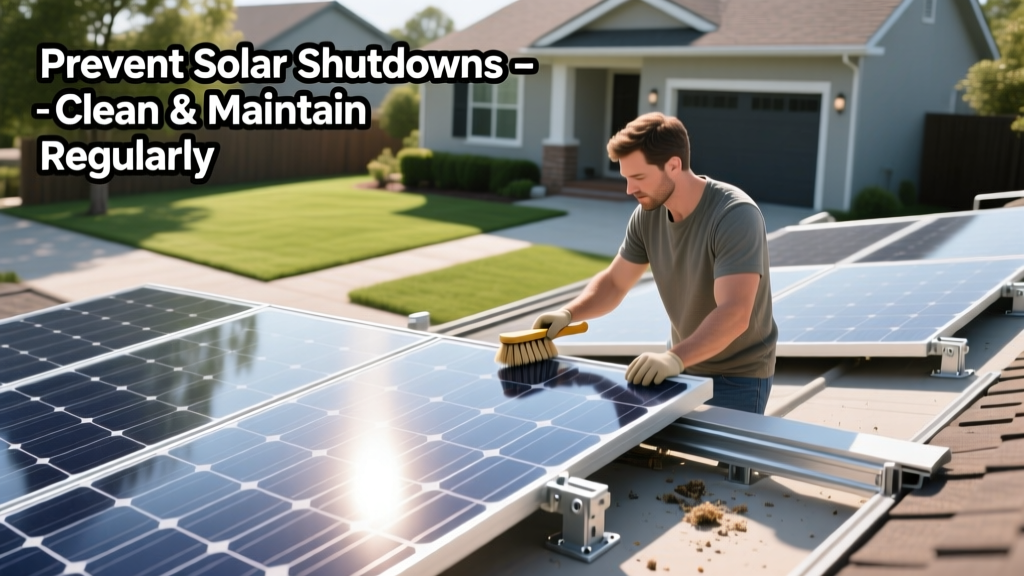
| Monthly | Clean panels with soft brush + deionized water if dust or pollen buildup exceeds 5% visible coverage | Avoid abrasive pads; never clean in direct sun (risk of thermal shock) |
| Yearly | Hire certified technician to inspect torque on racking bolts, check ground-fault protection, and perform IR thermography scan | Cost: $150–$300; catches hot spots before cell failure |
Warning Signs
Don’t wait for a bill to spike. These red flags appear weeks before measurable energy loss:
- Monitoring app shows consistent 10–15% lower yield on clear days vs. same month last year
- Inverter status light blinks amber (not green) for >10 minutes without reset
- One string’s voltage reads >15V lower than others during midday (use multimeter on combiner box)
- Visible discoloration or white “powder” (potential-induced degradation) near panel edges
Recommended Products
Invest in tools that catch problems early—not just fix them later:
- Panel cleaning kits with squeegee + non-ionic detergent (e.g., Goo Gone Solar Panel Cleaner) — avoids film residue that cuts transmission by up to 7%
- Wireless irradiance sensor (like Solmetric SunEye Pro) — confirms whether low output is due to shading or hardware fault
- DC arc-fault detector (UL 1699B-compliant) — shuts down faulty strings before fire risk develops
Can rain clean my panels well enough?
Rain removes loose dust but leaves mineral deposits, bird droppings, and pollen films untouched. In arid regions like Phoenix or Las Vegas, rain-only cleaning leads to 12–18% annual output loss (Arizona State University Solar Lab, 2021). A gentle rinse every 6–8 weeks is more effective—and safer—than relying on monsoons.
Do I need to shut off the system before cleaning?
Yes—if using water or contact tools. Shut down at the DC isolator switch (usually near inverter) and verify zero voltage with a CAT III multimeter. AC-side shutdown alone doesn’t de-energize panels. Skipping this step risks arc flash injury—even on cloudy days.
Why does my system produce less in summer despite more sun?
Heat reduces panel efficiency: most silicon panels lose ~0.4% output per °C above 25°C STC rating. On a 95°F roof surface (≈35°C ambient + 40°C heat gain), expect 12–15% derating. Proper racking airflow (≥1” gap beneath panels) and light-colored roofing help—see our guide to roof cooling strategies.
My monitoring shows one panel at 0W—does it need replacement?
Not necessarily. First, check for shading (e.g., new HVAC unit shadow), tripped optimizer (press reset button on Enphase IQ8), or loose MC4 connector. A single open-circuit panel in a string can drag the whole string to near-zero. Use a clamp meter on the string’s positive lead—if current reads 0A but voltage reads normal (~40V), the issue is downstream (optimizer or wiring), not the panel itself. Read our inverter error decoding guide for step-by-step diagnostics.
How often should I replace my inverter?
String inverters last 10–12 years; microinverters average 15–20 years (SEIA, 2023). But age alone isn’t the trigger—watch for rising internal temperature (>65°C sustained), audible buzzing, or repeated 'Ground Fault' alerts. Replacing at 10 years may be premature; waiting until 14 years risks cascading failures. Monitor fan RPM and thermal logs via your inverter’s service menu.
What’s the #1 thing homeowners overlook?
Vegetation management. A 6-foot branch growing within 10 feet of your array casts dynamic shade—reducing output more than static shading. Trim trees annually, not just when limbs touch panels. According to the Insurance Institute for Business & Home Safety's 2023 report, unmanaged vegetation accounts for 22% of avoidable solar underperformance claims.
"Most 'dead panel' calls we get are actually dirty connections or outdated firmware. We update inverter software first—9 out of 10 times, it restores full output." — Maria Chen, NABCEP-certified field technician, SunHarvest Energy (2024)
Prevention isn’t about perfection—it’s about consistency. Clean panels, updated firmware, and quarterly visual checks take less than an hour per year but protect decades of clean energy returns. Pair these habits with a real-time monitoring system, and you’ll spot trouble before it costs you a single kilowatt-hour.