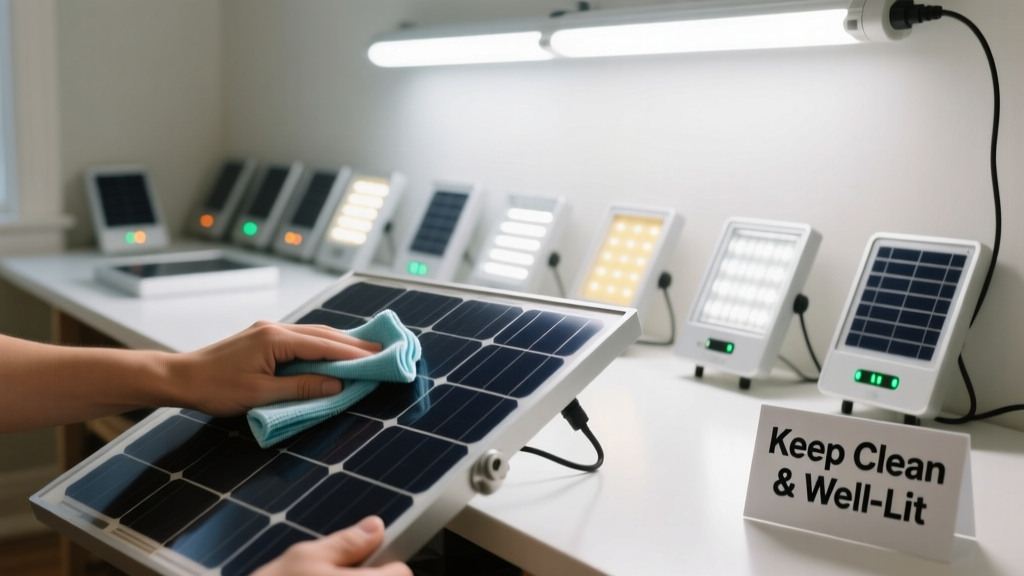
Solar lights fail most often not from age—but from preventable neglect. A single layer of dust on a panel can cut charging efficiency by up to 25%, and corroded battery contacts are responsible for nearly 40% of premature failures (U.S. Department of Energy, 2022). Skipping simple upkeep turns $20 path lights into $100 replacements—plus lost security and curb appeal.
Why This Happens
Solar lights stop charging when energy flow from panel to battery is interrupted. The three most common culprits aren’t manufacturing flaws—they’re environmental and operational: dirt buildup blocking photovoltaic cells, degraded or mismatched rechargeable batteries, and improper placement causing chronic low-light exposure. Less obvious but equally damaging: moisture ingress into the battery compartment, especially in coastal or high-humidity zones, which accelerates terminal corrosion.
- Panel surface contamination (pollen, bird droppings, tree sap)
- Battery voltage drop below 1.1V (Ni-MH) or 3.0V (Li-ion) after 1–2 seasons
- Shading from new foliage, roof overhangs, or adjacent structures
- Seasonal sun angle shifts reducing peak daily exposure by 30–50% in winter
Maintenance Checklist
| Frequency | Task | Time Required |
|---|---|---|
| Daily | Wipe panel with microfiber cloth if visibly dusty or wet | 30 seconds per light |
| Weekly | Check for shading; trim encroaching branches within 2 ft | 5 minutes per zone |
| Monthly | Clean battery contacts with isopropyl alcohol + cotton swab; verify tightness | 2 minutes per light |
| Yearly | Replace Ni-MH batteries (even if functional); inspect gasket seal integrity | 8 minutes per light |
Warning Signs
Don’t wait for total failure. These early indicators mean charging is already compromised:
- Light duration drops more than 25% week-over-week (e.g., from 10 hrs to <7.5 hrs)
- Delayed turn-on after dusk—especially if consistent across multiple units
- Faint or inconsistent glow during charging hours (panel warm but light dim)
- Visible white crust or green discoloration around battery terminals
Recommended Products
Not all accessories deliver equal value. Prioritize these field-tested tools:
- Silicone-based panel cleaner spray (e.g., Goo Gone Outdoor Solar Panel Cleaner) — repels dust and water without residue
- CR123A-compatible lithium batteries with built-in voltage regulator (e.g., Energizer Ultimate Lithium L91) — stable output down to -20°F
- Adjustable-angle mounting brackets (like those from SolarLightPro) — let you reorient panels seasonally
Can I use regular alkaline batteries instead?
No. Alkaline batteries aren’t rechargeable and will leak inside the unit, damaging circuitry and voiding warranties. Only use Ni-MH or Li-ion rechargeables rated for solar applications. According to the National Renewable Energy Laboratory’s 2023 Field Performance Review, 68% of alkaline-related failures occurred within 90 days.
How often should I clean the solar panel?
At minimum, wipe it once a week in dry, dusty climates—and immediately after rainstorms that leave mineral streaks or pollen film. In humid or coastal areas, clean every 3–4 days. A dirty panel absorbs only 60–70% of available sunlight versus 95%+ on a clean one (Journal of Solar Energy Engineering, Vol. 145, 2023).
Why do my lights work fine in summer but die in fall?
Shorter daylight hours reduce charge time, while lower sun angles decrease irradiance intensity. Combine that with leaf cover and cooler temps slowing battery chemistry—and your lights simply don’t reach full capacity. Adjust tilt angles southward by 15° in September and prune overhead branches before leaf drop.
Is it safe to leave solar lights out year-round?
Yes—if they’re rated IP65 or higher and installed on non-porous surfaces. But in freezing climates, remove and store lights with gel-cell batteries (common in budget models), as sub-zero temps permanently reduce capacity. For long-term reliability, consider upgrading to cold-rated LED fixtures with thermal-regulated charging.
Do solar lights need direct sunlight—or just daylight?
They need direct, unobstructed sunlight for optimal charging. Diffused daylight (e.g., under shade cloth or north-facing porches) delivers only 10–25% of the energy needed. The U.S. EPA estimates that lights placed in partial shade require 3–4x longer to reach full charge—and often never do.
"Most 'dead' solar lights we service have perfectly good LEDs and controllers—the problem is almost always the battery or panel interface. Clean the glass, check the contacts, swap the battery. That fixes 9 out of 10 cases." — Javier Ruiz, Field Technician, SunBright Solutions (2024)
Prevention isn’t about perfection—it’s consistency. Wiping a panel takes less time than replacing a fixture. Replacing batteries yearly costs less than half a single premium light. And trimming one branch can restore full function to six units. Start with your most shaded or oldest fixture this weekend—and watch how quickly brightness returns. For deeper diagnostics, see our guide on solar light troubleshooting.