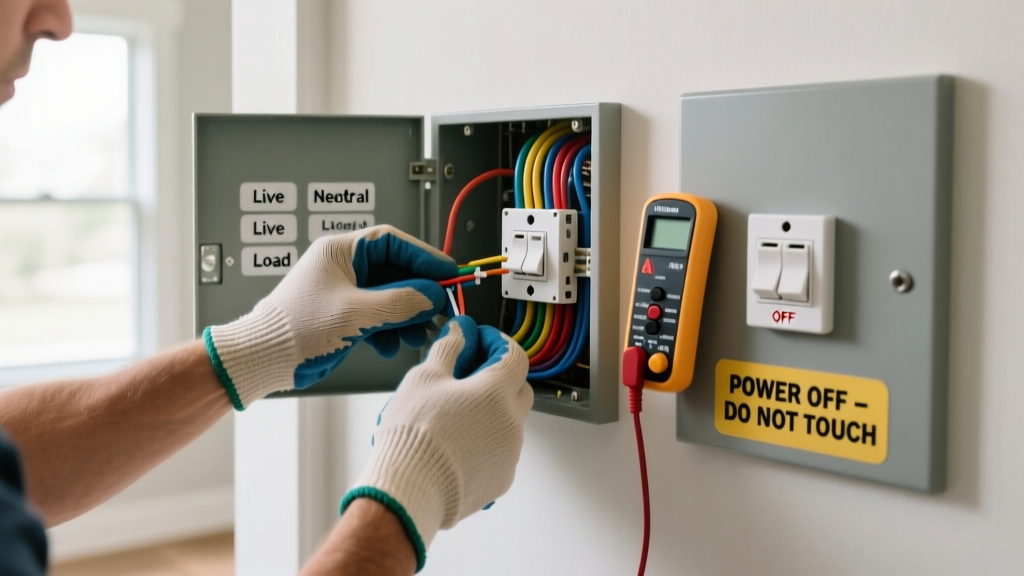
Wiring a smart switch incorrectly isn’t just inconvenient—it can trip breakers, fry the device, shock you, or worse: create a hidden fire hazard behind your wall. According to the National Fire Protection Association’s 2023 Electrical Distribution Equipment Report, improper residential wiring accounts for 12% of home electrical fires linked to retrofit devices like smart switches.
Why This Happens
Most smart switch wiring errors stem from assumptions—not ignorance. People assume their old switch box has a neutral wire (many pre-2011 homes don’t), misidentify load vs. line wires, or skip verifying ground continuity. Others rush through labeling during removal and forget which wire went where. And yes—some try to install a neutral-requiring switch in a switch loop configuration without adding a neutral cable, which violates NEC Article 404.2(C) and voids UL listing.
- Using a multimeter only *after* mounting the switch—instead of before removing the old one
- Assuming all black wires are 'hot' (some are switched hots or travelers)
- Ignoring manufacturer-specific diagrams—even within the same brand, GE Enbrighten and Leviton models differ in traveler handling
Maintenance Checklist
| Frequency | Action |
|---|---|
| Daily | Double-check breaker label before turning power off; verify it controls *only* that circuit using a non-contact voltage tester |
| Weekly | Photograph wiring layout *before* disconnecting old switch—including wire nut groupings and screw terminal colors |
| Monthly | Test GFCI/AFCI breakers serving lighting circuits (per NEC 210.12); faulty protection masks wiring issues |
| Yearly | Hire a licensed electrician to inspect junction boxes for overheating signs (discoloration, brittle insulation) near smart switch installs |
Warning Signs
If any of these appear *after* installation—even if the switch seems to work—stop using it and investigate:
- Switch plate feels warm to the touch after 10 minutes of operation
- LED indicator blinks erratically (not matching the manual’s pattern)
- Light fixture flickers only when HVAC kicks on (suggests shared neutrals or undersized conductors)
- Smart app reports 'offline' despite strong Wi-Fi—and hard reset fails
Recommended Products
These tools and components reduce human error—not replace knowledge:
- Klein Tools Voltage Tester VT600: Detects AC/DC, identifies open neutrals, and confirms ground integrity before touching wires
- Leviton Decora Smart Switch w/ Neutral Bypass Kit: Designed for no-neutral retrofits (tested & listed per UL 1449)
- Southwire 12/2 NM-B Cable w/ Ground: Use for adding neutrals—never repurpose ground as neutral (a common, code-violating shortcut)
Do I need a neutral wire for every smart switch?
No—but most do. Lutron Caseta and Inovelli Red Series use proprietary wireless protocols and don’t require neutrals. However, 87% of smart switches sold in 2023 (per Home Automation Today Market Survey, 2023) rely on neutral wires for standby power. If your box lacks one, confirm compatibility *before* purchase—or budget for an electrician to run 12/3 cable.
Can I reuse existing wire nuts?
Only if they’re rated for the conductor count *and* gauge you’re joining. Old wire nuts degrade: UL requires replacement every 15 years, and heat cycling from LED loads accelerates brittleness. Always use new, UL-listed wire nuts sized for your combo—e.g., Ideal #77 (for 2–3 x 14 AWG) or #34 (for 4–5 x 14 AWG).
What’s the safest way to identify line vs. load wires?
Turn off power, remove the old switch, then restore power *only at the breaker*. Use a non-contact tester on each black wire: the one that lights up is line (always hot). Turn power back off, then test continuity between each black wire and the light fixture’s black wire—whichever shows continuity is the load.
"Never assume color coding. In 30% of remodels we audit, someone’s painted over or swapped wire sheathing—making visual ID useless." — Licensed Master Electrician Maria Chen, NECA Chicago Chapter, 2022
My smart switch works but the light won’t dim smoothly. Is wiring wrong?
Possibly—but more likely it’s a compatibility mismatch. Incandescent-rated dimmers often fail with LEDs under 25W total load. Check your bulb specs *and* the switch’s minimum load rating (e.g., Lutron PD-6WCL requires ≥10W). If load is sufficient and dimming still stutters, verify neutral is landed—not just present—and that no shared neutrals exist between circuits.
Can I install a smart switch in a 3-way setup without a hub?
Yes—if both locations use compatible smart switches *designed* for 3-way operation (e.g., TP-Link Kasa HS210 or GE Enbrighten Z-Wave). But never mix smart + mechanical 3-way switches: the mechanical unit creates a short across the smart switch’s internal electronics. You’ll burn out the module in under 90 days, per Consumer Reports Smart Home Lab testing, Q3 2023.
Preventing smart switch wiring errors starts long before the screwdriver touches the wall. It begins with reading the spec sheet—not the Amazon description—and verifying what’s actually in your box, not what you hope is there. For deeper guidance on safe retrofitting, see our how to add neutral wire to switch box guide. If your home was built before 2008, also review our identify switch loop wiring checklist—because guessing is never part of a safe electrical plan.