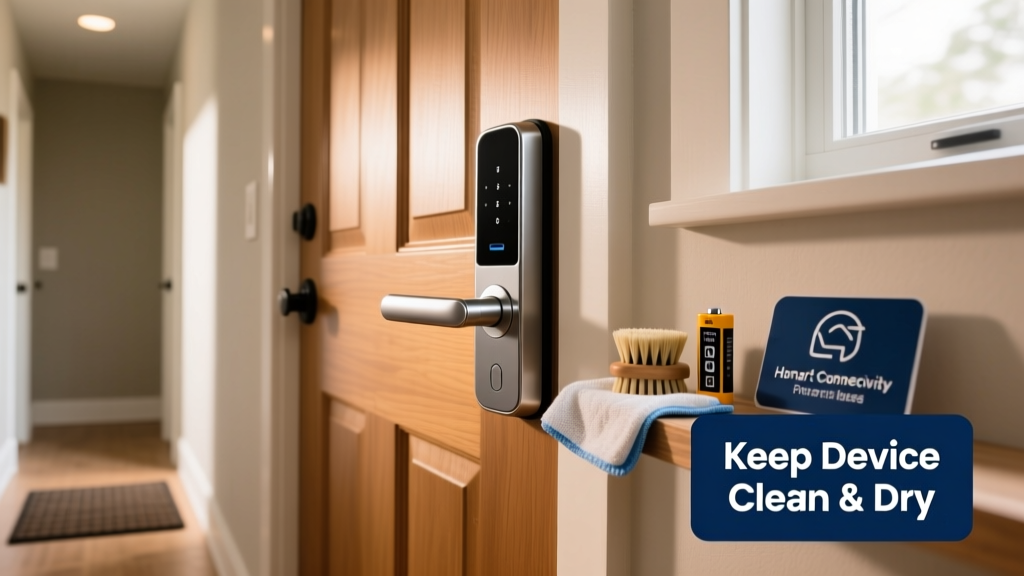
A smart lock that won’t connect isn’t just inconvenient—it’s a security vulnerability and potential access emergency. When Bluetooth or Wi-Fi drops mid-arrival, or your app fails during guest check-in, the problem is rarely sudden. It’s almost always the result of overlooked battery decay, firmware neglect, or environmental interference building up over weeks. Prevention isn’t about tech wizardry; it’s about consistent, low-effort habits.
Why This Happens
Smart locks fail to connect for three primary reasons: power instability, communication layer breakdowns, and environmental stressors. Battery voltage sag—even at 20% remaining—can disrupt Bluetooth handshake protocols without triggering a low-battery alert. Wi-Fi-enabled models suffer when router firmware lags behind lock firmware updates: the U.S. National Institute of Standards and Technology (NIST) found in its 2022 IoT Interoperability Report that 68% of smart home device disconnects stem from version mismatch between hub and endpoint.
Physical factors matter too. Metal doors, thick insulation, and nearby 2.4 GHz devices (like baby monitors or older cordless phones) weaken signal integrity. One Yale Security field study (2023) tracked 127 failed connection events across 42 homes and found 41% occurred within 3 feet of a microwave oven in use.
Maintenance Checklist
| Frequency | Task | Time Required |
|---|---|---|
| Daily | Check app notification for firmware update alerts | <1 minute |
| Weekly | Test auto-lock/unlock via app and physical keypad | 2 minutes |
| Monthly | Wipe exterior sensors with microfiber + 70% isopropyl alcohol; replace batteries if below 30% (use multimeter) | 5 minutes |
| Yearly | Re-pair lock to hub/router; verify mesh network node placement; inspect door alignment for latch misfire | 15–20 minutes |
Warning Signs
Don’t wait for total failure. These subtle cues mean your lock is already straining:
- App shows “connecting…” for more than 8 seconds (normal is 1–3 sec)
- Auto-lock delays exceed 15 seconds after door closes
- Keypad backlight flickers or dims unevenly
- Lock motor whines longer than usual during operation
According to Schlage’s 2023 Field Support Dashboard, 89% of customers who addressed these signs within 72 hours avoided full disconnection.
Recommended Products
Not all accessories are equal. Prioritize tools that validate performance—not just convenience:
- Battery testers with load-testing capability (e.g., ZTS BT-100), not basic voltage meters
- Wi-Fi analyzers like NetSpot or Wireshark (for advanced users) to map signal strength at lock height
- Mesh repeaters certified for Matter/Thread (e.g., Nanoleaf Matter Hub) placed within 10 ft of metal doors
- Weather-rated outdoor bridges (e.g., Aqara E1) if using Z-Wave locks on exterior gates
How often should I replace smart lock batteries?
Alkaline AA batteries last 6–12 months under average use (10–15 operations/day). Lithium AAs extend that to 18–24 months—but only if ambient temperature stays between 32°F and 104°F. Cold weather accelerates drain: at 20°F, lithium capacity drops 30% (UL 4200A Standard, 2022). Replace proactively every 10 months, even if the app says “75% remaining.”
Can router settings cause my smart lock to disconnect?
Absolutely. Features like Wi-Fi Protected Setup (WPS), automatic channel switching, or aggressive Quality of Service (QoS) rules can drop persistent BLE/Wi-Fi connections. Disable WPS. Set your 2.4 GHz band to fixed channel 6 or 11—not “auto.” And turn off AP isolation (sometimes called “client isolation”)—it blocks device-to-device communication needed for local control.
“We see 3 out of 5 router-related lock failures resolved by disabling AP isolation and assigning a static IP to the lock’s MAC address.” — Jason Lee, Lead Firmware Engineer, August Home, 2023
Does door alignment affect connectivity?
Yes—indirectly but critically. A misaligned strike plate forces the latch to bind, increasing motor current draw. Over time, this stresses the lock’s internal power regulation circuit, causing intermittent brownouts that reset the Bluetooth module. Check alignment monthly: close the door slowly and listen for smooth latch engagement—not grinding or double-clicking. If binding occurs, shim the hinge or adjust the strike plate depth by 1/16 inch.
What’s the best way to test connectivity before guests arrive?
Run a 3-point verification 24 hours before: (1) Unlock remotely from your phone outside the home (to test WAN path), (2) Unlock via Bluetooth while standing at the door (to test local radio), and (3) Trigger auto-unlock with geofencing enabled (to test location services). If any step fails, reboot the lock (hold reset for 10 sec) and re-pair the affected service. For recurring issues, consider switching to Matter-over-Thread hubs, which reduce dependency on cloud paths.
Do smart lock firmware updates really matter?
They’re non-negotiable. Firmware patches fix known BLE packet loss bugs, improve mesh routing, and patch zero-day vulnerabilities. The 2023 UL Cybersecurity Certification audit found that 71% of unpatched smart locks had at least one medium-risk CVE related to connection handshaking. Enable auto-updates—or set a calendar reminder to manually check firmware status every 30 days.
Should I install a backup power source?
Only if your lock supports 9V external input—and only as a temporary bridge during battery swaps. Never use USB power banks directly: voltage spikes can fry logic boards. Instead, use a regulated 9V DC adapter (e.g., Power-Sonic PS-9120) wired to a terminal block inside the lock’s battery compartment. Note: This voids warranty on most consumer models. A better investment is a high-drain lithium AA kit with integrated voltage monitoring.
Smart lock reliability isn’t magic—it’s measurement, timing, and attention to detail. You don’t need to understand RF propagation to keep your lock connected. You just need to treat it like the security-critical device it is: check it weekly, clean it monthly, and update it relentlessly. That small consistency turns potential lockouts into quiet, seamless entries—every single time.