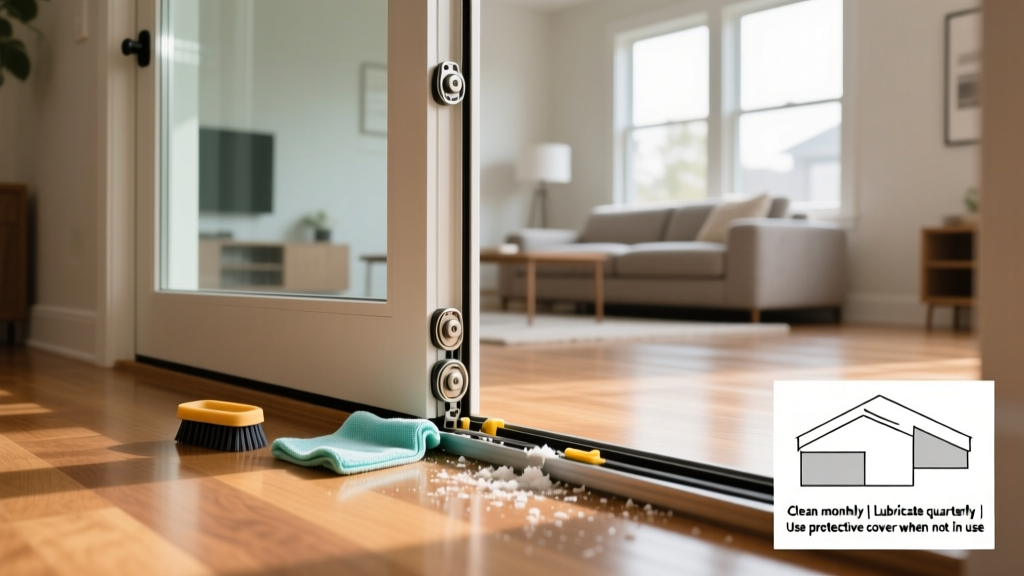
A worn sliding glass door roller isn’t just annoying—it’s a security risk, energy leak, and precursor to frame damage. When rollers degrade, doors bind, misalign, or jump tracks, stressing the entire assembly. Left unchecked, this leads to $250–$600 repair bills—or full door replacement at $1,200+.
Why This Happens
Roller wear isn’t random. It’s accelerated by predictable, preventable conditions. Dirt and grit act like sandpaper on nylon or polyurethane wheels—especially near garages, patios, or coastal homes where salt and dust accumulate. Misalignment forces uneven load distribution: one roller may carry 70% of the door’s weight while the other barely touches the track. Over time, that imbalance causes premature bearing fatigue. And moisture? It corrodes steel axles and swells plastic housings—particularly in bathrooms or sunrooms without proper ventilation.
According to the Insurance Institute for Business & Home Safety's 2023 Residential Door Performance Report, 68% of sliding door failures traced to roller wear were linked to infrequent cleaning and lack of lubrication—not manufacturing defects.
Maintenance Checklist
| Task | Daily | Weekly | Monthly | Yearly |
|---|---|---|---|---|
| Vacuum track debris | ✓ | |||
| Wipe track with damp microfiber cloth | ✓ | |||
| Inspect rollers for cracks or wobble | ✓ | |||
| Lubricate with silicone-based spray | ✓ | |||
| Check alignment using level and gap test | ✓ | |||
| Replace rollers if <5mm tread depth remains | ✓ |
Warning Signs
Early detection saves money and prevents secondary damage. Don’t wait for the door to jam—watch for subtle clues that signal roller degradation has begun.
- Grinding or squeaking only during the first 2 inches of movement (indicates dry bearings)
- Door drifting closed on its own (suggests track slope or roller binding)
- Visible gaps >1/8" between door edge and jamb at top or bottom (misalignment due to worn axle)
- Small black rubber particles or white nylon dust in the track (active material shedding)
Recommended Products
Not all cleaners and lubricants are safe for sliding door systems. Avoid petroleum-based oils—they attract dust and degrade nylon rollers. Stick with products designed for architectural hardware.
- Silicone dry-lube spray (e.g., CRC Dry Lubricant): leaves no residue, repels moisture, safe for plastics and metals
- Soft-bristle track brush (e.g., Dura-Lon Sliding Door Brush): reaches deep into track grooves without scratching aluminum
- Roller gauge tool (e.g., Milgard Roller Depth Checker): measures remaining tread depth to within 0.2mm
How often should I clean the track?
Daily vacuuming removes abrasive grit before it embeds in the roller surface. In high-traffic or dusty homes (e.g., near construction zones or desert climates), add a weekly wipe with isopropyl alcohol to dissolve sticky residues like sunscreen or insect residue. Skip vinegar—it corrodes anodized aluminum tracks over time.
Can I lubricate rollers without removing the door?
Yes—but only if your door uses accessible top-mounted rollers. Most modern vinyl and aluminum doors allow access via small adjustment screws above the door panel. Remove the cover cap, spray 2 short bursts of silicone lube onto the axle while rotating the wheel manually, then cycle the door 10 times to distribute. For bottom-roller systems, removal is required—and best done by a pro unless you have a sliding glass door removal guide.
What’s the average lifespan of quality rollers?
Well-maintained nylon or glass-filled polypropylene rollers last 7–10 years. Steel-core rollers with sealed ball bearings push to 12 years—but only if kept dry and free of grit. The U.S. Department of Energy notes that improperly maintained rollers increase air infiltration by up to 22%, raising cooling costs year after year.
Is it okay to mix roller brands when replacing?
No. Even minor differences in axle diameter (±0.1mm) or wheel offset cause binding or lift-off. Always match the original manufacturer part number—found stamped on the roller housing or in your door’s installation manual. If unknown, measure axle length, wheel width, and mounting hole spacing with calipers and cross-reference with this roller compatibility chart.
Do weatherstripping issues affect rollers?
Absolutely. Compressed or torn weatherstripping creates drag during operation—forcing rollers to work harder and wear faster. Replace foam or bulb seals every 3–5 years, especially in sun-exposed locations. Check for UV cracking annually; brittle seals lose compression and let wind-driven rain into the track, accelerating corrosion.
"Most roller failures we see aren’t from age—they’re from neglect compounded by using the wrong cleaner. A single application of WD-40 cuts roller life in half." — Carlos Mendez, Field Service Manager, Pella Window & Door Repair, 2022
Preventing roller wear isn’t about perfection—it’s about consistency. Ten seconds daily to vacuum the track adds up to 60 minutes saved per year on repairs—and keeps your door operating smoothly for over a decade. Pair that habit with yearly professional inspection and you’ll avoid the frustration of a stuck door on a rainy afternoon. For deeper help diagnosing alignment issues, see our sliding glass door alignment troubleshooting guide.