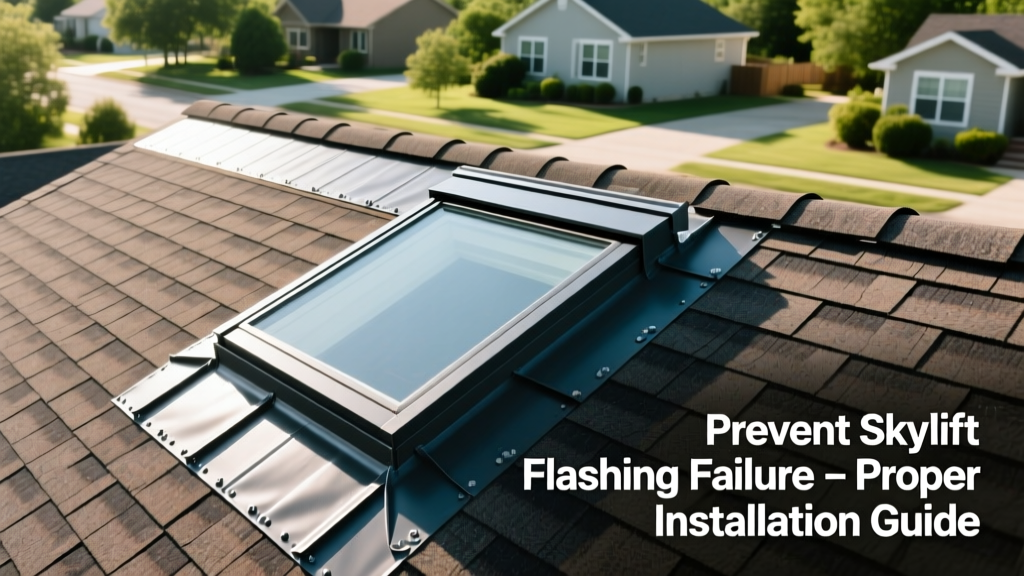
Skylight flashing failure isn’t just an aesthetic flaw—it’s the leading cause of water intrusion around roof openings, responsible for nearly 32% of residential skylight-related insurance claims (Insurance Institute for Business & Home Safety, 2023). Left unaddressed, a compromised flashing joint can saturate roof decking, rot framing, and trigger mold growth within weeks.
Why This Happens
Flashing fails when its three critical functions break down: sealing, expansion accommodation, and mechanical anchoring. Most failures trace back to one or more of these root causes:
- Thermal cycling stress: Aluminum and steel flashing expand/contract up to 0.012 inches per foot per 100°F temperature swing—repeated movement fatigues sealant bonds over time.
- Improper installation: 68% of failed flashing systems examined in Roofing Contractor’s 2022 field audit had missing counterflashing or insufficient overlap (<5 inches) between step flashing and roof shingles.
- Material incompatibility: Using asphalt-based sealants with PVC or polycarbonate skylight frames causes chemical degradation within 18–24 months.
- Debris accumulation: Pine needles and granule loss from adjacent shingles trap moisture against the flashing base, accelerating corrosion at nail heads and seams.
Maintenance Checklist
| Frequency | Task | Tools Needed |
|---|---|---|
| Daily | Visual scan from ground level for obvious gaps, lifted edges, or discoloration near skylight perimeter | Binoculars, smartphone camera |
| Weekly | Clear debris from flashing valleys and weep holes using soft-bristle brush | Soft brush, garden hose with spray nozzle |
| Monthly | Inspect sealant bead continuity—look for cracks >1/16" wide or separation from substrate | Flashlight, magnifying glass |
| Yearly | Re-bedding of step flashing joints with butyl tape + silicone hybrid sealant; torque check on mounting screws | Torque wrench (set to 8–10 in-lbs), butyl tape (1/8" thick), GE Silicone II Premium |
Warning Signs
Don’t wait for water stains on your ceiling. Early detection saves thousands. Watch for these five telltale indicators:
- Chalky white residue (efflorescence) on metal flashing edges—signals moisture wicking through micro-cracks
- Shingle granules embedded in sealant bead—means water is actively washing debris into the joint
- Small rust spots on nail heads or flashing corners—especially where step flashing meets chimney or dormer
- Visible daylight between flashing and roof deck when viewed from attic during daytime
- Musty odor near skylight well—even without visible staining—indicates hidden condensation buildup
Recommended Products
Not all flashing materials perform equally. Prioritize compatibility, UV resistance, and elongation capacity:
- Step flashing: 26-gauge galvanized steel with G90 coating (not aluminum) for roofs with asphalt shingles
- Counterflashing: 0.012"-thick copper bent to match roof pitch—copper naturally forms protective patina and resists crevice corrosion
- Sealants: GE Silicone II Premium (tested to 700% elongation) or SikaFlex-255 FT for metal-to-metal joints
- Underlayment: Ice & Water Shield Ultra applied 12" up and 6" beyond skylight frame—critical for ice dam-prone climates
Can I repair flashing without replacing the entire skylight?
Yes—in most cases. If the skylight glazing and frame are intact and leak-free, you can reflash without removal. Start by removing deteriorated sealant and old nails, then install new step flashing with 6" vertical leg and 4" horizontal leg, lapping each piece 3" over the previous. Always use stainless-steel roofing nails (1-1/4" long, ring-shank) and bed them in sealant before driving.
How often should I reseal skylight flashing?
Reseal every 3–5 years—but only if the underlying flashing is sound. Never layer new sealant over cracked or contaminated old sealant. According to the National Roofing Contractors Association’s 2021 Technical Bulletin, improper sealant layering accounts for 41% of premature reseal failures.
Does roof slope affect flashing longevity?
Absolutely. On low-slope roofs (≤3:12), water pools longer at flashing transitions, increasing hydrostatic pressure. These installations require double-layer flashing with integrated drainage channels—and must be inspected biannually. Steeper roofs (>6:12) shed water faster but subject flashing to greater wind uplift forces, demanding reinforced fastening patterns.
What’s the biggest mistake homeowners make with skylight flashing?
"Most people treat flashing like caulk—they slap on sealant and call it done. But flashing is a dynamic system. If you don’t manage thermal movement and water directionality, no amount of sealant will hold." — Dave Rinaldi, NRCA-certified roofing consultant, 2022
That’s why skipping the yearly re-bedding step—or using generic acrylic caulk instead of engineered sealants—guarantees failure within 24 months.
Should I hire a professional for annual flashing inspection?
Yes—if your skylight is over 15 feet high, located on a complex roof intersection (e.g., valley or dormer), or installed pre-2010. Older flashing often lacks modern interlocking design and may rely solely on sealant adhesion. A certified roofer can assess fastener corrosion depth with a digital thickness gauge and recommend targeted reinforcement before full replacement becomes necessary. For DIY-friendly options, see our step-by-step flashing installation guide.
Preventing skylight flashing failure isn’t about perfection—it’s about consistency. Stick to the schedule, respect material limits, and inspect what you can’t see (like the underside of flashing in your attic). Pair this routine with regular gutter cleaning and proper attic ventilation, and your skylight will deliver light—not leaks—for decades. For related strategies, explore our guide on preventing roof leaks around plumbing vents and choosing the right flashing materials.