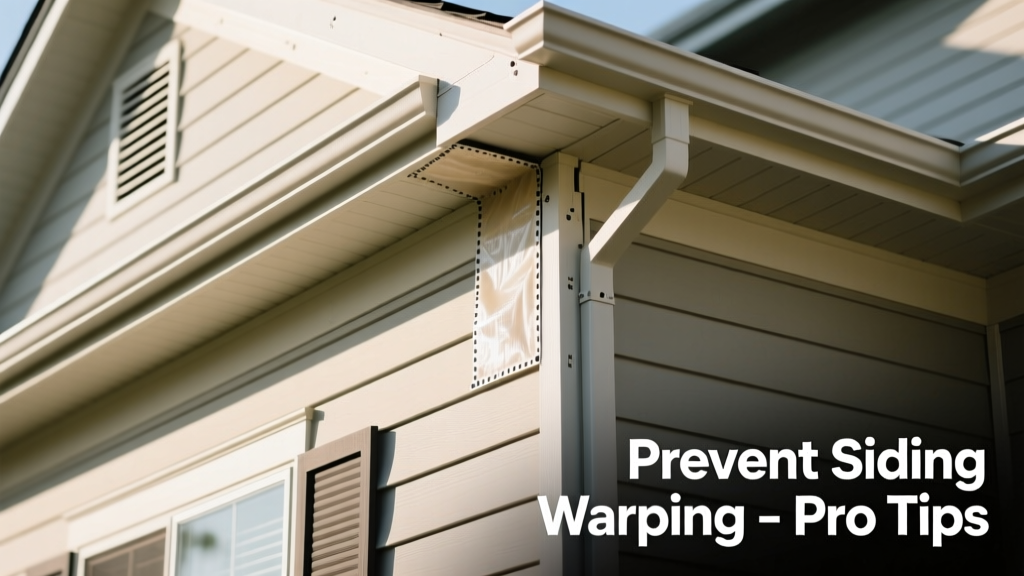
Warped siding isn’t just an eyesore—it’s a red flag that moisture, heat, or structural stress is compromising your home’s first line of defense. Left unchecked, warped panels invite water intrusion, insect entry, and insulation damage; the Insurance Institute for Business & Home Safety’s 2023 report found that 27% of siding-related insurance claims involved secondary water damage originating from undetected warping.
Why This Happens
Siding warps when materials expand, contract, or degrade unevenly. Vinyl buckles under sustained surface temperatures above 160°F—common on south-facing walls with dark finishes and no shading. Wood swells and twists when moisture content exceeds 19%, often due to clogged gutters or poor ventilation behind the cladding. Fiber cement cracks and bows if fastened too tightly or installed without proper expansion gaps (minimum 1/8" per 12' panel, per James Hardie’s 2022 Installation Guidelines).
- Direct sun exposure on unshaded, dark-colored vinyl
- Poor drainage directing runoff toward foundation and siding base
- Insufficient clearance between siding bottom and soil (should be ≥6")
- Missing or compressed house wrap creating vapor traps
- Overdriven nails or screws restricting natural panel movement
Maintenance Checklist
| Frequency | Task |
|---|---|
| Daily | Check for obvious bulging or rippling near windows, doors, or corners |
| Weekly | Clear debris from weep holes at bottom of vinyl panels using a soft brush |
| Monthly | Inspect caulk lines at window/door perimeters for cracking or separation |
| Yearly | Hire certified inspector to verify fastener spacing, expansion gap integrity, and house wrap continuity |
Warning Signs
Early detection saves thousands. Don’t wait for visible bowing—look for subtle precursors:
- Small ripples or ‘oil-canning’ in large flat vinyl sections (especially after hot, still days)
- Paint blistering or peeling localized to one board—not the whole wall
- Gaps widening between panels during summer, then tightening in winter
- Soft spots or spongy feel when pressing gently on wood or engineered siding
- Mold or mildew streaks behind loose-fitting panels near ground level
Recommended Products
Not all products prevent warping—but these reduce key risk factors:
- Rain dispersal systems: LeafGuard® seamless gutters (tested to divert >90% of debris, per UL 2218 2021)
- Ventilation aids: Cor-A-Vent SV-3 soffit vents (provide 3.25 sq. in./ft² net free area)
- Thermal break coatings: Sherwin-Williams Loxon Cool Roof Acrylic (reflects 82% of solar radiation)
- Moisture-monitoring tools: General Tools MM100 pinless moisture meter (accurate to ±2.5% in wood and fiber cement)
Can pressure washing cause siding to warp?
Yes—especially on vinyl older than 15 years or installed before 2010. High-pressure streams (>1,500 PSI) force water behind panels, saturating sheathing and swelling framing. Use a wide-angle tip (40°), keep nozzle ≥24" from surface, and never spray upward. For best practices, see our pressure washing safety guide.
Does paint color really affect warping risk?
Absolutely. Dark colors absorb up to 70% more solar heat than light ones. In Phoenix, black vinyl siding regularly hits 175°F on summer afternoons—well past its deformation threshold. The U.S. Department of Energy recommends Light Reflectance Value (LRV) ≥55 for exterior cladding in hot climates. Stick with whites, beiges, or soft grays unless your installer confirms enhanced UV-stabilized backing.
How much clearance should siding have above soil or mulch?
Minimum 6 inches—and that’s non-negotiable. A 2022 study by the National Association of Home Builders found homes with ≤4" clearance had 3.2× higher incidence of baseboard warping and rot. Mulch, gravel, or soil piled against siding traps moisture and blocks airflow. Re-grade soil away from the foundation slope at 1" per foot for at least 6 feet.
Do I need furring strips behind new siding?
Yes—if installing over existing wood or stucco, or on walls without continuous rigid insulation. Furring strips create a rainscreen gap (≥3/8") that lets trapped moisture escape and equalizes air pressure behind panels. According to the Building Science Corporation’s 2021 Field Guide, this simple step reduces inward solar-driven moisture drive by up to 60%.
What’s the biggest installation mistake that leads to warping?
Over-tightening fasteners. Vinyl and fiber cement need room to expand: nails must float in elongated slots, not grip tight.
“We see more warping from fastener error than material defect—9 out of 10 cases involve nails driven flush or countersunk,” says Mark Delaney, lead inspector at Siding Integrity Group (2023 field audit).Always follow manufacturer specs: James Hardie requires fasteners 1/32"–1/16" proud; CertainTeed vinyl demands nail heads centered in slot, not touching edges.
Warping rarely happens overnight—but it’s almost always preventable. Stay ahead with consistent checks, smart product choices, and installation that respects material behavior. For related guidance, explore our siding inspection checklist and house wrap installation mistakes to close common moisture pathways before they start.