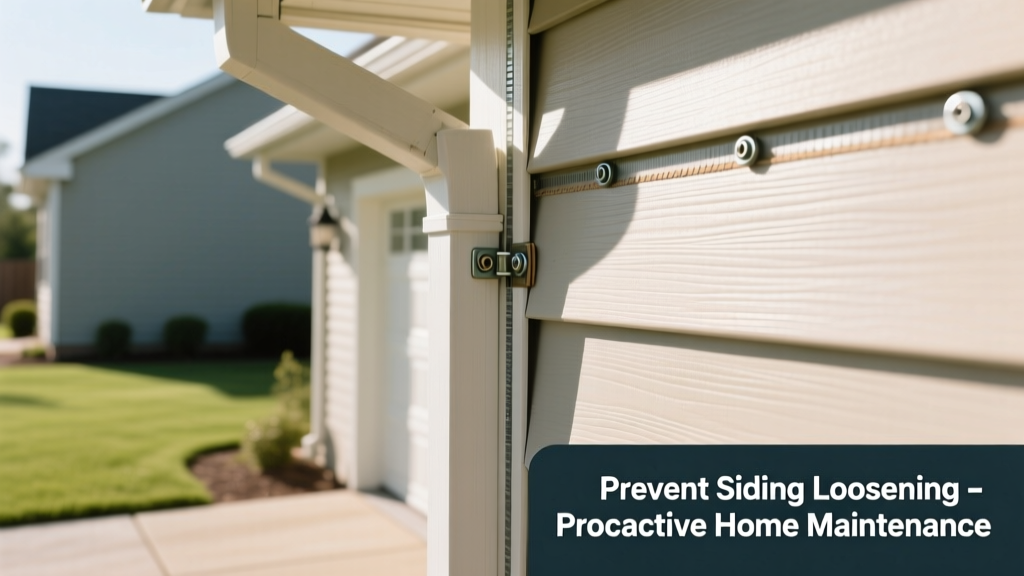
Loose siding isn’t just an eyesore—it’s a red flag for water intrusion, pest entry, and insulation failure. Once panels shift, even slightly, wind-driven rain can bypass the weather barrier, leading to rot behind vinyl or fiber cement, mold growth in wall cavities, and energy losses up to 20% (U.S. Department of Energy, 2022). Prevention is far cheaper and simpler than replacement—especially since 68% of siding failures stem from avoidable neglect, not material defects (NAHB Remodeling Impact Report, 2023).
Why This Happens
Siding loosens due to cumulative stress—not one dramatic event. Thermal expansion and contraction fatigue fasteners over time, especially with vinyl or metal panels exposed to wide temperature swings. Poor initial installation—like nails driven too deep, too shallow, or without proper clearance at panel ends—sets the stage for movement within 2–5 years. High winds during storms accelerate existing weaknesses, while moisture trapped behind panels causes wood substrate swelling or rust on steel framing, pushing panels outward.
- Over-torqued or under-driven fasteners create uneven stress points
- Missing or corroded screws/nails in high-wind zones (e.g., gables, corners)
- Blocked weep holes or clogged drainage gaps behind cladding
- Unsealed seams near windows, doors, or roof intersections
Maintenance Checklist
| Frequency | Task | Time Required |
|---|---|---|
| Daily | Visually scan south- and west-facing walls after strong winds | 2 minutes |
| Weekly | Clear debris from base of walls and foundation vents | 5 minutes |
| Monthly | Check for nail pop-out or screw head corrosion at corners and trim | 10 minutes |
| Yearly | Inspect and reseal all perimeter joints; tighten loose fasteners with torque-limited driver | 1–2 hours |
Warning Signs
Don’t wait for panels to flap in the wind. Early detection saves hundreds in labor and avoids secondary damage. Pay close attention after winter thaws and summer thunderstorms—these are peak times for movement onset.
- Gaps wider than 1/8 inch between panels or at trim edges
- Visible rust stains bleeding from fastener heads
- Soft spots or spongy feel when pressing gently on panels
- Peeling paint or chalky residue concentrated near seams
- Wasp or carpenter ant activity near panel overlaps
Recommended Products
Not all sealants or fasteners work equally well for siding retention. Prioritize compatibility: vinyl needs flexible adhesives, fiber cement demands stainless steel, and wood siding benefits from ring-shank nails.
- Silicone-acrylic hybrid sealants (e.g., OSI Quad Max) for expansion joints
- Stainless steel #10 x 1-5/8" pan-head screws with EPDM washers for fiber cement
- Vinyl-specific fasteners like color-matched ring-shank nails with 1/32" clearance at panel ends
- Drainage matting (e.g., Benjamin Obdyke Home Slicker) for rainscreen retrofits
How often should I inspect siding fasteners?
Check every 12 months—but increase to quarterly if you live in coastal, high-wind, or freeze-thaw zones (e.g., Great Lakes, Pacific Northwest). Use a torque-limiting screwdriver set to 4.5–5.5 in-lbs for fiber cement; never exceed manufacturer specs. Over-tightening cracks panels and strips threads faster than under-tightening.
Can pressure washing loosen siding?
Yes—if done incorrectly. Keep nozzles at least 18 inches from the surface and use a 40° fan tip. Never aim upward behind panels or at seam lines. According to the Vinyl Siding Institute’s 2021 Field Manual, improper washing accounts for 11% of premature fastener failure—mostly from forced water behind the nailing flange.
Does house wrap affect siding stability?
Absolutely. Torn, overlapped, or unfastened house wrap creates air channels that amplify wind suction behind siding—increasing pull-out force on fasteners by up to 30% (Building Science Corporation, 2020). Always staple wrap vertically every 12 inches, lap seams 6 inches minimum, and tape all penetrations.
What’s the best way to reattach a loose panel?
Don’t just drive a new nail beside the old one. First, remove the original fastener and inspect the substrate for rot or rust. Drill pilot holes, use a compatible fastener with proper embedment depth (minimum 1-1/4" into framing), and leave 1/32" gap at the top edge for expansion. If more than two adjacent panels are loose, call a certified installer—it’s likely a systemic issue.
"Most 'loose siding' calls we get are really 'failed flashing' calls in disguise. Water behind the wall pushes panels out from the inside—not wind from the outside." — Mike R., 22-year exterior envelope inspector, IBHS Certified
Should I caulk around siding panels?
No—caulking over panel seams traps moisture and prevents natural drainage. Only seal where siding meets dissimilar materials: windows, doors, brick ledges, and rooflines. Use backer rod + sealant for gaps over 1/4", and always tool the bead smooth to prevent ponding. Caulk failure is the #2 cause of hidden rot behind vinyl (NAHB 2023 Siding Failure Survey).
Does insulation type impact siding movement?
Indirectly, yes. Spray foam applied directly to the back of siding restricts thermal movement and has caused buckling in multiple retrofit cases (Building America Solution Center, 2022). Opt for cavity-fill fiberglass or dense-packed cellulose instead—and always maintain a minimum 3/8" air gap behind cladding for ventilation and drainage.
Preventing loose siding isn’t about perfection—it’s about consistency. A 10-minute walk-around each spring and fall, paired with targeted tightening and sealing, extends siding life by 7–12 years. And when you catch movement early, you’re not just saving money—you’re protecting the structural integrity of your home’s envelope, one fastener at a time.