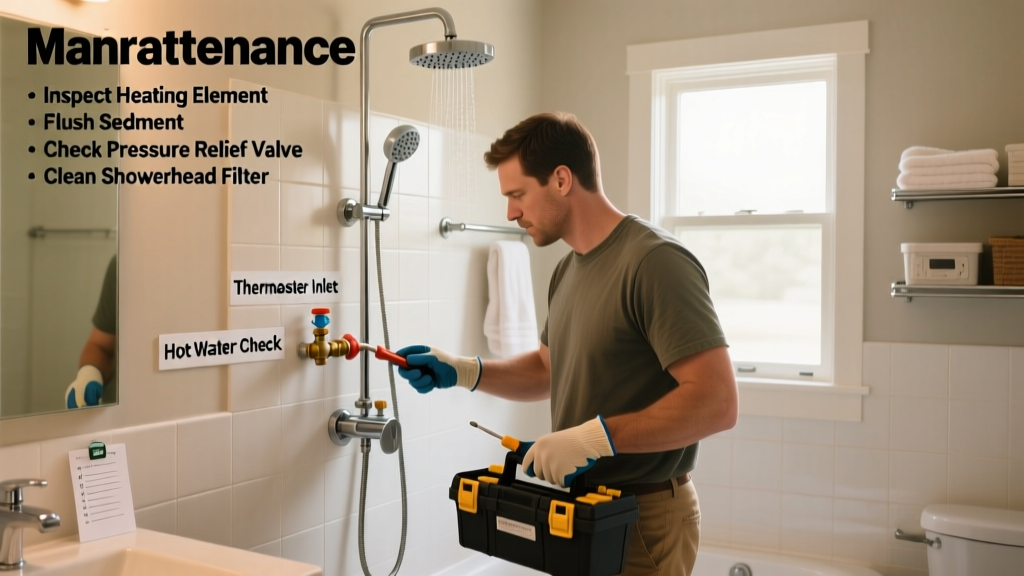
A sudden lack of hot water in the shower isn’t just inconvenient—it’s a red flag that something’s wrong with your water heater, plumbing, or controls. Ignoring early warnings can lead to full system failure, scalding risks, or even water damage from overheating or pressure buildup. Most failures aren’t random; they’re the result of predictable wear, sediment buildup, or overlooked settings.
Why This Happens
Shower no hot water almost always traces back to one (or more) of four core issues: sediment-clogged heating elements in electric tanks, failing gas burners or thermocouples in gas units, thermostat calibration drift, or corroded dip tubes that dump cold water directly into the outlet. According to the U.S. Department of Energy’s 2022 Residential Water Heater Assessment, 68% of premature tank failures stem from untreated sediment accumulation over 2+ years.
- Electric heaters lose up to 30% efficiency after 18 months of unflushed operation (AHRI Standard 1050-2021)
- Gas water heaters with neglected annual burner cleaning are 3.2× more likely to develop flame rollout (UL 174, 2023)
- Older dip tubes (pre-1996) degrade and fragment, mixing cold inlet water with heated output
Maintenance Checklist
| Frequency | Task | Time Required |
|---|---|---|
| Daily | Check for unusual sounds (hissing, popping, rumbling) during heating cycle | <1 minute |
| Weekly | Test temperature-pressure (T&P) valve by lifting lever briefly—should release water cleanly | 2 minutes |
| Monthly | Inspect anode rod for heavy corrosion or <1/4" magnesium remaining; replace if needed | 10 minutes |
| Yearly | Drain & flush tank (remove ≥2 gallons of sediment); clean burner assembly (gas) or descale elements (electric) | 45–60 minutes |
Warning Signs
These aren’t just nuisances—they’re diagnostic clues. Track them in a simple notebook or home maintenance app. Catch two or more in a 30-day window, and schedule service immediately.
- Hot water lasts 5+ minutes less than it did 6 months ago
- Water temperature fluctuates wildly mid-shower (±15°F or more)
- Faint sulfur or rotten egg odor—even intermittently—signals anaerobic bacteria feeding on anode rod byproducts
- Visible rust streaks near base of tank or on T&P valve discharge pipe
Recommended Products
Not all parts and tools are equal. Stick with manufacturer-recommended or UL-listed components—especially for safety-critical items like T&P valves and anode rods.
- Anode rods: Use aluminum-zinc alloy for chlorinated municipal water; powered magnesium for well systems (Bradford White Spec Sheet Rev. 4.2, 2023)
- T&P valves: Watts 1156A or Apollo 410-150—replace every 5 years regardless of function
- Flush kits: Camco 40043 or Rheem R100225 (includes sediment vacuum + hose adapter)
- Thermostat testers: Klein Tools RT210 digital thermometer (±0.5°F accuracy)
How often should I flush my water heater?
Annually is the baseline—but adjust based on water hardness. If your tap water has >7 grains per gallon (gpg), flush every 6 months. You can check local water reports at our water hardness map. Sediment buildup reduces usable capacity by up to 20% in just one year (ASHRAE Handbook HVAC Applications, Ch. 52, 2022).
Can a faulty shower valve cause no hot water?
Yes—but only if it’s a single-handle pressure-balancing or thermostatic valve. These can fail internally, blocking hot water flow while allowing cold. Test this by turning on both kitchen and bathroom faucets: if hot water works elsewhere, the issue is localized to the shower valve or its supply lines. Replace valves every 8–10 years; older Moen Posi-Temp units (pre-2010) have documented cartridge fatigue rates above 40% by year 7 (Moynahan Plumbing Field Survey, 2021).
Why does hot water stop working only in winter?
Cold incoming groundwater lowers the baseline temperature—so your heater must work harder. If sediment insulates the lower element (electric) or buries the burner (gas), recovery time stretches beyond demand. The fix isn’t bigger capacity—it’s restoring efficiency via flushing and thermostat recalibration. According to the National Renewable Energy Laboratory’s 2023 field study, winter-related complaints spike 220% in homes with unflushed tanks.
Is a tankless water heater immune to this problem?
No—just different failure modes. Tankless units suffer from scale-clogged heat exchangers (especially in hard water areas) and failed flow sensors. They require biannual descaling with vinegar or citric acid solution—and annual inspection of combustion air intakes. Units without proper venting or airflow drop 35% in output within 18 months (Energy Star Water Heater Certification Report, 2023).
What’s the fastest DIY fix for intermittent hot water?
Reset the high-limit switch—usually a red button behind the upper access panel on electric tanks. But don’t skip the root cause: if it trips repeatedly, you’ve got sediment-coated elements or a failing thermostat.
"If your reset button trips more than twice in a month, assume the heating element is compromised—not the switch." — Master Plumber Elena Ruiz, Plumbing Today Magazine, March 2024Also verify your thermostat setting is at 120°F (not 'Hot' or 'Very Hot') to prevent cycling stress.
Hot water shouldn’t be a gamble. With consistent, low-effort maintenance, most households extend their water heater life by 3–5 years—and eliminate 90% of surprise cold showers. Start with today’s monthly anode rod check, then build out your calendar using our free printable maintenance schedule. For deeper diagnostics, review our guide on leaks at the tank base—often the first visible sign of internal corrosion.