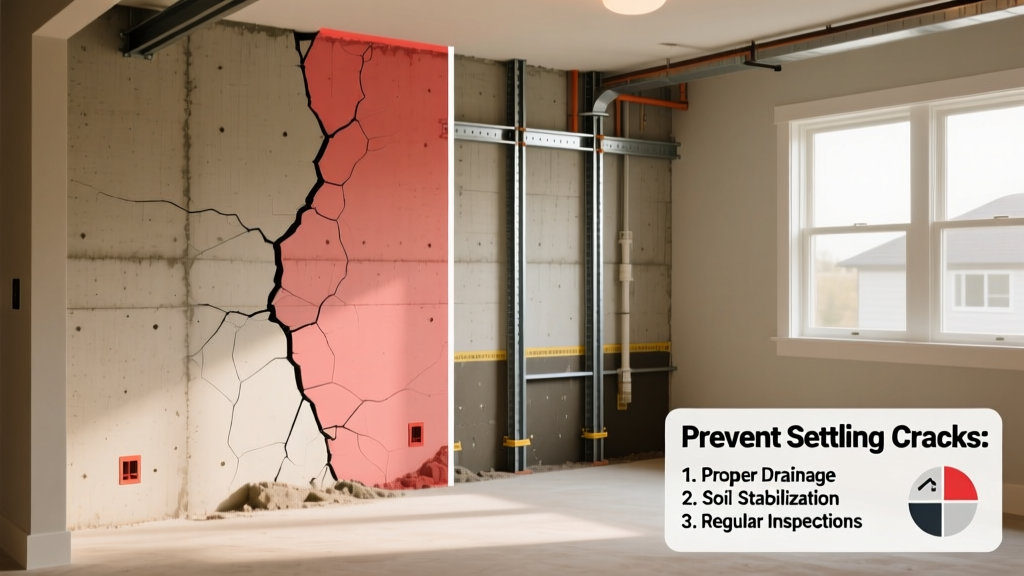
Settling cracks aren’t just cosmetic—they’re early warnings of uneven foundation movement that can escalate into misaligned doors, plumbing leaks, or even structural instability. Left unchecked, minor hairline fissures can widen into 1/4-inch gaps requiring $8,000–$15,000 in underpinning repairs, according to the American Society of Civil Engineers’ 2022 Infrastructure Report Card.
Why This Happens
Foundation settling isn’t random—it’s driven by predictable physical forces. Expansive clay soils swell when wet and shrink during droughts, creating cyclical stress on footings. Poorly compacted fill dirt beneath slabs settles over time, especially in homes built on recently graded lots. Tree roots within 10 feet of the foundation extract moisture from soil, accelerating localized shrinkage. And chronic poor drainage—like downspouts dumping water within 3 feet of the foundation—softens supporting soil year after year.
Maintenance Checklist
| Frequency | Task | Time Required |
|---|---|---|
| Daily | Check for pooling water near foundation after rain | 2 minutes |
| Weekly | Inspect exterior grade for erosion or low spots near walls | 5 minutes |
| Monthly | Clean gutters and verify downspout extensions are ≥5 ft from foundation | 15 minutes |
| Yearly | Hire a licensed inspector to measure slab elevation with laser level (±1/8" tolerance) | 2 hours |
Warning Signs
Early detection is your best defense. Watch for these subtle but telling indicators—not just cracks themselves, but their context and behavior:
- Stair-step cracks in brick veneer or concrete block walls (not random spiderwebbing)
- Doors that stick at the top corner or won’t latch without lifting
- Floors sloping toward interior walls (test with a marble or ball bearing)
- Cracks wider at one end than the other—especially if >1/16" wide
Recommended Products
Not all products prevent settling—but these support long-term soil stability and moisture control:
- Perforated French drain pipe (4" PVC with filter sock) installed along perimeter footing
- Soil moisture meters (e.g., Teralink TLM-100) to monitor clay soil moisture at 12" and 24" depths
- Root barrier fabric (HDPE, 30-mil) buried vertically 30" deep between trees and foundation
- Adjustable downspout extensions with swivel joints and splash blocks rated for 5+ years of UV exposure
How often should I check my home’s grading?
Recheck grading every spring and fall—especially after heavy rains or freeze-thaw cycles. Soil heaves and washouts happen fastest in those windows. Use a 6-foot level and string line to confirm a minimum 6-inch drop over the first 10 feet away from your foundation. If you find low spots, add crushed gravel (not topsoil) and tamp in 2-inch lifts.
Can irrigation help prevent settling cracks?
Yes—if applied precisely. The U.S. Department of Agriculture’s 2021 Soils Handbook notes that consistent moisture in expansive clays reduces seasonal shrink-swell amplitude by up to 40%. Install drip lines 18" from the foundation edge, running 30 minutes twice weekly in summer—but only if your soil moisture meter reads <18% volumetric water content at 12" depth.
Do tree roots always cause settling?
No—but certain species do. According to the International Society of Arboriculture’s 2020 Urban Root Study, oak, poplar, and willow trees within 20 feet of foundations contribute to 68% of documented moisture-related settlement cases. Maples and dogwoods pose far less risk. When removing high-risk trees, avoid sudden removal; prune roots gradually over 12–18 months to prevent abrupt soil rehydration and heaving.
What’s the biggest mistake homeowners make with gutters?
Assuming “clean” means “functional.” A clogged gutter isn’t the only problem—many homes have gutters that are clean but misaligned, dumping water directly onto porous backfill.
“Over 73% of foundation cracks we see start within 36 inches of a downspout outlet—even when gutters are debris-free,” says structural engineer Lena Cho, PE, of Foundation Integrity Group, 2023 field survey.Always verify downspout discharge points land on solid, sloped surfaces—not mulch beds or bare dirt.
Is DIY crack monitoring reliable?
For early-stage tracking, yes—with discipline. Tape a clear acrylic ruler across a suspect crack and photograph it monthly with date/time stamp. Measure width changes using calipers (not eyeballing). If growth exceeds 1/32" per month for three consecutive months, contact a foundation specialist. For more details, see our guide on foundation crack monitoring techniques.
Should I seal existing hairline cracks preventively?
No—and here’s why: sealing surface cracks doesn’t address subsurface movement. In fact, rigid epoxies can trap moisture behind them, worsening spalling in freeze-prone climates. Instead, focus on root causes: drainage, soil moisture, and vegetation. If cracks are stable (<1/16" and unchanged for 12+ months), they’re likely cosmetic. Learn more about safe vs. risky crack types in our foundation crack identification guide.
Preventing settling cracks isn’t about perfection—it’s about consistency. Small actions taken quarterly—like verifying downspout flow paths or checking soil moisture after dry spells—add up to decades of foundation stability. Pair those habits with annual professional elevation checks, and you’ll catch shifts while they’re still correctable with grading or drainage fixes—not hydraulic piers. For deeper soil analysis, consider a soil testing kit review to match your yard’s composition with targeted prevention strategies.