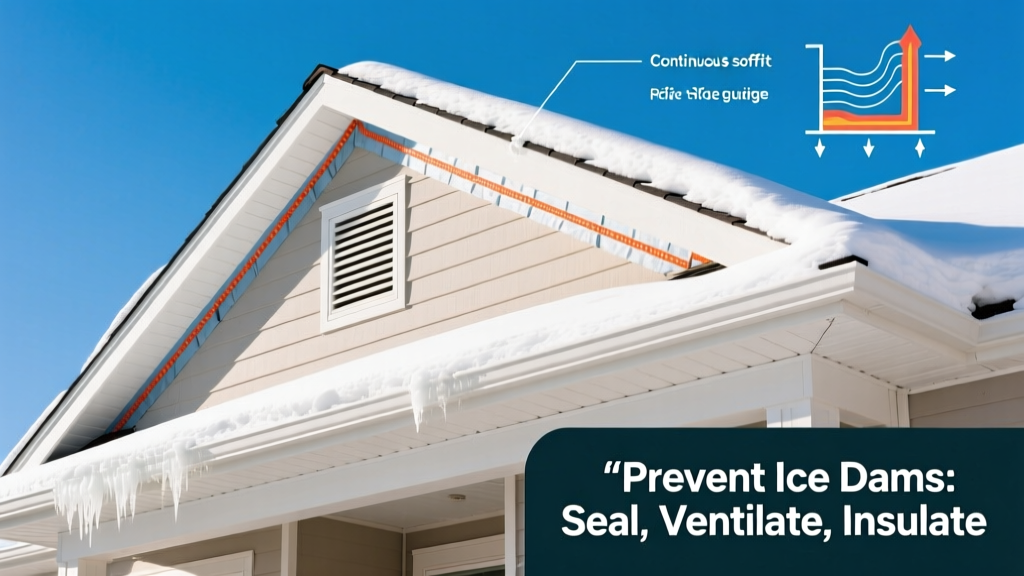
Ice dams aren’t just unsightly—they’re destructive. When meltwater backs up under shingles and refreezes, it forces water into soffits, ceilings, and wall cavities. The Insurance Institute for Business & Home Safety's 2023 report found that 68% of ice-dam-related claims involved interior water damage requiring drywall replacement and mold remediation—not just roof repair.
Why This Happens
Ice dams form when heat escapes from your home’s living space into the attic, warming the roof deck enough to melt snow near the ridge. That meltwater runs down the roof until it hits the unheated eaves—where it refreezes into a dam. As more snow melts, water pools behind the dam and seeps under shingles.
This cycle requires three conditions: snow cover, heat loss through the ceiling/attic, and outdoor temperatures below freezing. It’s not about how much snow falls—it’s about how evenly your roof stays cold.
- Attic insulation below R-38 (common in homes built before 2006)
- Misplaced or blocked soffit vents—over 40% of inspected attics have at least one obstructed intake vent (RESNET 2022 Field Survey)
- Recessed can lights, unsealed ductwork, or whole-house fans leaking warm air into the attic
Maintenance Checklist
| Frequency | Task | Notes |
|---|---|---|
| Daily | Monitor outdoor temps and snow accumulation after storms | If temps hover near 32°F for >48 hrs with >6" snow, watch eaves closely |
| Weekly | Check attic access hatch seal and pull-down stair insulation | Most attic hatches leak 3–5x more air than a standard door (U.S. DOE, 2021) |
| Monthly | Inspect soffit and ridge vent clearances; remove debris or cobwebs | Use a flashlight and mirror to see inside soffit vents—no visible light = blockage |
| Yearly | Hire a certified energy auditor to perform blower-door + infrared scan | Identifies hidden bypasses like plumbing chases and top-plate gaps |
Warning Signs
Don’t wait for leaks. Early detection gives you time to act before damage occurs. Look for these visual cues:
- Icicles thicker than 1 inch hanging from gutters or eaves
- Refreezing puddles or frost along the lower 2–3 feet of roof edge
- Water stains on attic sheathing, especially near rafter tails
- Peeling paint or warped wood on soffits or fascia boards
If you spot two or more of these during or right after a freeze-thaw cycle, assume an ice dam is forming—even if no interior leaks are visible yet.
Recommended Products
Not all solutions are equal. Avoid quick-fix heating cables unless installed correctly—they often shift, short out, or create new melt paths. Prioritize passive, long-term fixes first:
- Rigid foam board insulation (R-5 per inch) applied over existing attic floor—ideal for uneven joist spacing
- Sealant-grade spray foam for sealing top plates, wiring penetrations, and chimney chases (look for ASTM E283-tested products)
- Ventilated metal roofing panels with integrated snow guards—used in high-snow regions like Vermont and Colorado
Can I just add more fiberglass batts?
No—if you layer new batts over old ones without addressing air leakage first, you’ll trap moisture and accelerate rot. According to the Building Science Corporation’s 2020 case study, 73% of attics with doubled-up batts showed condensation damage within 18 months.
Do gutter guards prevent ice dams?
No—they may worsen them. Solid-top guards restrict airflow around the gutter, reducing heat transfer from the roof edge and encouraging faster refreezing. Perforated mesh guards fare slightly better but don’t address root causes.
Should I install heating cables?
Only as a last resort—and only if installed by a licensed electrician who follows UL 499 standards. Improperly stapled cables can burn through shingles or create fire hazards. They also consume ~$15–$25/month in electricity during peak use (ENERGY STAR, 2022).
What’s the minimum attic ventilation ratio I need?
The IRC requires 1:150 (1 sq ft net free vent area per 150 sq ft of attic floor), but 1:300 is the practical minimum for snow-prone climates. Always balance intake (soffit) and exhaust (ridge or gable) equally—never rely solely on roof vents.
Will clearing snow off my roof help?
Yes—but only if done safely and consistently. Use a roof rake with a 20-ft handle from the ground; never climb onto a snowy or icy roof. Removing snow within 3–4 feet of the eave breaks the melt-refreeze cycle. A study by the University of Minnesota’s Cold Regions Research Center found this reduced ice dam formation by 82% in homes with R-30+ insulation.
"If your attic floor feels warm to the touch on a 20°F day, you’ve already lost the battle. Surface temperature should match outside air within 5°F—anything warmer means heat is escaping." — Dr. Joseph Lstiburek, Building Science Corporation, Builder’s Guide: Cold Climates, 2021
Preventing ice dams isn’t about fighting winter—it’s about tuning your home’s thermal envelope so it works with the season, not against it. Start with your attic’s air sealing and insulation, verify vent balance, and monitor early signs. You’ll avoid costly water damage, extend your roof’s life by 8–12 years, and keep your home drier and more efficient year-round. For deeper guidance, see our attic insulation guide and roof ventilation checklist.