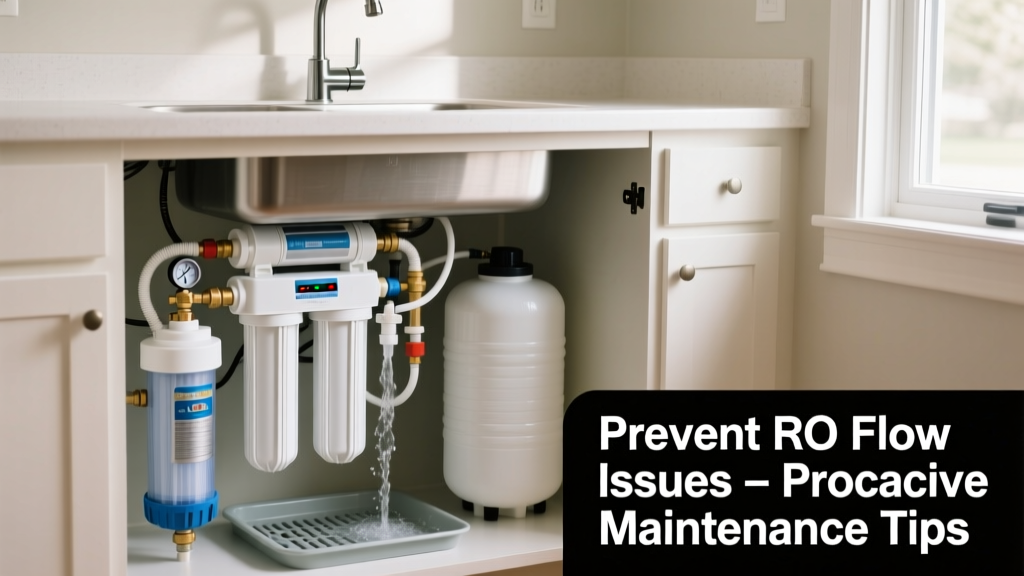
When your reverse osmosis system stops flowing—or trickles at a fraction of its rated output—it’s rarely a sudden failure. It’s the end result of months of unnoticed sediment buildup, neglected filter changes, or pressure imbalances. A stalled RO system doesn’t just mean inconveniently waiting for a glass of water: it can indicate compromised membrane integrity, bacterial growth in stagnant lines, or even backflow contamination risks. According to the Water Quality Association’s 2022 Residential RO Survey, 68% of service calls for low-flow RO units involved filters overdue by 3+ months.
Why This Happens
Low or no flow isn’t one problem—it’s a symptom cluster rooted in four primary causes. First, clogged pre-filters (especially the 5-micron sediment and carbon blocks) restrict feed water before it reaches the membrane. Second, fouled or scaled RO membranes—often from hard water with >170 ppm TDS—lose permeability over time. Third, low inlet pressure (<40 psi) starves the system; many homes with well water or older plumbing fall below this threshold without realizing it. Fourth, air-locked storage tanks or faulty check valves prevent proper pressurization or cause backflow that halts production.
- Sediment buildup in 5-micron polypropylene filter (most common cause of initial slowdown)
- Chlorine damage to thin-film composite (TFC) membranes due to exhausted carbon filter
- Calcium carbonate scaling on membrane surface in areas with unsoftened hard water
- Frozen or kinked tubing between tank and faucet—especially in garages or crawl spaces
Maintenance Checklist
| Frequency | Task | Notes |
|---|---|---|
| Daily | Check for visible leaks at fittings and drain saddle | Especially after winter thaw or pressure spikes |
| Weekly | Flush system for 15–20 minutes if unused >48 hrs | Prevents biofilm formation in idle membranes |
| Monthly | Inspect and wipe down storage tank air charge valve | Use a tire gauge; ideal pressure = 7–8 psi when empty |
| Yearly | Replace RO membrane & sanitize entire system | Even if flow seems fine—membrane efficiency drops 10–15% annually (NSF/ANSI 58, 2021) |
Warning Signs
Don’t wait for zero flow. These subtle indicators appear weeks in advance—and catching them early saves $200+ in service calls and extends membrane life by 2–3 years.
- Tank takes >4 hours to refill (normal: 2–3 hours for a 3.2-gallon tank)
- Faucet flow drops noticeably after first 2 cups (suggests membrane fatigue)
- Water tastes slightly sweet or musty—biofilm or degraded carbon media
- Pressure gauge (if installed) reads <35 psi at feed line during operation
Recommended Products
Not all replacement parts perform equally. Prioritize NSF-certified components designed for your system’s GPD rating and feed water profile.
- 5-micron sediment + coconut shell carbon combo cartridges (replaced every 6 months)
- Smart pressure gauges with low-pressure shutoff alerts (e.g., PureLine PL-PS1)
- Non-toxic membrane cleaner like KlearFilter RO-100 (for quarterly maintenance flushes)
- Butyl rubber bladder tanks—not butyl-free PVC—rated for potable water contact (ASTM D1248-22)
Can I increase flow without replacing the membrane?
Yes—if the membrane still has >75% rejection rate (test with a TDS meter). Install a booster pump (e.g., Shurflo 8000 series) to raise inlet pressure to 60–80 psi. But only do this after confirming pre-filters are fresh and feed water hardness is <250 ppm. Over-pressurizing a scaled membrane accelerates delamination.
Why does my RO flow fine for the first minute, then drop off?
This points to a partially restricted post-filter or air-bound storage tank. When the tank empties quickly, pressure plummets and flow collapses. Check tank air charge first—you’ll hear a hiss if it’s undercharged. If pressure is correct, replace the inline post-carbon filter; carbon fines often compact after initial use.
Does cold weather really affect RO flow?
Absolutely. At 40°F, RO production drops ~50% versus 77°F (standard test temperature per NSF/ANSI 58). That’s physics—not malfunction. Insulate feed lines in unheated spaces and avoid installing systems in garages below 45°F unless using a thermostatically controlled booster pump.
My system was working fine—then suddenly stopped. What’s most likely?
A failed check valve is the top culprit for abrupt stoppage. It allows backflow from the tank into the membrane, causing hydraulic lock. Replace it with a stainless-steel version (not plastic) during annual service. As
"Over 42% of 'sudden no-flow' cases in field diagnostics trace to check valve failure—especially in systems older than 3 years." — WaterTech Service Manual, Rev. 4.1 (2023)
Do whole-house water softeners help RO systems?
Yes—but only if they’re properly maintained. Softened water reduces scaling, but excess sodium can impact taste and membrane longevity. Use a dedicated softener bypass for the RO feed line, or install a salt-free conditioner like ScaleBlaster if your source water exceeds 10 gpg hardness. See our RO and water softener compatibility guide for setup diagrams.
Preventing RO flow failure isn’t about reacting to symptoms—it’s about respecting the system’s rhythm. Track filter dates on your fridge door, test tank pressure every month, and treat your membrane like a precision instrument, not a disposable part. A few minutes each month preserves clean, reliable water for years—and keeps your kitchen faucet flowing like new.