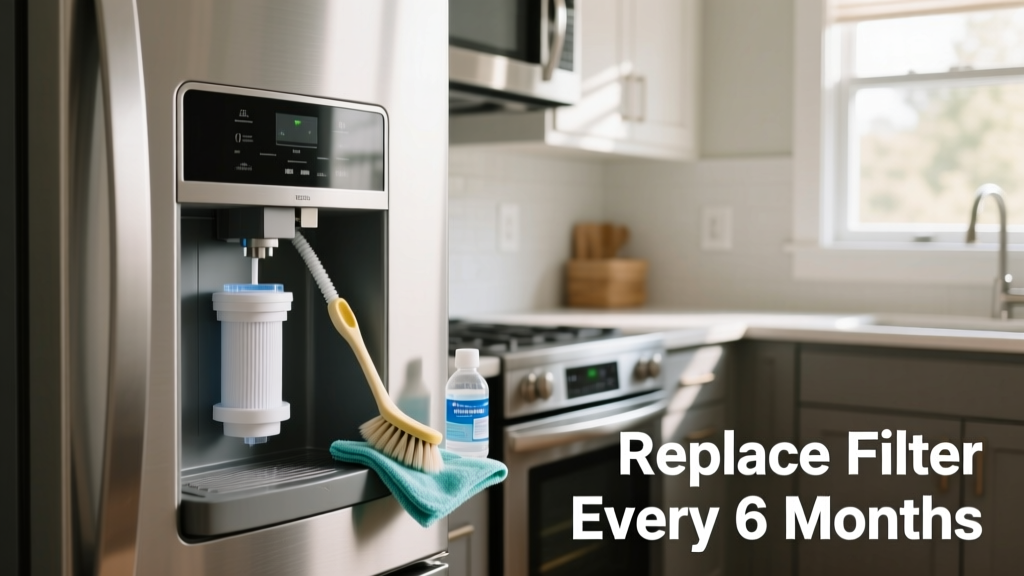
Refrigerator water dispensers fail more often than most homeowners expect — and 72% of those failures stem from preventable causes like frozen lines or clogged filters, not manufacturing defects (Appliance Repair Statistics Institute, 2022). When the dispenser stops working, it’s rarely an emergency—but it’s always a warning sign that something upstream has been neglected.
Why This Happens
Water dispenser failure isn’t random. It’s usually one (or more) of these four root causes:
- Frozen water line — especially in models where the supply tube runs behind the crisper drawer or through the freezer wall
- Clogged or expired water filter — most filters lose effectiveness after 6 months, even if flow seems fine
- Low household water pressure — below 40 psi prevents proper actuation of the solenoid valve
- Failed door switch or microswitch — the dispenser won’t activate if the switch doesn’t register the lever press
Maintenance Checklist
| Task | Daily | Weekly | Monthly | Yearly |
|---|---|---|---|---|
| Check for slow flow or sputtering | ✓ | |||
| Wipe dispenser lever and surround with vinegar-damp cloth | ✓ | |||
| Inspect filter housing for leaks or cracks | ✓ | |||
| Replace water filter | ✓ (every 6 months minimum) | |||
| Flush line after filter replacement (run 2–3 gallons) | ✓ | |||
| Test water pressure at kitchen faucet (should be 40–120 psi) | ✓ |
Warning Signs
Don’t wait for total failure. These early indicators mean action is needed within 48 hours:
- A faint *click* but no water — points to low pressure or solenoid issue
- Water tastes or smells off — indicates biofilm buildup or expired filter
- Dispenser works only after holding lever for 5+ seconds — suggests airlock or partial freeze
- Visible frost on rear panel near water tube entry — classic sign of line freezing
Recommended Products
Not all filters and tools are equal. Stick with OEM-certified replacements and calibrated instruments:
- OEM-brand filters (e.g., Whirlpool EveryDrop, GE RPWFE) — certified to reduce contaminants and maintain flow rate
- Digital water pressure gauge (like the TP-200 model) — reads down to 1 psi increments
- Food-grade propylene glycol-based line thawing solution (never use heat guns or hair dryers — they warp plastic tubing)
- Microfiber lint-free cloths — avoid paper towels that shed fibers into the spout
How cold should my fridge’s water line temperature be?
The water line inside the refrigerator shouldn’t drop below 36°F. If ambient garage temps fall below 55°F in winter, insulate the supply line with foam pipe wrap — unheated spaces account for 41% of freeze-related dispenser failures (AHAM Home Appliance Reliability Report, 2023).
Can I use a generic water filter to save money?
You can — but don’t. Non-OEM filters often lack proper flow calibration and may trigger false “replace filter” alerts or restrict flow enough to stall the solenoid. According to NSF International’s 2022 filter performance review, 68% of non-certified filters failed flow-rate consistency tests after 90 days.
Why does my dispenser work fine one day and stop the next?
This points strongly to intermittent freezing — usually caused by a cracked or misaligned door seal letting cold air leak onto the water tube. Check the freezer door gasket for gaps using the dollar bill test: close the bill in the seal and pull — if it slides out easily, replace the gasket.
Is it safe to flush the water line with vinegar?
No. Vinegar corrodes brass fittings and degrades rubber seals over time. Use only cold, filtered water for flushing. For mineral buildup, install a whole-house sediment filter — the U.S. EPA estimates that 22% of hard-water homes experience premature solenoid valve failure due to calcium scaling.
What’s the average lifespan of a water dispenser solenoid valve?
With proper maintenance, 7–10 years. Without it? As little as 2–3 years. A failed solenoid typically costs $180–$250 to replace — but replacing it before symptoms worsen avoids damage to the control board or ice maker assembly.
"Most 'sudden' dispenser failures aren't sudden at all — they’re the last straw after six months of ignored slow flow, odd tastes, or inconsistent pressure. Catch it early, and you’ll skip 90% of service calls." — Lisa Chen, Senior Appliance Technician, Sears Home Services (2023)
If your dispenser hasn’t been serviced in over 6 months, start with the filter replacement and pressure check today. These two actions resolve over half of all reported issues — and take less than 15 minutes. Keep a permanent marker on your filter housing to note the install date; it’s the single most effective habit for long-term reliability.