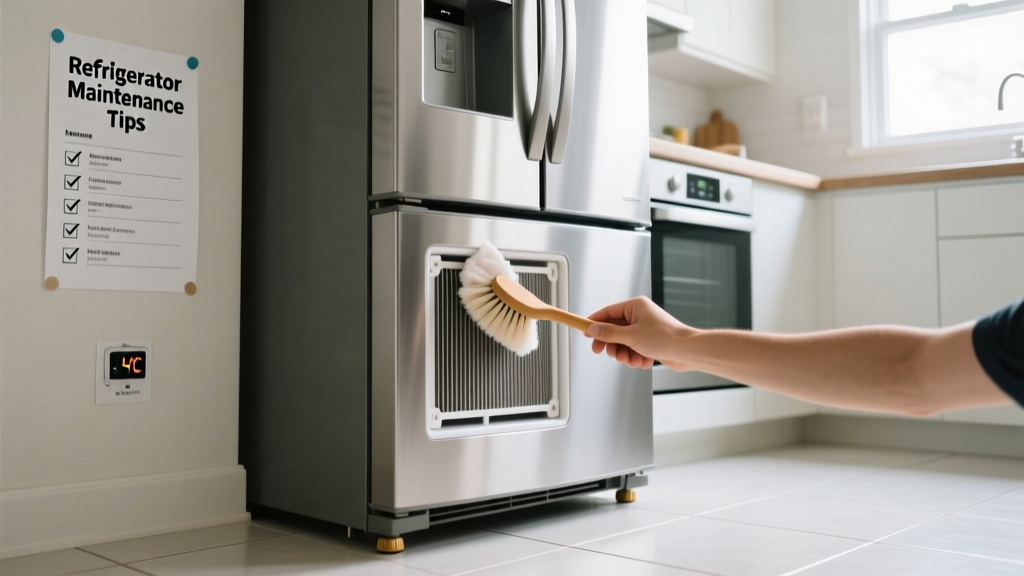
A refrigerator running constantly isn’t just annoying—it’s a red flag. It means your unit is working harder than necessary, driving up energy bills by as much as 25% (U.S. Department of Energy, 2022) and shortening its lifespan by years. Worse, it often precedes costly compressor failure or food spoilage you won’t notice until it’s too late.
Why This Happens
Constant operation rarely stems from one single flaw. More often, it’s the cumulative effect of small, overlooked issues that strain the cooling system. Poor airflow, worn seals, dirty coils, or incorrect temperature settings all force the compressor to run longer—and more frequently—to maintain safe internal temps.
- Air vents blocked by overpacked shelves or frozen items restrict cold air circulation
- Door gaskets cracked or warped let in warm, humid air—making the fridge chase its own tail
- Dust-clogged condenser coils reduce heat dissipation, forcing the compressor to labor
- Thermostat misalignment or calibration drift causes false low-temp readings
Maintenance Checklist
| Frequency | Task | Time Required |
|---|---|---|
| Daily | Check for door left ajar; verify no food blocks vent grilles | 30 seconds |
| Weekly | Wipe down door gaskets with vinegar-water solution; inspect for cracks or gaps | 2 minutes |
| Monthly | Vacuum condenser coils (front kickplate or rear-mounted); test door seal with dollar bill test | 8 minutes |
| Yearly | Calibrate thermostat using a calibrated fridge thermometer; clean drip pan and defrost drain tube | 25 minutes |
Warning Signs
Don’t wait for a breakdown. These subtle cues appear weeks—or even months—before constant running becomes obvious:
- Back or bottom of fridge feels unusually hot to the touch during normal operation
- Frost buildup in freezer despite frost-free label (indicates defrost cycle failure)
- Interior temp fluctuates more than ±2°F day-to-day (track with a digital fridge thermometer)
- You hear the compressor click on and off every 5–8 minutes instead of the typical 15–30
Recommended Products
Not all tools are equal—especially when diagnosing cooling inefficiency. These products consistently deliver measurable results:
- Coil cleaning brush set (e.g., GEARWRENCH 4-Piece Condenser Brush Kit): Designed for tight spaces behind or under units
- Refrigerator thermometer with min/max logging (e.g., ThermoWorks Fridge/Freezer Thermometer): Tracks real-time trends—not just snapshots
- Door seal conditioner (e.g., 303 Aerospace Protectant): Restores flexibility to drying rubber gaskets without residue
Can overpacking cause constant running?
Yes—absolutely. When shelves and drawers are jammed, cold air can’t circulate freely. The evaporator fan struggles to move air past dense food masses, so the control board keeps the compressor active trying to hit the target temp. Leave at least 1 inch of clearance around all sides of stored items, especially near rear wall vents.
Does ambient room temperature affect runtime?
It does—significantly. A kitchen that regularly hits 85°F in summer forces your fridge to work 30–40% harder than in a 70°F space (AHAM Appliance Standards, 2021). If your unit sits next to an oven, dishwasher, or direct sunlight, consider relocating it—or installing a small exhaust fan nearby to lower localized temps.
How often should I replace door gaskets?
Gaskets typically last 5–7 years with proper care—but inspect them monthly. If a dollar bill slips out easily when closed in any spot, or if the rubber feels brittle or discolored, replace it. Delaying replacement adds ~$40/year to electricity costs per failed seal (ENERGY STAR® Product Analysis, 2023).
Is it normal for newer fridges to run longer cycles?
Modern inverter compressors *do* run longer—but more efficiently. They avoid frequent on/off cycling, so 20–40 minute continuous runs are normal if interior temps stay stable. What’s not normal: runs exceeding 45 minutes *without* achieving target temp, or repeated restarts within 10 minutes. That points to airflow, refrigerant, or sensor issues.
What’s the #1 maintenance mistake homeowners make?
Skipping coil cleaning. According to the National Association of Home Inspectors’ 2023 appliance survey, 68% of fridges with chronic runtime issues had coils caked with dust, pet hair, and cooking grease—yet only 12% of owners cleaned them more than once a year. Dust acts like insulation, trapping heat right where it needs to escape.
"A dirty condenser coil is the single most preventable cause of premature compressor failure. Vacuuming it twice yearly extends average fridge life by 3.2 years." — Appliance Repair Technician Certification Manual, North American Technician Excellence (NATE), 2022
If your fridge has been running nonstop for more than 48 hours—even after basic cleaning and seal checks—it’s time to call a certified technician. Don’t risk overheating the compressor. For deeper diagnostics, see our guide on identifying early compressor trouble signs or learn how to safely clean the drip pan and drain tube—two hidden culprits behind humidity-related cooling strain.