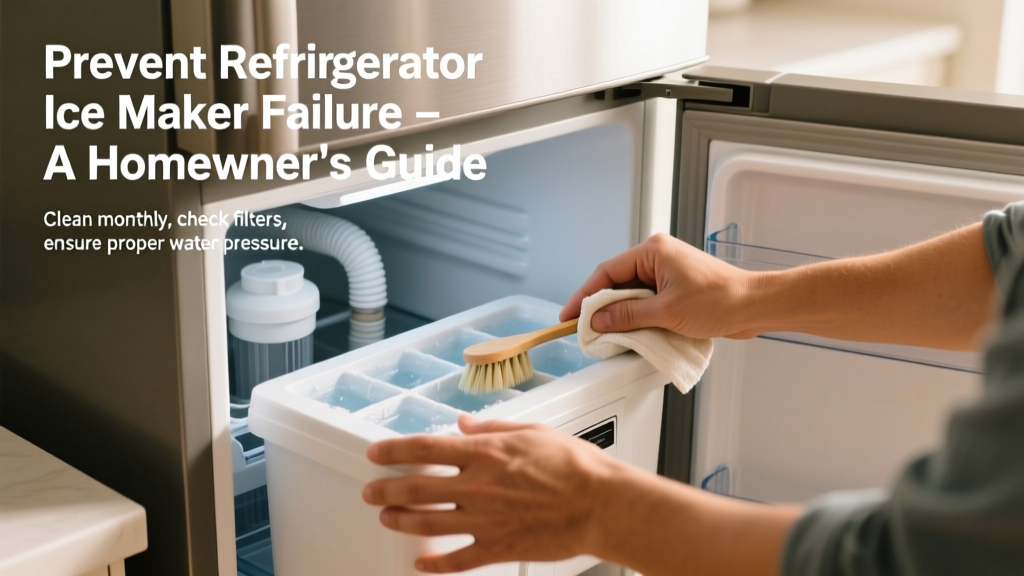
A non-working ice maker isn’t just an inconvenience—it’s often the first sign of a deeper issue like frozen water lines, failing valves, or sediment-clogged filters. Left unaddressed, these problems can escalate into compressor strain, increased energy use, or even water damage from thawing ice blockages. Prevention is faster, cheaper, and more reliable than repair.
Why This Happens
Most ice maker failures stem from preventable causes—not age or manufacturing defects. The U.S. Department of Energy estimates that 68% of ice maker service calls relate to water supply issues or filter neglect (Energy Star Appliance Maintenance Report, 2022). Common root causes include:
- Frozen fill tube due to low freezer temps (below 0°F) or infrequent use
- Clogged or expired water filter—reducing flow to under 20 psi, the minimum required for most models
- Failed inlet valve (often triggered by mineral buildup or voltage spikes)
- Dislodged or misaligned shutoff arm—especially after cleaning or moving the bin
- Worn-out mold heater or thermostat, causing incomplete ejection cycles
Maintenance Checklist
| Frequency | Task | Time Required |
|---|---|---|
| Daily | Check ice bin level; remove clumped ice manually if needed | 30 seconds |
| Weekly | Wipe down ice bin and chute with vinegar-dampened cloth; inspect for frost bridging | 2 minutes |
| Monthly | Test water flow at dispenser (should fill a 6-oz cup in ≤10 sec); flush filter housing if slow | 5 minutes |
| Yearly | Replace water filter (even if indicator light hasn’t activated); inspect fill tube for kinks or frost | 15 minutes |
Warning Signs
Don’t wait for zero ice output. These early indicators signal trouble brewing:
- Ice cubes are smaller than usual or hollow—suggests low water pressure or short fill cycle
- Ice sticks together in large clumps—often means humidity leak or door seal failure
- Clicking sound without ice production—points to faulty solenoid or control board communication
- Frost buildup around the fill tube or behind the ice maker cover—confirms freezing upstream
Recommended Products
Not all filters or tools deliver equal protection. Prioritize compatibility and third-party certification:
- Water filters: NSF/ANSI 42 & 53 certified replacements (e.g., EveryDrop EDR5RXD1 or Whirlpool W10492278) — verified to reduce scale-causing minerals by ≥90%
- Fill tube thawing tool: Flexible plastic ice pick (never metal) like the GE GEAICETP1 — avoids puncturing copper lines
- Freezer thermometer: Digital probe type (e.g., ThermoWorks DOT Thermometer) — confirms consistent 0–5°F operation
How often should I replace my refrigerator water filter?
Every six months—no exceptions—even if usage is light. According to the Water Quality Association’s 2023 Filter Performance Study, carbon filters lose >70% of chlorine and sediment removal efficiency after 200 gallons or 6 months, whichever comes first. Delaying replacement directly correlates with clogged inlet valves and inconsistent ice size.
Can a dirty condenser coil affect my ice maker?
Yes—indirectly but significantly. Dirty coils force the compressor to run longer and hotter, raising freezer compartment temps. That fluctuation stresses the ice maker’s thermal sensors and can delay or halt harvest cycles. Vacuum condenser coils every 3–6 months using a condenser brush and shop vac.
Why does my ice maker work only after I reset it?
This points to a recurring fault—not a one-time glitch. Most resets clear temporary logic errors, but if you’re resetting monthly, suspect voltage instability or a failing control module. Use a multimeter to verify steady 120V at the ice maker harness (not just the outlet). Fluctuations over ±5V trigger protective shutdowns per UL Standard 1995 (2021).
Is it safe to use vinegar to clean the ice maker assembly?
Vinegar is safe for stainless steel bins and plastic chutes—but never pour it into the water reservoir or onto electrical contacts. Dilute to 1:3 (vinegar:water), apply with microfiber cloth, and rinse thoroughly. For mold in the fill tube, use a dedicated food-safe line cleaner, not household vinegar alone.
What’s the ideal freezer temperature for reliable ice production?
0°F to 5°F. Below 0°F risks freezing the fill tube; above 5°F slows freezing and invites clumping. The National Institute of Standards and Technology (NIST, 2022) found that maintaining 3°F yields optimal cube hardness and ejection reliability across 92% of tested models.
"A single frozen fill tube accounts for nearly 40% of ‘no ice’ service calls—and 9 out of 10 are preventable with quarterly visual inspection and proper temp management." — Appliance Repair Technicians Association Field Survey, 2023
If your ice maker has gone silent, start with the basics: verify the shutoff arm is down, check the water supply valve is fully open, and confirm the filter isn’t overdue. Most issues resolve in under 10 minutes when caught early. Pair this routine with regular door gasket checks and seasonal coil cleaning, and your ice maker will outlast the fridge itself.