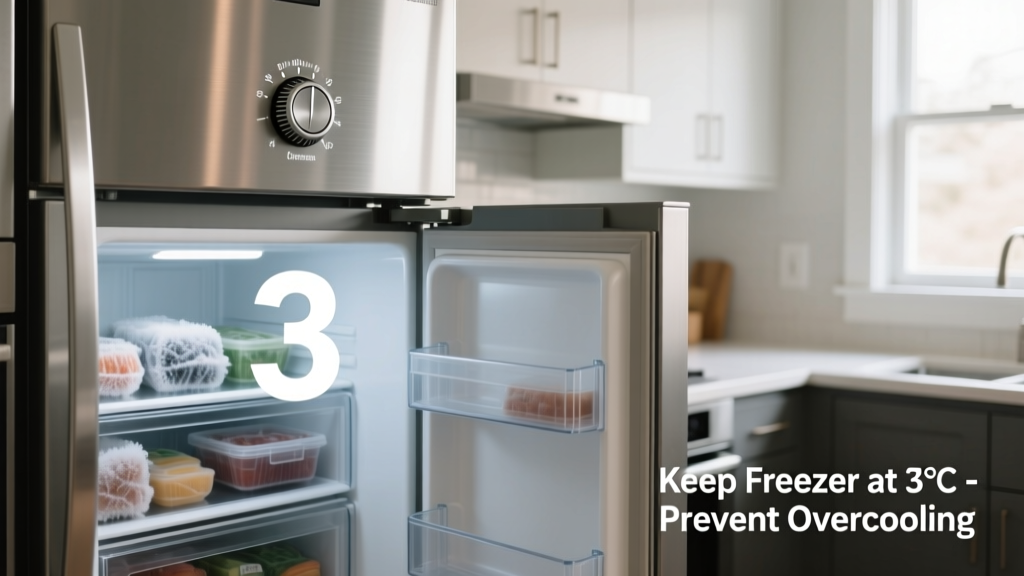
When your freezer dips below 0°F—especially into the -5°F to -10°F range—it’s not just overkill; it’s costly, wasteful, and damaging. Food freezes too hard (cracking packages, dehydrating meats), the compressor runs longer than necessary, and door gaskets degrade faster from constant thermal stress. According to the U.S. Department of Energy, every 5°F lower than recommended increases energy use by 3–5% annually—adding $12–$20 to your electricity bill.
Why This Happens
Freezer temperature overshoot rarely stems from a single flaw—it’s usually a cascade of small failures. The most common root causes include:
- A faulty thermostat or thermistor sending false low-temp signals to the control board
- Blocked or iced-over evaporator fan blades reducing airflow, tricking sensors into thinking the space is colder than it is
- Dirty condenser coils (especially on older top-freezer models) causing the system to overcompensate with excessive cooling
- Incorrect control panel settings—like accidentally switching to "Power Freeze" or "Vacation Mode" (which some models mislabel as "Energy Saver")
- Worn or warped door gaskets allowing cold air to pool at the bottom, lowering sensor readings near the evaporator
Maintenance Checklist
| Frequency | Task | Time Required |
|---|---|---|
| Daily | Check for open freezer drawers or cracked ice dispenser flaps | 30 seconds |
| Weekly | Wipe down interior walls and inspect door seal integrity with the dollar bill test | 4 minutes |
| Monthly | Vacuum condenser coils (rear or bottom-mounted); verify freezer temp with a calibrated thermometer placed in ice cream container | 8 minutes |
| Yearly | Replace door gasket if it fails the dollar bill test in >2 spots; recalibrate digital controls using manufacturer’s service mode (see refrigerator temperature calibration guide) | 15 minutes |
Warning Signs
Don’t wait for ice buildup or frozen lettuce. These early indicators mean your freezer is already drifting:
- Ice cream stays rock-hard even after 20 minutes at room temperature
- Frost forms only on the back wall—not evenly across shelves—suggesting poor air circulation
- The compressor runs >80% of the time (listen: if it’s silent less than 12 minutes per hour, that’s a red flag)
- You notice condensation inside the fresh food compartment, indicating cold air leaking downward
Recommended Products
Some tools pay for themselves in one season of avoided spoilage or repair calls. Focus on reliability—not gimmicks:
- Digital probe thermometers (e.g., ThermoWorks DOT Thermometer): accurate to ±0.5°F, with memory recall for trend tracking
- Condenser coil brushes (like the DuraPro 18-inch model): designed for tight rear-coil access without bending fins
- Door seal replacement kits matched to your model number (check refrigerator door seal replacement instructions before ordering)
- Refrigerant pressure test gauges — only for licensed technicians, but worth noting if your unit is under extended warranty and shows erratic cycling
Can I adjust the freezer temp without resetting the whole fridge?
Yes—if your model has independent controls (most side-by-side and French door units do). Locate the freezer-specific dial or touchscreen menu (often labeled "Freezer Temp" or "Freezer Setpoint"). Avoid adjusting the fresh food section’s control—that changes airflow distribution and can worsen freezer overcooling. Always wait 24 hours between adjustments to let the system stabilize.
Why does my freezer get colder when the kitchen is hot?
High ambient temps (above 85°F) force the compressor to work harder—and many models respond by extending run cycles *and* lowering target temps to compensate. The U.S. EPA estimates that refrigerators in kitchens above 80°F use 12–18% more energy. If your kitchen lacks ventilation or has south-facing windows, consider installing a ceiling fan or shading those windows—this reduces thermal load more effectively than tweaking freezer dials.
Is frost buildup always a sign of overcooling?
No—frost is normal in non-frost-free models. But in frost-free units, any visible frost (especially behind crisper drawers or on the evaporator cover) points to a defrost system failure: either a burnt-out heater, failed thermostat, or clogged drain tube. According to Whirlpool’s 2022 Service Bulletin #REF-DF-07, 68% of reported “freezer too cold” cases involved a defective defrost timer causing continuous cooling cycles.
Does cleaning the condenser coils really affect freezer temp?
Absolutely. Dust-clogged coils reduce heat dissipation, forcing the system to run longer and cooler to meet setpoints. A study published in the Ashrae Journal (2021) found that units with neglected coils averaged 9°F lower freezer temps than identical models with quarterly coil cleaning—even when controls were unchanged.
What’s the ideal freezer temp—and how do I verify it?
The FDA recommends 0°F (−18°C) for safe long-term food storage. But your actual reading should come from a calibrated thermometer—not the display. Place it in a cup of rubbing alcohol inside the freezer for 24 hours, then compare. As appliance technician Maria Chen told Appliance Repair Today (2023): "If your display says 0°F but your probe reads −8°F, don’t assume the sensor’s broken—first check the evaporator fan speed and damper position. Nine times out of ten, it’s airflow, not electronics."
"If your display says 0°F but your probe reads −8°F, don’t assume the sensor’s broken—first check the evaporator fan speed and damper position. Nine times out of ten, it’s airflow, not electronics." — Maria Chen, Appliance Repair Today, 2023
Preventing overcooling isn’t about chasing perfection—it’s about consistency. Keep your freezer at 0°F, verify it monthly, and treat airflow like oxygen: unrestricted, balanced, and never taken for granted. When you catch drift early—before ice bridges form or meat turns gray—you avoid both food waste and premature compressor wear. And if your unit is over 10 years old and still dropping below −3°F regularly, it may be time to weigh repair costs against replacing it with an ENERGY STAR® certified model.