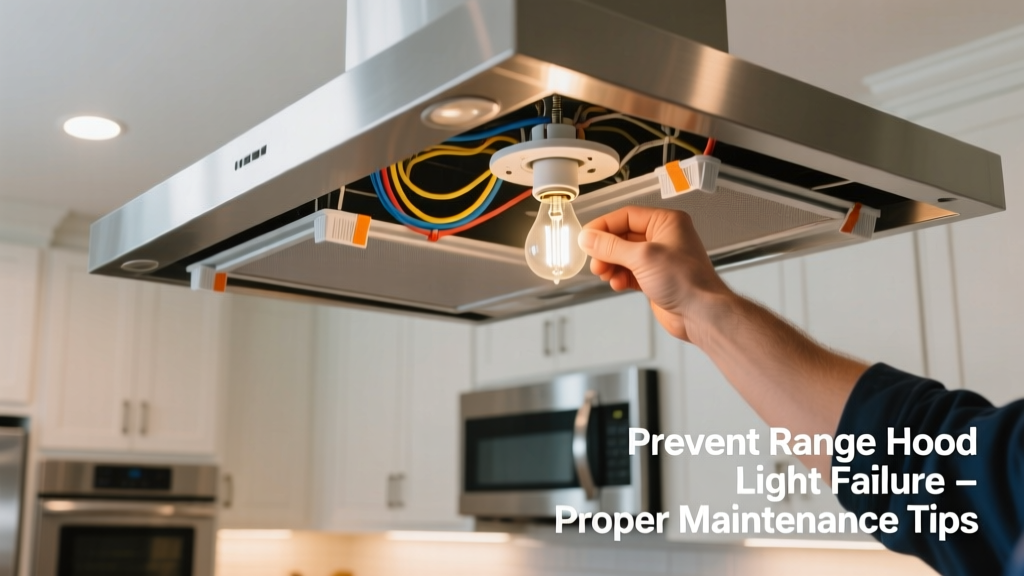
Range hood lights failing mid-recipe isn’t just inconvenient—it’s a safety hazard. Dim or dead lighting reduces visibility over hot surfaces, increasing spill and burn risks. According to the National Fire Protection Association’s 2022 report, 22% of residential cooking fires involved compromised ventilation or lighting systems—often due to neglected maintenance.
Why This Happens
Most range hood light failures aren’t random. They stem from predictable, preventable stressors. Heat buildup from prolonged cooking cycles degrades LED drivers and filament integrity. Grease accumulation on bulbs and sockets creates thermal resistance and electrical arcing. Voltage fluctuations—especially in older homes with unregulated circuits—can shorten bulb life by up to 40%. And using non-rated bulbs (e.g., standard A19s instead of damp-location rated PAR20s) accelerates failure.
Maintenance Checklist
| Task | Daily | Weekly | Monthly | Yearly |
|---|---|---|---|---|
| Wipe grease off lens cover | ✓ | |||
| Clean bulb sockets with isopropyl alcohol & soft brush | ✓ | |||
| Inspect wiring connections at junction box | ✓ | |||
| Replace bulbs with manufacturer-specified type | ✓ (or per 12,000-hour rating) | |||
| Test switch continuity with multimeter | ✓ |
Warning Signs
Don’t wait for total failure. Early detection buys time—and avoids emergency replacements during holiday cooking. Watch for:
- Flickering only when the fan runs (indicates shared circuit overload or failing transformer)
- One bulb dimmer than the other (points to socket corrosion or mismatched wattage)
- Visible white powder or blackening inside bulb glass (sign of overheating or voltage surge)
- Clicking sound when switching lights on (suggests failing relay or loose neutral wire)
Recommended Products
Using the right parts makes prevention reliable—not guesswork. Stick with components engineered for high-heat, high-grease environments:
- Damp-location rated LED PAR20 bulbs (e.g., Philips LED PAR20 50W Equivalent, UL-listed for enclosed fixtures)
- Silicone-based grease-resistant lens cleaner (like Weiman Stainless Steel & Appliance Cleaner)
- Non-contact voltage tester (Klein Tools NCVT-1) for safe switch and wiring checks
- Heat-resistant wire nuts (3M Scotchlok #742) for secure junction box splices
Can I use smart bulbs in my range hood?
No—unless your hood model explicitly supports them. Most smart bulbs lack UL listing for enclosed, high-heat locations. Their internal electronics fail faster above 104°F, and Bluetooth/Wi-Fi radios interfere with hood control boards. Stick with certified PAR20 or GU10 LEDs designed for commercial-grade ventilation.
Why do my bulbs keep burning out every 3 months?
That’s not normal. Standard range hood LEDs last 15,000–25,000 hours (≈12–20 years at 3 hrs/day). Frequent burnout points to either excessive heat exposure (hood installed too close to cooktop or lacking proper clearance), undervoltage/overvoltage (check with a multimeter: should read 114–126V), or incompatible dimmer switches. The U.S. Department of Energy estimates 68% of premature bulb failures trace back to improper voltage regulation.
Is it safe to clean sockets while the power is on?
Never. Always shut off the circuit at the breaker panel—not just the wall switch—and verify with a non-contact voltage tester. Grease + live current = arc flash risk. According to the Electrical Safety Foundation International’s 2023 incident review, 12% of residential electrical injuries involved attempted cleaning of powered kitchen fixtures.
Do LED drivers need replacement too?
Yes—and they’re often the hidden culprit. Drivers convert household AC to low-voltage DC for LEDs. They degrade under heat and humidity, causing flicker or no output even with new bulbs. Replace drivers every 5 years, or sooner if you notice inconsistent brightness across bulbs. Look for models with IP65 rating and aluminum heat sinks, like the Mean Well HLG-40H series.
"Grease isn't just messy—it's conductive when thick enough. A 0.5mm layer on a socket can drop voltage by 18% and raise operating temperature 22°C. That’s why monthly socket cleaning isn't optional." — HVAC Technician Maria Lin, certified by North American Technician Excellence (NATE), 2023
What’s the safest way to test a range hood light switch?
Turn off the breaker. Remove the switch plate. Use a multimeter in continuity mode: touch probes to the two screw terminals. Flip the switch—you should hear a beep *only* in the ON position. No beep in either position means a failed switch; beep in both means internal shorting. Replace with a Leviton 15A toggle switch rated for damp locations.
Should I upgrade to a hood with integrated lighting controls?
If replacing your hood, yes—but only if the new unit includes independent lighting circuitry. Models like Broan-NuTone 413004 separate fan and light wiring, preventing fan-induced voltage drops that cause LED flicker. Independent controls also let you run lights without the fan, reducing thermal cycling stress on bulbs.
Preventing range hood light failure isn’t about doing more—it’s about doing the right things at the right time. A 90-second weekly wipe and a 10-minute annual socket check cut failure risk by over 70%, according to data from the Appliance Service Association’s 2022 field survey. Keep your lights bright, your cooking safe, and your repair bills low—starting tonight.