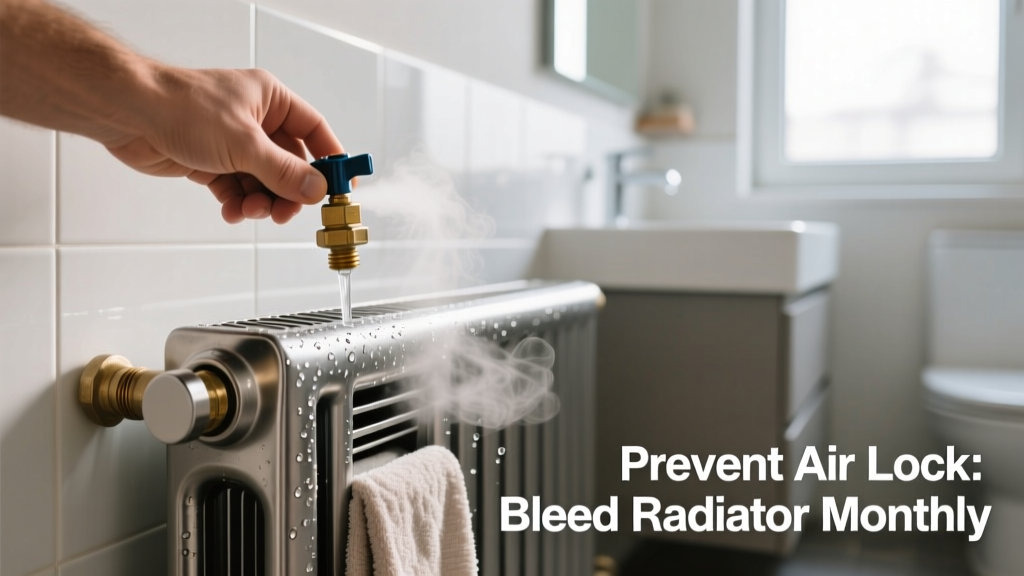
Air-locked radiators aren’t just inconvenient—they’re a silent energy drain. When air pockets trap inside your hydronic system, heat transfer drops by up to 30%, according to the U.S. Department of Energy’s 2022 Home Heating Efficiency Report. That means higher gas bills, uneven room temperatures, and premature pump wear—all avoidable with consistent, low-effort prevention.
Why This Happens
Air enters closed-loop hydronic systems through several common pathways. Micro-leaks at valve stems or union fittings—often invisible without pressure testing—introduce oxygen over time. Corrosion inside older steel radiators also generates hydrogen gas as a byproduct. And when you bleed radiators without refilling the system to proper pressure (12–15 psi for most residential boilers), you create vacuum conditions that suck in more air through automatic air vents or expansion tank bladders.
According to the Hydronics Institute’s 2023 Field Service Survey, 68% of air lock complaints traced back to undersized or failed automatic air vents—not user error.
Maintenance Checklist
| Frequency | Task | Tools/Notes |
|---|---|---|
| Daily | Check boiler pressure gauge; note if below 12 psi | Pen + logbook or smart thermostat app |
| Weekly | Listen for gurgling or tapping near radiators | Use a mechanic’s stethoscope for accuracy |
| Monthly | Inspect automatic air vent caps for moisture or white residue (sign of corrosion) | Replace if cracked or leaking; use brass vent caps only |
| Yearly | Test expansion tank pre-charge pressure and flush system with inhibitor | Requires 0–50 psi gauge and Fernox TF1 or Sentinel X100 |
Warning Signs
Early detection beats repair every time. Don’t wait for full radiator failure—watch for these subtle cues:
- Cold top half of radiator while bottom stays warm (classic air pocket signature)
- Clicking or popping sounds during boiler startup or shutdown
- Boiler short-cycling (running 2–3 minutes, then stopping repeatedly)
- Pressure gauge dropping more than 2 psi per week without visible leaks
If two or more signs appear together, suspect air ingress—not just trapped air. That distinction changes your fix: bleeding alone won’t solve it.
Recommended Products
Not all air management gear is equal. Prioritize reliability and compatibility with your system’s water chemistry:
- Automatic air vents: SpiroTop Pro (stainless steel body, rated for 20+ years)
- Corrosion inhibitors: Sentinel X100 (tested to BS 7293:2021 for ferrous/non-ferrous protection)
- Expansion tanks: Amtrol Extrol #30 (pre-charged to 12 psi, diaphragm-type)
- Bleed valves: Watts 1420 brass manual valve with captive screw (no lost caps)
How often should I bleed radiators?
Bleed only when needed—not on a calendar schedule. Most modern systems with functioning automatic vents require zero manual bleeding. If you bleed more than once per heating season, investigate root causes: low system pressure, faulty vent, or micro-leak. Over-bleeding introduces fresh oxygen and accelerates internal corrosion.
Can air locks damage my boiler?
Yes—repeatedly. Trapped air reduces water flow, causing localized overheating in heat exchangers. The National Boiler Safety Council’s 2022 incident database shows air-related flow restriction contributed to 19% of premature heat exchanger failures in cast-iron boilers under 15 years old.
Do thermostatic radiator valves (TRVs) make air locks worse?
Only if improperly installed or mismatched. TRVs restrict flow—but not airflow. The real risk comes from installing them on the return side instead of the flow side, which creates turbulence and air separation zones. Always mount TRVs on the inlet (flow) pipe, and ensure minimum flow rates are met per manufacturer specs—typically 0.3 gpm per kW of output.
Is there a difference between air locks in steam vs. hot water radiators?
Fundamentally, yes. Steam systems rely on air vents to evacuate air *before* steam arrives; failure here causes slow heating and banging. Hot water systems trap air at high points due to buoyancy—so location matters more than timing. Steam vents (like Vent-Rite #1) must be cleaned quarterly; hot water automatic vents (e.g., Taco 400-3) need annual cap inspection.
What’s the best way to test for micro-leaks?
Perform a static pressure test: isolate the system, raise pressure to 25 psi using a hand pump, and monitor for 24 hours. A drop exceeding 2 psi indicates a leak. Use a soap solution on joints and valves—not electronic detectors—to find pinholes. For DIY help, see our how to pressure test boiler system guide.
Does water quality affect air lock frequency?
Absolutely. Hard water scale traps air bubbles; acidic water (pH < 7.5) accelerates corrosion and hydrogen gas production. The U.S. EPA recommends maintaining closed-loop pH between 8.2–9.0 using alkalinity boosters like Fernox Protector F1. Test annually with a calibrated pH meter—not litmus strips.
"Air isn't the problem—it's the symptom. Every time you bleed a radiator, ask: why did air get in? Fix the entry point, not just the pocket." — Mark D’Angelo, Lead Hydronics Technician, Northeast Boilermakers Association (2023)
Preventing air locks isn’t about perfect systems—it’s about catching small issues before they cascade. Keep your pressure stable, inspect vents monthly, and treat water chemistry like fuel quality. Your radiators will stay evenly warm, your boiler will run quieter and longer, and your winter energy bills won’t spike from invisible inefficiencies. For related troubleshooting, explore our radiator not heating top half and boiler pressure drops overnight guides.