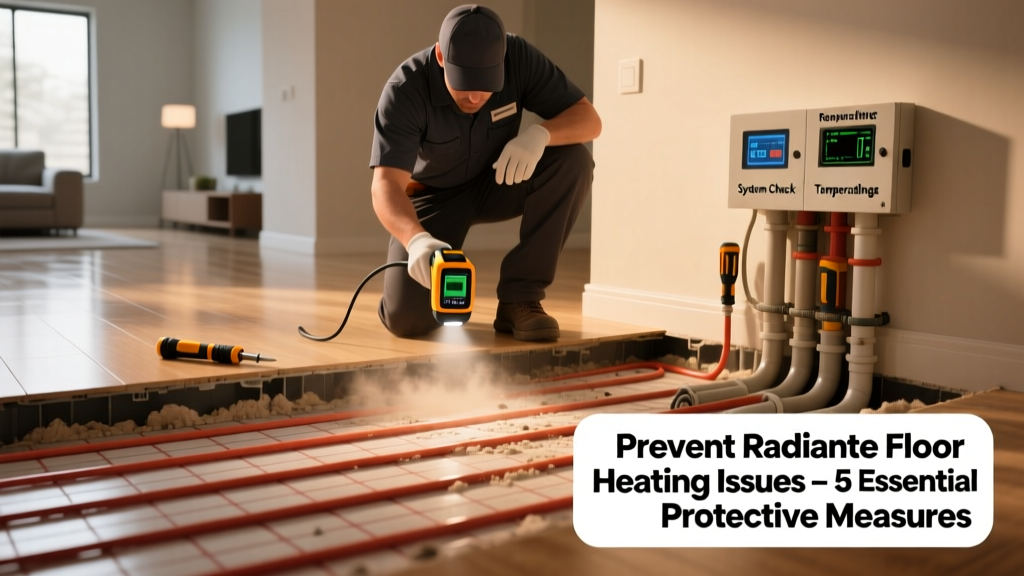
Radiant floor heating delivers quiet, even warmth—but when it fails, the problem is rarely sudden. More often, it’s the result of months or years of overlooked maintenance: a clogged manifold filter, a slowly degrading thermostat sensor, or air trapped in hydronic loops. Left unchecked, these issues escalate into full system shutdowns during sub-zero weather—when you need heat most. Prevention isn’t just convenient; it’s how you protect your investment and avoid emergency service calls costing $250–$450 per visit (National Association of Home Builders, 2023).
Why This Happens
Most radiant floor heating failures stem from preventable root causes—not manufacturing defects. Hydronic systems suffer most from airlocks and sediment buildup, while electric mats degrade due to moisture intrusion or improper subfloor prep. Thermostat misplacement (e.g., mounted near a drafty window) or uncalibrated sensors account for nearly 30% of reported 'no heat' complaints, according to the Radiant Professionals Alliance’s 2022 field survey.
- Air trapped in PEX tubing loops (hydronic only)
- Calcium and iron oxide deposits clogging manifold valves or boiler heat exchangers
- Failed or drifting temperature sensors—especially in older programmable thermostats
- Moisture damage to electric heating cables beneath tile or stone
- Improperly balanced zone valves causing uneven flow distribution
Maintenance Checklist
| Task | Daily | Weekly | Monthly | Yearly |
|---|---|---|---|---|
| Check boiler pressure (hydronic) | ✓ | |||
| Inspect thermostat display & setpoint accuracy | ✓ | |||
| Flush manifold filter (hydronic) | ✓ | |||
| Bleed air from highest loop valve | ✓ (if cold spots appear) | |||
| Test GFCI outlets powering electric mats | ✓ | |||
| Professional system flush & inhibitor test | ✓ |
Warning Signs
Don’t wait for total failure. These early indicators mean action is needed within days—not weeks:
- Cold zones that don’t respond to thermostat adjustments
- Gurgling or hissing sounds from floor or manifold cabinet
- Thermostat showing correct setpoint but floor surface staying below 70°F after 90 minutes
- Boiler cycling on/off more than 8 times per hour (check via aquastat log)
- Visible discoloration or warping of tile above electric mat areas
"If your hydronic system’s supply-return delta-T drops below 15°F during normal operation, it’s almost always an airflow or flow-rate issue—not a boiler problem." — Jim O’Leary, RPA Certified Hydronics Trainer, 2023
Recommended Products
Use only components rated for radiant applications. Generic plumbing parts or HVAC thermostats lack the precision and durability needed.
- Manifold filters: Taco FloChek™ with 50-micron stainless mesh (reusable, NSF-certified)
- Thermostats: Warmup 4iE Smart Thermostat (Wi-Fi enabled, floor sensor calibration mode)
- Boiler additives: Fernox Protector F1 (tested for PEX compatibility; extends fluid life to 10+ years)
- Electric mat testers: Fluke 1587 FC Insulation Multimeter (measures continuity and ground-fault resistance)
How often should I bleed my hydronic system?
Bleed only when cold spots appear—or proactively every 3 months during heating season. Over-bleeding introduces oxygen, accelerating corrosion. Use a digital pressure gauge to confirm system stays between 12–20 psi post-bleed. For homes above 5,000 ft elevation, target the lower end of that range.
Can I use a standard multimeter to test electric radiant cables?
No. Standard multimeters can’t detect micro-fractures or insulation breakdown under load. You need a megohmmeter (like the Fluke 1587 FC) to measure resistance-to-ground at 500V DC. Readings below 1 MΩ indicate compromised cable integrity—and require replacement, not repair.
What’s the best way to clean a clogged manifold filter?
Remove the filter cartridge and soak it in white vinegar for 20 minutes, then scrub gently with a nylon brush. Rinse thoroughly with distilled water—tap water leaves mineral residue. Replace cartridges annually if your water hardness exceeds 7 gpg (grains per gallon), per EPA water hardness guidelines (2022).
Does radiant floor heating need annual professional servicing?
Yes—if you have a hydronic system. The U.S. Department of Energy recommends certified hydronics technicians perform a full flush, inhibitor level check, and flow balancing every 12 months. Electric systems require less frequent visits, but a licensed electrician should verify GFCI function and circuit load every other year.
Why does my floor heat unevenly even though the thermostat reads correctly?
That’s usually a zoning or flow issue—not a thermostat fault. Check if zone valves are fully opening (listen for a soft 'clunk' when activated). Also inspect for furniture blocking heat dispersion: area rugs with dense rubber backings reduce radiant output by up to 40%, per the Radiant Panel Association’s 2021 thermal testing report. Move rugs or switch to low-pile wool or jute options.
Prevention pays off in comfort, control, and cost savings. A single annual hydronic flush costs $180–$220—far less than replacing a corroded heat exchanger ($1,200+) or tearing up floors to access damaged electric cables. Stay ahead of the chill by treating your radiant system like the precision network it is—not just ‘pipes under the floor.’