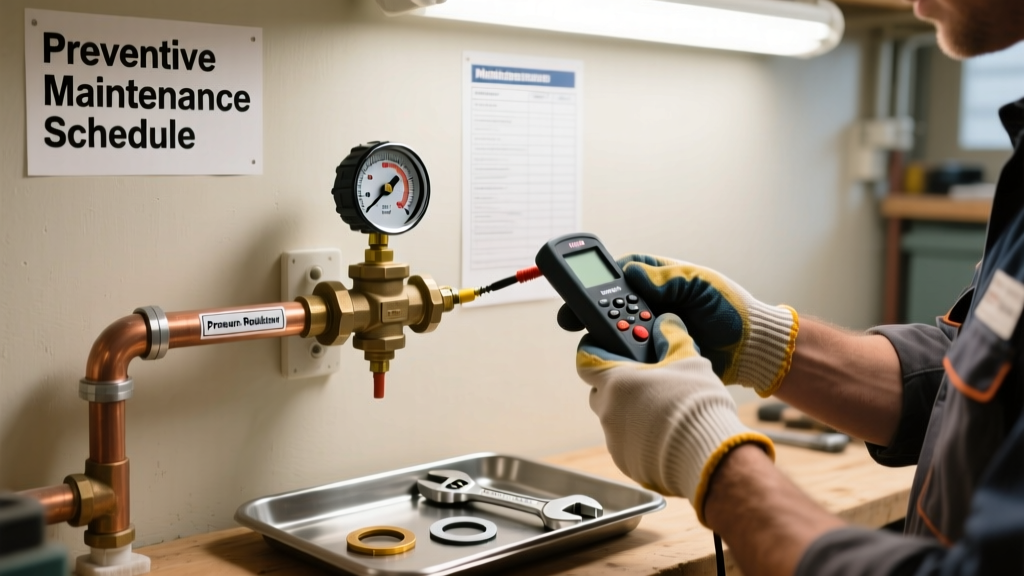
A failed pressure reducing valve (PRV) doesn’t just cause annoying low or high water pressure—it can burst supply lines, wreck water heaters, and trigger insurance-claim-worthy leaks. According to the Insurance Institute for Business & Home Safety's 2023 report, 22% of residential water damage claims involve undetected PRV malfunction or age-related failure.
Why This Happens
PRVs fail due to predictable wear patterns—not random breakdowns. Internal diaphragms fatigue after 10–15 years; sediment clogs the pilot orifice; and sustained high inlet pressure (above 80 psi) accelerates spring degradation. Chlorine and hard water scale also corrode brass components faster in homes with municipal water above 120 ppm hardness.
- Sediment buildup from unfiltered incoming water
- Thermal cycling stress on rubber diaphragms (especially near water heaters)
- Improper installation—like omitting upstream shut-off valves or strainers
- Exposure to freezing temperatures without insulation
Maintenance Checklist
| Frequency | Task | Tools/Notes |
|---|---|---|
| Daily | Check for wet spots or mineral crust near valve body | None—visual only |
| Weekly | Test downstream pressure with a gauge at cold kitchen faucet | Accurate 0–120 psi gauge (e.g., digital gauge with NPT thread) |
| Monthly | Flush strainer screen (if equipped) and inspect for debris | Small wrench + soft brush; replace screen if pitted |
| Yearly | Replace diaphragm kit and recalibrate pressure setting | Manufacturer-specific kit (e.g., Watts 909-120 for 60 psi models) |
Warning Signs
Don’t wait for total failure. Early symptoms are measurable—and fixable—with prompt action.
- Pressure fluctuates more than ±5 psi when multiple fixtures run simultaneously
- Hot water heater relief valve drips regularly (often misdiagnosed as thermal expansion)
- Hissing or vibrating noise from the PRV during water use
- Water pressure reads below 40 psi or above 75 psi consistently at the main cold line
"If your PRV is over 12 years old and you’ve never replaced the diaphragm, assume it’s operating at 60% efficiency—even if pressure seems normal." — John R. Lee, Master Plumber, Plumbing Code Institute Annual Seminar (2022)
Recommended Products
Not all PRVs are equal—and not all accessories are optional. These reduce long-term risk:
- Upstream sediment filter: 5-micron pleated stainless steel (e.g., Pentair FLEXX 5M) prevents grit from reaching the PRV pilot
- Pressure-regulating expansion tank: Required where thermal expansion occurs (e.g., Rheem XE50T12SHE); balances system stress
- Smart pressure monitor: Like the Phyn Plus, which alerts at >3 psi/hour drift—catching slow creep before failure
Can I test my PRV without a pressure gauge?
Yes—but less precisely. Turn off all water-using appliances, then open a cold faucet fully. If flow starts strong but drops within 5 seconds, suspect PRV restriction. Compare that faucet to one downstream of the PRV (e.g., basement sink) and one upstream (if accessible)—a 20+ psi difference indicates failure. For accuracy, always verify with a gauge.
Does water softener use increase PRV failure risk?
Yes—softened water increases conductivity and accelerates electrochemical corrosion inside brass PRVs. The Water Quality Association’s 2021 Corrosion Study found PRVs in softened systems failed 37% sooner than in untreated wells or municipal supplies. Install dielectric unions and inspect annually if using salt-based softening.
What’s the right pressure setting for my home?
Most homes need 50–60 psi. Set higher only if you have a two-story home with poor upper-floor flow *and* verified static pressure ≥75 psi upstream. Never exceed 70 psi—per ASSE 1003 standards, that’s the max safe setting for residential fixtures. Over-pressurizing stresses toilets, washing machines, and PEX tubing.
Is DIY PRV replacement safe?
Only if you’ve isolated and drained the system correctly. A single missed step—like forgetting to relieve pressure from the water heater—can cause scalding steam or pipe rupture. We recommend hiring a licensed plumber for replacement, but DIYers can safely handle diaphragm kits and strainer cleaning using this step-by-step guide.
Do PRVs require backflow prevention?
Yes—if installed downstream of a cross-connection (e.g., irrigation tie-in or fire sprinkler). Per the 2021 Uniform Plumbing Code Section 608.3, a reduced-pressure principle (RP) backflow preventer must be upstream of any PRV serving mixed-use systems. Skip it, and you risk contaminating potable lines during backpressure events.
Preventing PRV failure isn’t about waiting for trouble—it’s about treating your home’s pressure regulation like brake pads: replace proactively, monitor regularly, and never ignore early feedback from the system. With consistent checks and smart upgrades, most PRVs last 15+ years without incident—and keep your pipes, fixtures, and insurance deductible intact.