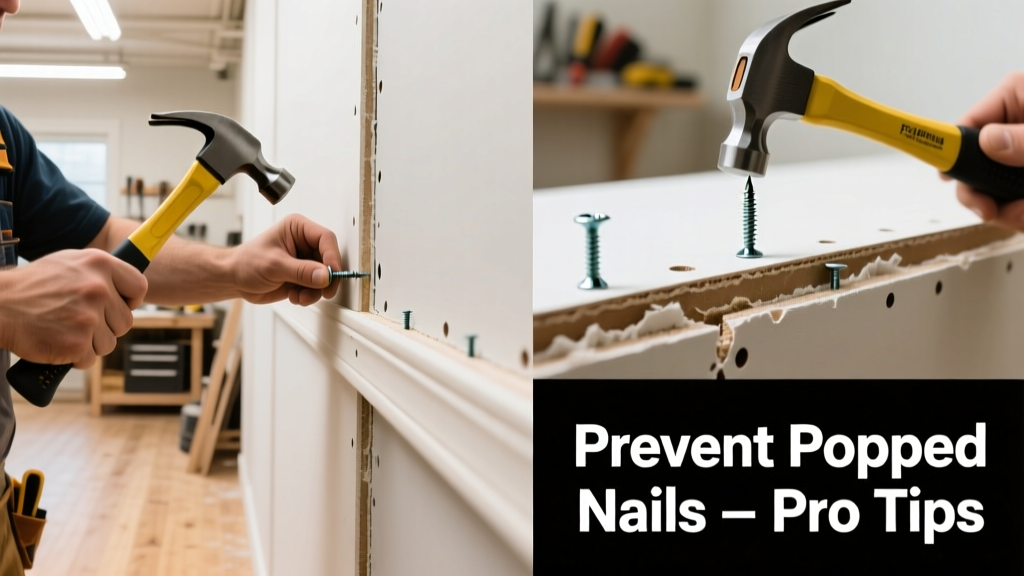
Popped nails—those small, unsightly bumps or dimples where a nail head pushes through drywall or trim—are more than just an eyesore. Left unaddressed, they signal underlying stress in your home’s framing or fastening system, and repeated popping can lead to cracking, moisture trapping, and costly repairs down the line. According to the National Association of Home Builders’ 2022 Residential Construction Performance Guidelines, nearly 68% of drywall-related warranty claims involve nail pops linked to seasonal wood shrinkage or improper installation.
Why This Happens
Nail pops occur when the fastener loses grip or the surrounding material moves relative to the nail. The most common triggers aren’t random—they’re predictable, measurable, and often preventable.
- Wood framing shrinkage: Freshly milled lumber (especially studs with >19% moisture content) dries over time, pulling away from drywall and allowing nails to shift upward.
- Thermal expansion/contraction: Seasonal temperature swings cause framing members to expand and contract at different rates than drywall or fasteners—especially problematic in attics and garages.
- Improper fastener depth: Nails driven too shallow (not flush or slightly countersunk) lack holding power; those driven too deep can fracture gypsum board backing.
- Vibration and load shifts: Heavy foot traffic on upper floors, HVAC cycling, or nearby construction can jostle framing enough to loosen marginal fasteners.
Maintenance Checklist
| Frequency | Action | Where to Focus |
|---|---|---|
| Daily | Check for new dimples or raised spots while dusting or vacuuming walls | High-traffic hallways, stairwells, and near exterior doors |
| Weekly | Inspect baseboards and crown molding for gaps or bulges | Rooms with large windows or exterior walls |
| Monthly | Verify attic access hatch is sealed and insulation isn’t compressing top plates | Attic framing near roofline and wall intersections |
| Yearly | Hire a qualified inspector to assess framing moisture content (target: ≤15%) and fastener integrity | All load-bearing walls and second-floor joist connections |
Warning Signs
Don’t wait for paint to crack or a nail head to pierce the surface. Early detection saves time and materials.
- A faint, circular depression in drywall—no visible metal, but light reflects differently there.
- Fine spiderweb cracks radiating from a single point, especially along seams or corners.
- Baseboard gaps widening seasonally (more than 1/16" between winter and summer).
- Slight ‘give’ or hollow sound when tapping drywall near stud lines.
- Multiple pops appearing in a vertical line—often indicates a single undersized or warped stud.
Recommended Products
Not all fasteners or compounds are equal when preventing future pops. Prioritize compatibility and long-term hold—not just initial ease of use.
- Ring-shank drywall nails (1-1/4"): Provide up to 3× the withdrawal resistance of smooth shank nails (per ASTM C1396-23 test data).
- Self-drilling drywall screws (Type S, #6 × 1-1/4"): Eliminate pilot hole errors and reduce framing vibration during installation.
- Low-shrinkage joint compound (e.g., USG All-Purpose or Sheetrock Brand Lite): Minimizes rework if minor settling occurs post-finishing.
- Moisture-monitoring hygrometer (with wood moisture scale): Essential for verifying framing is at equilibrium before drywall hangs.
Can I just hammer popped nails back in?
No—hammering resets the nail but doesn’t restore grip. The surrounding wood is already compromised. Instead, drive a drywall screw 1–2 inches above or below the pop to secure the panel to the stud, then patch and sand. As drywall contractor Maria Lin advises in Residential Framing Best Practices (NAHB, 2021): “A popped nail is never isolated—it’s a symptom. Fixing only the nail without addressing the cause invites recurrence within 6–18 months.”
Do newer homes get fewer nail pops?
Not necessarily. Homes built after 2015 actually see higher reported pop rates in some regions—due to tighter building envelopes trapping interior moisture, accelerating framing movement. The U.S. Department of Energy’s 2023 Building America Report found homes with continuous exterior insulation had 22% more early-stage nail pops than conventionally sheathed homes, likely due to differential thermal expansion.
Should I replace all nails with screws during renovation?
Yes—if you’re removing drywall or trim. Screws offer superior shear strength and don’t loosen as easily under cyclic loading. But avoid mixing fastener types in the same wall section: inconsistent pull-out resistance creates uneven stress points. For guidance on proper screw spacing, see our drywall screw spacing guide.
Does humidity control help prevent nail pops?
Absolutely. Keeping indoor relative humidity between 30–50% year-round reduces wood moisture fluctuations. The U.S. EPA estimates that homes with whole-house dehumidification systems show 40% fewer nail pops in the first five years versus homes relying solely on exhaust fans. Pair this with a proper attic ventilation checklist to manage moisture migration from below.
Are nail pops covered by home warranties?
Rarely beyond the first year. Most builder warranties exclude “settling-related issues” unless proven due to defective materials or workmanship. Third-party inspectors often cite improper fastener selection or failure to acclimate lumber as root causes—which voids coverage. Document everything: photos, dates, and moisture readings help substantiate claims.
What’s the difference between a nail pop and a drywall bubble?
A nail pop is a localized protrusion caused by fastener movement; a drywall bubble is a soft, spongy area indicating adhesive failure between the gypsum board and substrate (common with glue-assisted installations). Bubbles require full replacement; pops can often be repaired in place—if caught early. Learn more in our drywall bubble repair guide.
“Nail pops aren’t inevitable—they’re diagnostic. Every one tells you something about moisture, movement, or method.” — James R. Teller, P.E., Building Science Advisor, IBHS, 2023
Preventing popped nails isn’t about perfection—it’s about consistency. Monitor, maintain, and intervene before the first dimple appears. When you catch movement early, you’re not just preserving drywall; you’re protecting the integrity of your home’s structure, finish quality, and long-term resale value. And remember: a well-maintained home doesn’t stay that way by accident—it stays that way because someone paid attention to the small things, like a barely-there bump on the wall.