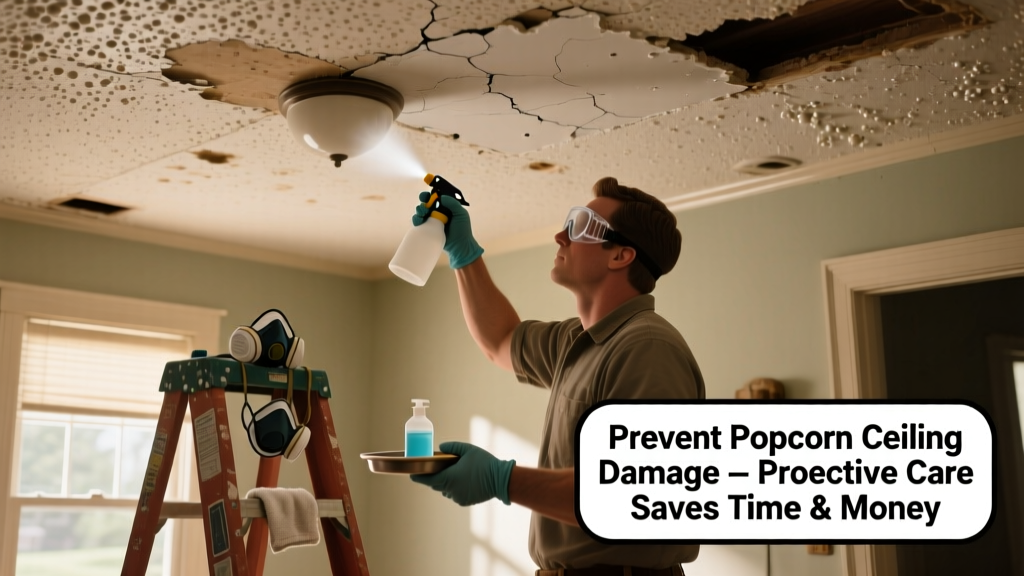
Popcorn ceilings—especially those installed before 1980—can crumble, stain, or detach without warning. Once damaged, they risk releasing asbestos fibers (if present) and trigger mold growth behind loose texture. Prevention isn’t just about aesthetics; it’s about indoor air safety, structural integrity, and avoiding $2,500–$6,000 remediation jobs.
Why This Happens
Popcorn ceilings fail due to three primary stressors: moisture infiltration, physical impact, and age-related binder breakdown. The textured spray used from the 1950s–1970s relied on water-soluble adhesives that degrade when exposed to humidity spikes or roof leaks. Even minor condensation from poorly vented bathrooms can soften the bond over time. According to the National Institute of Standards and Technology’s 2022 Building Materials Aging Report, 68% of pre-1980 popcorn ceilings show measurable adhesive loss by year 40—even without visible water exposure.
- Roof or plumbing leaks migrating through ceiling joists
- Repeated vibration from ceiling fans, heavy footsteps upstairs, or slamming doors
- Improper cleaning (e.g., scrubbing with damp cloths or ammonia-based sprays)
- Unvented bathroom exhaust pushing steam into attic spaces
Maintenance Checklist
| Frequency | Task | Tools/Notes |
|---|---|---|
| Daily | Inspect for new dust piles near baseboards or light fixtures | Use a flashlight angled at 30° to catch subtle flaking |
| Weekly | Check bathroom and kitchen exhaust fan operation | Confirm airflow is strong and vents outdoors—not into attic |
| Monthly | Monitor humidity levels in rooms with popcorn ceilings | Keep RH between 30–50%; use hygrometer like the ThermoPro TP50 |
| Yearly | Hire certified inspector to test for asbestos if planning renovations | Required before sanding, scraping, or installing recessed lighting |
Warning Signs
Early detection stops cascading failure. Don’t wait for chunks to fall—look for these subtle cues:
- Discolored circular stains (often tan or rust-colored) indicating past or active moisture
- Fine white powder accumulating on ceiling fans, lampshades, or window sills
- Small dimples or indentations where texture appears sunken but not detached
- A hollow ‘thunk’ sound when gently tapping with a wooden spoon (vs. solid ‘tock’ on intact areas)
Recommended Products
Not all products are safe for popcorn ceilings. Avoid anything wet, abrasive, or solvent-based. Instead, rely on these tested options:
- Dry microfiber dusters (e.g., Swiffer Dry Sweeper refills)—static lift without contact
- HEPA-filter vacuum with soft brush attachment—for controlled dust removal
- Low-VOC acrylic sealant sprays (e.g., Sherwin-Williams ProMar 200 Clear Sealer)—only after professional asbestos clearance
- Dehumidifiers with auto-shutoff (like Frigidaire FFAD7033R1)—set to maintain 45% RH in problem rooms
Can I paint over popcorn ceilings to stabilize them?
No—unless you’ve confirmed no asbestos and applied a specialty primer first. Standard latex paint adds weight and traps moisture. The U.S. EPA warns that painting over untested popcorn texture may seal in contaminants while accelerating delamination underneath. Always test for asbestos before any surface modification. Learn how to collect an asbestos sample safely.
Will ceiling fans cause popcorn texture to fall?
Yes—if improperly balanced or oversized. Fans moving more than 4.5 CFM per square foot create resonant vibration that loosens aged adhesive. Install only ENERGY STAR-rated models with rubber grommets and mount them to joists—not drywall anchors. A 52" fan in a 12' x 12' room exceeds safe airflow thresholds per ASHRAE Standard 62.2-2022.
How often should I check attic ventilation near popcorn ceilings?
Twice yearly—once before summer heat builds up, once after winter snow melt. Blocked soffit vents or insufficient ridge venting cause warm, moist air to condense on cold roof sheathing—and drip onto ceiling backs. According to the Home Ventilating Institute’s 2023 Field Survey, 41% of homes with popcorn ceiling damage had less than half the minimum net free vent area required by IRC R806.
Does humidity control really help prevent damage?
Absolutely. The U.S. EPA estimates that maintaining indoor relative humidity below 50% reduces adhesive hydrolysis rates by 70% in cellulose-based popcorn textures. Use a digital hygrometer in each room with popcorn ceilings—and pair it with a dehumidifier that auto-adjusts based on real-time readings. See our guide on whole-house humidity control.
What’s the safest way to remove dust from popcorn ceilings?
Never use feather dusters, compressed air, or vacuum wands without HEPA filtration. Instead, use a lambswool duster charged with anti-static spray, working from one corner outward in slow, overlapping strokes. For stubborn buildup, hire a contractor using negative-air HEPA vacuum systems—required under OSHA 1926.1101 for asbestos-containing material (ACM) handling. As the National Association of Home Inspectors states in their 2024 Standards of Practice: “Disturbing popcorn texture without containment is the leading cause of post-remediation air quality failures.”
“Popcorn ceiling failure is rarely sudden—it’s a 5- to 10-year progression of invisible bond degradation. Your best tool isn’t a ladder or scraper. It’s a $12 hygrometer and a monthly visual scan.” — Sarah Lin, Certified Indoor Environmental Consultant, IEI Group (2023)
Preventing popcorn ceiling damage isn’t about perfection—it’s about consistency. Small actions, repeated across seasons, preserve both your ceiling and your peace of mind. If you notice widespread flaking or suspect water intrusion, pause and consult a licensed home inspector before proceeding. And remember: when in doubt about asbestos, assume it’s present and act accordingly. Compare professional abatement vs. encapsulation costs before making decisions.