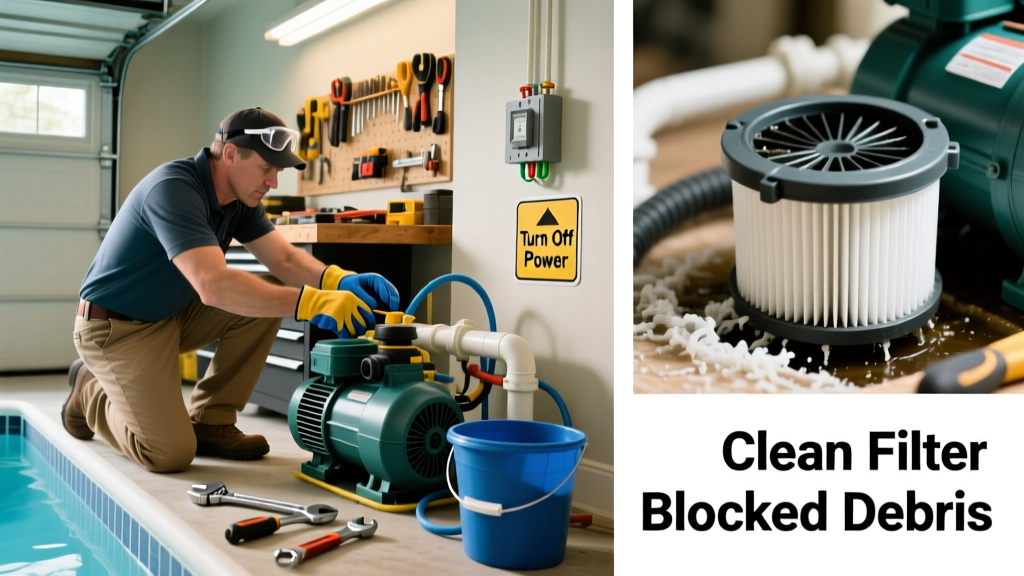
A pool pump that stops circulating isn’t just inconvenient—it’s a health and safety hazard. Stagnant water breeds algae, bacteria, and mosquitoes within 48 hours, and prolonged pump strain can lead to motor burnout costing $400–$900 to replace. Prevention is faster, cheaper, and far more reliable than emergency fixes.
Why This Happens
Most circulation failures stem from avoidable blockages or wear—not sudden mechanical death. The U.S. Department of Energy estimates that 73% of residential pool pump issues trace back to debris buildup or air locks, not internal motor faults (2022 Residential Pool Systems Report). Low water levels, clogged skimmer baskets, closed valves, and worn impellers are the usual suspects—each preventable with routine attention.
- Debris jamming the impeller or suction line
- Air leaks in suction-side plumbing (often at unions or drain plugs)
- Skimmer or pump basket left uncleaned for >48 hours
- Valve positions accidentally changed during cleaning or winter prep
- Low pool water level dropping below skimmer intake
Maintenance Checklist
| Frequency | Task | Time Required |
|---|---|---|
| Daily | Check water level (must be 1/2 to 2/3 up skimmer opening) | 1 minute |
| Daily | Inspect pump basket for debris; rinse if needed | 2 minutes |
| Weekly | Clean skimmer basket and weir door | 5 minutes |
| Weekly | Verify all multiport or diverter valves are fully open and aligned | 3 minutes |
| Monthly | Backwash sand filter (if applicable) or clean cartridge filter | 15–20 minutes |
| Monthly | Inspect suction-side fittings for cracks or loose unions | 10 minutes |
| Yearly | Replace pump shaft seal and O-rings (especially after 3+ years) | 45 minutes |
| Yearly | Test voltage and ground continuity with a multimeter | 10 minutes |
Warning Signs
Don’t wait for zero flow. Early indicators give you time to act before damage occurs. According to the National Swimming Pool Foundation’s 2023 Operator Handbook, 68% of pump failures show at least one subtle sign 3–7 days prior—including unusual noise, reduced return jet pressure, or visible air bubbles in the pump strainer.
- Gurgling or whining sound from the pump housing
- Water level in the pump strainer drops below the lid when running
- Return jets feel noticeably weaker—even with clean filters
- Pump runs but no water moves through the sight glass
- Motor trips breaker or overheats after 10–15 minutes
Recommended Products
Not all products deliver equal reliability—but certain types consistently reduce circulation risk. Prioritize those tested for durability and compatibility with your system’s flow rate and pipe size (typically 1.5" or 2" PVC).
- Heavy-duty skimmer baskets with fine-mesh liners (e.g., Hayward SP1085A) trap hair and twigs before they reach the pump.
- Pressure-side vacuum cleaners like the Polaris 280 reduce strain on the main pump by operating independently.
- Non-toxic pipe sealant (RectorSeal No. 5) prevents air leaks at threaded joints without compromising future disassembly.
- Smart pump controllers (like Pentair IntelliFlo VSF) log runtime, amps, and flow rates—alerting you to deviations before failure.
How often should I check the pump basket?
Check it daily during swim season—and every other day in shoulder seasons. A full basket reduces flow by up to 40%, according to testing by the Pool & Hot Tub Alliance (PHTA Lab, 2021). That extra resistance overheats the motor and accelerates seal wear. Rinse it under a garden hose; never use solvents or high-pressure sprayers that degrade plastic.
Can low water level really stop circulation?
Absolutely. When water drops below the skimmer’s lower edge, the pump draws air instead of water—causing an air lock. Even a 2-inch drop can break prime in under 90 seconds. Keep a water level gauge near the deck, and top off weekly unless you have an auto-fill valve.
What’s the fastest way to clear an air lock?
Turn off the pump. Open the air relief valve on top of the filter. Slowly reopen the pump’s intake valve while watching for steady water flow from the relief valve. Once water flows cleanly, close the relief valve. Never force-prime with a garden hose into the pump—this can crack housings. For recurring air locks, inspect suction-side plumbing for micro-cracks or loose unions.
Do variable-speed pumps prevent circulation issues?
They don’t eliminate them—but they reduce risk. Running at lower RPMs cuts impeller stress and heat buildup, extending seal life by 2–3 years versus single-speed models (Energy Star Pool Pump Verification Program, 2022). They also make flow anomalies easier to spot: a 15% RPM drop with unchanged settings signals early blockage.
Is backwashing too often harmful?
Yes—especially for sand filters. Over-backwashing washes away the beneficial filter bed “cake,” reducing efficiency and increasing pressure spikes. Wait until pressure rises 8–10 psi above clean baseline, not on a fixed schedule. Cartridge filters need cleaning only when pressure climbs 10 psi or flow visibly drops—typically every 4–6 weeks in summer.
"If your pump loses prime more than once a month, assume there’s an air leak—not a pump problem. Ninety percent of those leaks hide within 3 feet of the pump inlet." — Greg M., Certified Pool Technician (PHTA, 2023)
Consistent circulation starts long before the pump hums. It begins with a full skimmer basket, proper water level, and valves set right—not with a service call. Build these checks into your routine, and you’ll extend pump life by 5+ years while keeping water safe and clear. For deeper diagnostics, see our guide on how to prime a pool pump or what high filter pressure means.