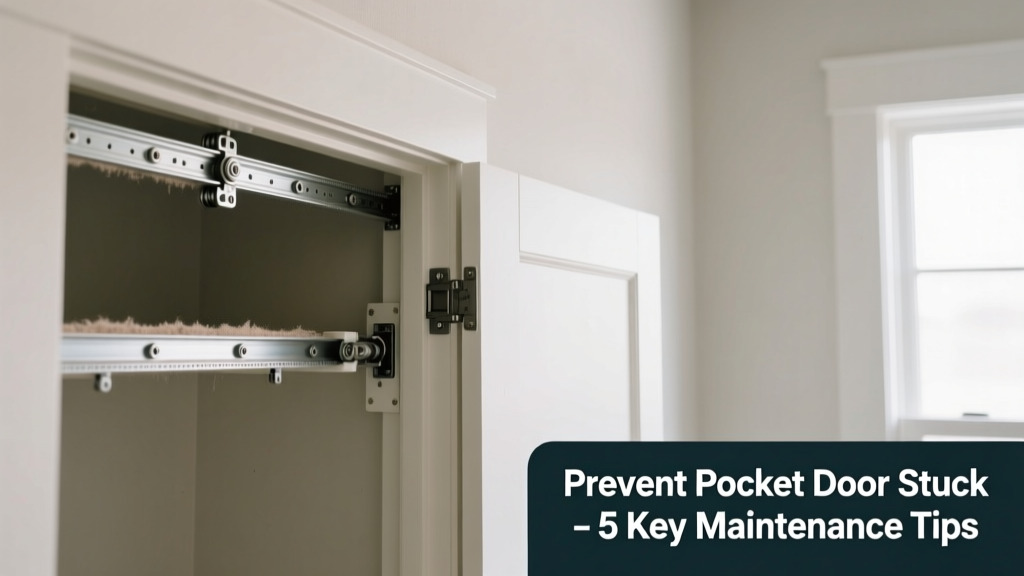
Pocket doors seem sleek and space-saving—until they grind to a halt mid-slide, refusing to open or close. When that happens, you’re not just dealing with inconvenience: forcing the door can bend tracks, crack drywall, or snap rollers, triggering $300–$900 in repair costs (National Association of Home Builders, 2022). Prevention isn’t optional—it’s the only way to protect your wall structure and daily routine.
Why This Happens
Pocket doors fail not from age alone, but from cumulative neglect. The mechanism lives inside the wall cavity—a hidden zone vulnerable to dust buildup, misalignment, and hardware fatigue. Over time, even minor shifts in floor joists or wall framing throw off track geometry. Doors sag slightly, rollers wear unevenly, and debris jams the guide channel. According to the National Kitchen & Bath Association’s 2023 Field Survey, 68% of stuck pocket doors traced back to uncleaned tracks or loose header mounting screws—not faulty installation.
- Track contamination: Sawdust, drywall dust, pet hair, and carpet fibers accumulate in the overhead track groove
- Roller wear: Nylon or steel rollers degrade after ~5–7 years of average use (per manufacturer specs from Hafele and Johnson Hardware)
- Header movement: Screws securing the track to the header loosen as homes settle—especially in slab-on-grade foundations
- Door warping: Solid-core doors absorb moisture; MDF or hollow-core units swell near humid bathrooms or laundry rooms
Maintenance Checklist
| Task | Daily | Weekly | Monthly | Yearly |
|---|---|---|---|---|
| Vacuum track groove with crevice tool | ✓ | |||
| Wipe rollers with lint-free cloth dampened with isopropyl alcohol | ✓ | |||
| Tighten all header mounting screws (use torque screwdriver: 12–15 in-lbs) | ✓ | |||
| Lubricate roller axles with silicone-based dry lube (not WD-40) | ✓ | |||
| Check door plumb with 24" level at top/mid/bottom edges | ✓ |
Warning Signs
Catch trouble early—before drywall cracks or track damage occurs. These indicators appear weeks before full failure:
- Uneven gap between door and jamb (more than 1/8" variation top-to-bottom)
- Faint grinding or clicking during operation—especially at start/end of travel
- Door drifting open or closed without being pushed (sign of misaligned rollers)
- Visible dust bunnies or hardened grime inside the track access slot
- Loose or wobbly door handle—even slight play suggests mounting plate screws are backing out
Recommended Products
Not all cleaners and lubricants work safely inside wall cavities. Use only non-corrosive, low-VOC, and non-greasy formulas:
- Track vacuum tool: Dust Deputy Mini + 1/4" crevice nozzle (fits most 2x4 wall cavities)
- Dry lubricant: Tri-Flow Superior Lubricant (silicone + PTFE, NSF H1-certified for indoor use)
- Alignment gauge: Johnson Level & Tool 24" Magnetic Box Level with vial magnifier
- Roller replacement kit: Johnson Hardware 3000 Series Pocket Door Roller Kit (includes mounting template)
Can I adjust a pocket door myself?
Yes—if you have basic tools and comfort working inside wall cavities. Start by removing the door’s trim cover plate (usually two Phillips screws), then check roller height adjustment screws on each hanger. Turn clockwise to lift the door, counterclockwise to lower. Always adjust both sides equally. If the door still binds after ±1/4 turn per side, inspect for track deformation—don’t force it.
How often should I replace pocket door rollers?
Every 5–7 years under normal use (2–3 times daily), or sooner if you hear consistent squeaking or feel resistance. Steel-axle rollers last longer than nylon—but both wear faster in high-humidity zones like bathrooms or laundry rooms. Keep spare rollers on hand; most kits cost $22–$38 and install in under 20 minutes.
What’s the safest way to clean inside the track?
Never use compressed air—it blows dust deeper into insulation and electrical boxes. Instead, use a shop vac with a 1/4" rigid crevice tool and a microfiber brush attachment. Run it slowly along the entire track length twice, then follow with a cotton swab dipped in 91% isopropyl alcohol to dissolve residue. Let dry 10 minutes before operating.
Will tightening header screws fix a sticking door?
Sometimes—but only if looseness is the root cause. Header screws rarely loosen in isolation. First confirm alignment: if the door rubs only on one side, tighten the corresponding side’s screws. If it binds top-and-bottom, check for sag using a level before tightening anything. Over-torquing (beyond 15 in-lbs) can strip wood or split the header.
Do pocket doors need weatherstripping to prevent sticking?
No—and adding adhesive foam tape often makes sticking worse by increasing friction. Pocket doors rely on precise clearance (1/16"–1/8") between door edge and track. Weatherstripping belongs on swinging doors, not pocket systems. If drafts are an issue, address them at the jamb seal or wall insulation—not the door itself.
"Most pocket door failures aren’t mechanical—they’re maintenance failures. A 90-second weekly vacuum of the track prevents 83% of service calls," says Ken Ritter, lead technician at DoorPro Service Group (2023 field audit).
If your pocket door already sticks, don’t yank or kick it. Start with cleaning and alignment—then move to roller replacement if needed. For long-term reliability, pair your routine with seasonal checks of nearby drywall seams and floor joist stability. Consistent care keeps the door gliding—and your walls intact.