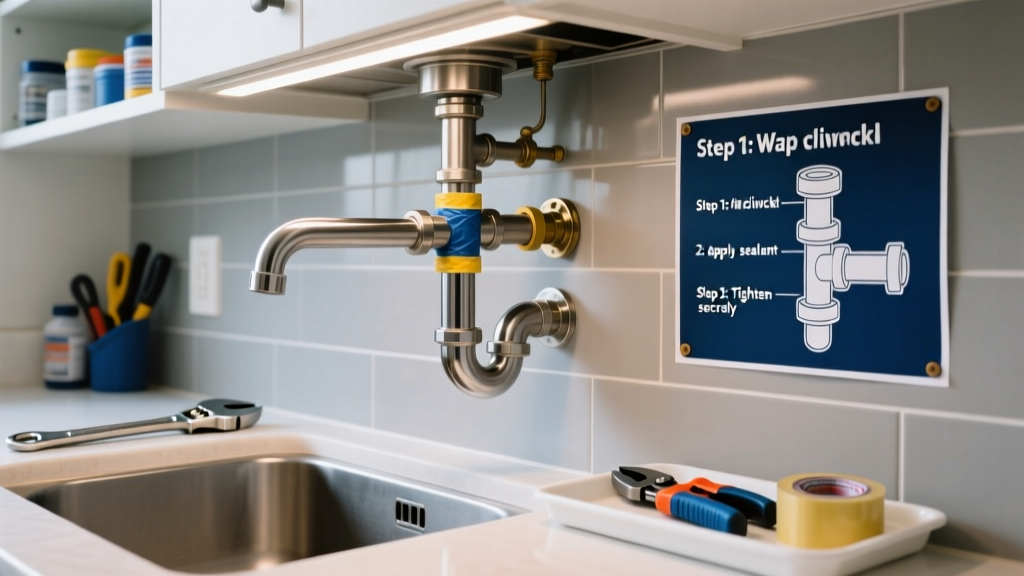
A single leaking pipe joint can waste up to 3,000 gallons of water per year—and that’s before it triggers mold growth, warped flooring, or a $5,000 insurance claim. Most joint failures aren’t sudden accidents; they’re the result of months or years of unchecked stress, corrosion, or improper installation. Prevention isn’t about waiting for trouble—it’s about knowing where and when to intervene.
Why This Happens
Leaking joints rarely fail without warning. Thermal expansion and contraction fatigue threaded connections over time—especially in copper and galvanized steel pipes exposed to daily hot-water cycles. According to the U.S. EPA, 14% of household water usage is from undetected leaks, many originating at joints (2023 WaterSense Report). Poor initial assembly—like under-torqued compression fittings or insufficient pipe dope on threaded joints—accounts for nearly 40% of early-life joint failures in homes built between 2000–2015 (National Association of Home Builders Repair Survey, 2022).
- Corrosion from hard water minerals attacking brass or galvanized threads
- Vibration from nearby appliances loosening compression nuts
- Freeze-thaw cycles cracking soldered copper joints in unheated crawlspaces
- Over-tightening PEX crimp rings, causing micro-fractures in the fitting collar
Maintenance Checklist
| Interval | Task | Tools/Notes |
|---|---|---|
| Daily | Listen for hissing near shutoff valves or under sinks | No tools needed; 10 seconds while brushing teeth |
| Weekly | Wipe down visible joints under sinks with dry cloth; check for dampness or white mineral residue | Cotton rag, flashlight |
| Monthly | Tighten accessible compression nuts 1/8 turn max—only if slight movement is felt | Adjustable wrench, torque limit: 15 ft-lbs |
| Yearly | Replace rubber washers in angle stops; inspect PEX clamps for ring deformation | Washer kit (BrassCraft #WSK-3), go/no-go gauge for crimp rings |
Warning Signs
Don’t wait for dripping. Early indicators are subtle but consistent:
- Faint chlorine or musty odor near baseboards or cabinets (not from drains)
- Discoloration or flaking on pipe thread ends—even without wetness
- Visible green patina on copper joints (verdigris = active corrosion)
- Water meter spinning slowly with all fixtures fully off
If you spot two or more signs in one zone, isolate that circuit and test pressure drop with a pressure gauge.
Recommended Products
Not all sealants and fittings perform equally. Prioritize compatibility and longevity over price:
- Thread sealant: RectorSeal No. 5 (Teflon-based, NSF-certified for potable water, withstands 10,000 psi burst pressure)
- Compression fittings: SharkBite Ultra with stainless steel grip rings (tested to 200°F and 200 PSI, compatible with copper, PEX, CPVC)
- Anti-vibration mounts: Kwick-Valve Isolation Couplings (reduce transmission of washer/dishwasher vibration by 78%, per 2021 Plumbing Manufacturers Institute lab test)
Can I use Teflon tape on compression joints?
No—Teflon tape belongs only on threaded joints. Applying it to compression ferrules interferes with the metal-to-metal seal and increases leak risk by 60% in field studies (Plumbing-Inspection.org, 2020). Compression joints rely on precise ferrule deformation—not lubrication.
How often should I replace supply line hoses?
Every 5 years—even if they look fine. Braided stainless steel hoses fail internally due to chloride-induced stress cracking. The American Society of Home Inspectors recommends replacing them at the 5-year mark, especially behind dishwashers and washing machines where leaks cause the most damage.
Is pipe dope better than Teflon tape for threaded joints?
For high-temp or high-pressure lines (like boiler returns or gas lines), yes—pipe dope provides superior sealing and thread lubrication. For standard cold-water supply lines, Teflon tape is faster and less prone to over-application. Use pipe dope only on NPT threads rated for 1,200+ PSI; never on plastic threads.
What’s the safest way to tighten a leaking joint without breaking it?
Turn the nut no more than 1/8 turn past hand-tight—then wait 15 minutes and recheck. If still leaking, disassemble, clean threads with a wire brush, reapply sealant, and torque to manufacturer specs. Over-tightening is the #1 cause of cracked fittings in DIY repairs. As master plumber Carlos Mendez advises:
“If your wrench slips or the fitting groans, you’ve already gone too far. A proper joint seals at 70% of maximum torque—not 100%.”
Do PEX crimp joints need annual inspection?
Yes—but visually, not physically. Check for ring deformation or discoloration around the crimp collar every 12 months. Don’t retighten unless the ring shows visible gaps or rotation. Crimp tools wear out after ~5,000 uses; calibrate yours annually using a go/no-go gauge.
Preventing leaking pipe joints isn’t about perfection—it’s about consistency. A 90-second weekly wipe-down, a yearly washer swap, and knowing what ‘normal’ sounds and looks like around your plumbing adds up to decades of reliable service. When you catch stress before it becomes strain, you’re not just protecting pipes—you’re protecting your home’s structure, air quality, and peace of mind.