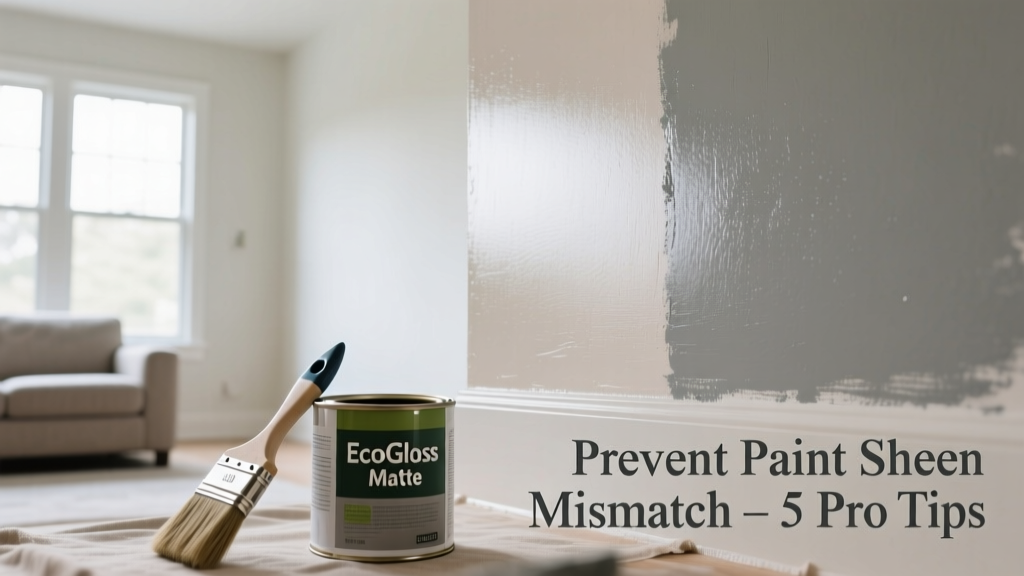
A single sheen mismatch—glossy trim next to flat walls, satin doors beside eggshell ceilings—can make a freshly painted room look amateurish, dated, or poorly maintained. Worse, it’s rarely caught until after the fact, triggering costly touch-ups or full re-dos. Prevention isn’t about perfection—it’s about consistency, documentation, and smart storage.
Why This Happens
Sheen mismatch stems from three primary causes: inconsistent product batches, unrecorded sheen changes during prior touch-ups, and environmental degradation over time. Paint sheen isn’t just surface-level—it’s tied to resin concentration and pigment dispersion, both of which shift subtly between manufacturing runs. According to Sherwin-Williams’ Paint Formulation Standards Report (2022), even same-sheen batches from different production lines can vary up to 8% in reflectance under controlled lighting.
- Using leftover paint from a 5-year-old can of 'Flat' that’s oxidized or settled unevenly
- Touching up a hallway wall with a new can labeled "Matte"—a term not standardized across brands
- Applying interior paint on exterior-grade drywall compound, altering light scatter
Maintenance Checklist
| Frequency | Task | Notes |
|---|---|---|
| Daily | Label all opened paint cans with date, room, and sheen (e.g., "Kitchen wall – Benjamin Moore Aura Flat – 03/17/2024") | Use waterproof label tape; avoid masking tape—it yellows and peels |
| Weekly | Inspect high-traffic walls for scuff marks or gloss buildup from cleaning products | Gloss buildup mimics higher sheen and fools your eye during touch-ups |
| Monthly | Stir stored paint for 90 seconds with a drill-mounted mixer—not a stick—to re-suspend solids evenly | Older paints settle into layers; hand-stirring rarely achieves uniform dispersion |
| Yearly | Photograph each room’s walls and trim with a calibrated white balance setting; store in cloud folder titled "Sheen Reference – [Year]" | Smartphone cameras distort sheen without proper white balance—use Pro mode or Adobe Lightroom Mobile |
Warning Signs
Early detection beats correction. Watch for these visual cues:
- Walls appear streaky under angled morning light—even when clean and dry
- Touch-up patches visibly "float" above surrounding surface, especially near corners or outlets
- Trim looks duller than adjacent walls despite being the same labeled sheen (e.g., both labeled "Satin")
- One wall reflects ceiling lights more strongly than others in identical lighting conditions
Recommended Products
Investing in the right tools prevents guesswork. These aren’t luxury upgrades—they’re consistency safeguards:
- Digital gloss meter (e.g., BYK-Gardner Micro-TRI-gloss): Measures 20°, 60°, and 85° reflectance—standard industry method per ASTM D523-14
- Sheen-matching swatch book (Glasurit Color System 2023 edition): Physical samples backed by spectral data, not screen renderings
- Non-yellowing acrylic primer (e.g., Zinsser Bulls Eye 1-2-3 Plus): Prevents substrate absorption variance that exaggerates sheen differences
Can I mix two different sheens to get an in-between finish?
No—sheen is engineered at the resin level, not blended like color. Mixing flat and satin doesn’t yield eggshell; it creates micro-phase separation, leading to visible mottling within 72 hours. The U.S. Paint Manufacturers Association explicitly warns against this in their Formulation Integrity Guidelines (2021).
Does humidity affect how sheen appears on the wall?
Yes—indirectly. High humidity slows drying, allowing surfactants to migrate and concentrate at the surface. This forms a temporary glossy film that fades unevenly as moisture escapes. That’s why sheen often looks inconsistent in bathrooms and basements—even with perfect application.
Why does the same paint look glossier on drywall than on wood trim?
Porosity. Drywall absorbs more binder, leaving pigment-rich top layer less reflective. Wood trim, especially sealed or primed, holds more resin at the surface—boosting reflectance. Always test sheen on both substrates before full application. See our guide on how to test substrate absorption.
Is there a way to fix sheen mismatch without repainting the whole wall?
Sometimes—but only if caught early. Light sanding (220-grit) followed by a thin, even coat of the correct sheen *applied with the same roller nap and technique* can harmonize small areas. Don’t try this on textured walls or over vinyl wallpaper—see texture repair best practices. For larger mismatches, feathering rarely works: “You can’t sand away chemistry,” says veteran painter and PPG Certified Trainer Maria Chen in her 2023 workshop at the National Painting Contractors Association Conference.
“Sheen isn’t cosmetic—it’s functional. Glossier finishes resist scrubbing but highlight flaws; flatter ones hide imperfections but wear faster. Matching sheen means matching performance expectations.” — Maria Chen, PPG Certified Trainer, NPCCA Workshop 2023
Do LED lights make sheen mismatches worse?
Yes—especially cool-white LEDs (5000K+). Their narrow spectral output exaggerates reflectance differences. Warm-white bulbs (2700K–3000K) diffuse light more evenly and are far more forgiving during inspection. Test your sheen matches under both daylight and your primary room lighting before signing off.
Preventing sheen mismatch isn’t about obsessive control—it’s about building habits that honor how paint actually behaves. Keep labels, stir properly, photograph consistently, and trust instruments over eyes alone. A well-documented wall is always easier to maintain than one you’re constantly trying to disguise. For related strategies, explore our guides on preventing paint chalking and long-term paint storage.