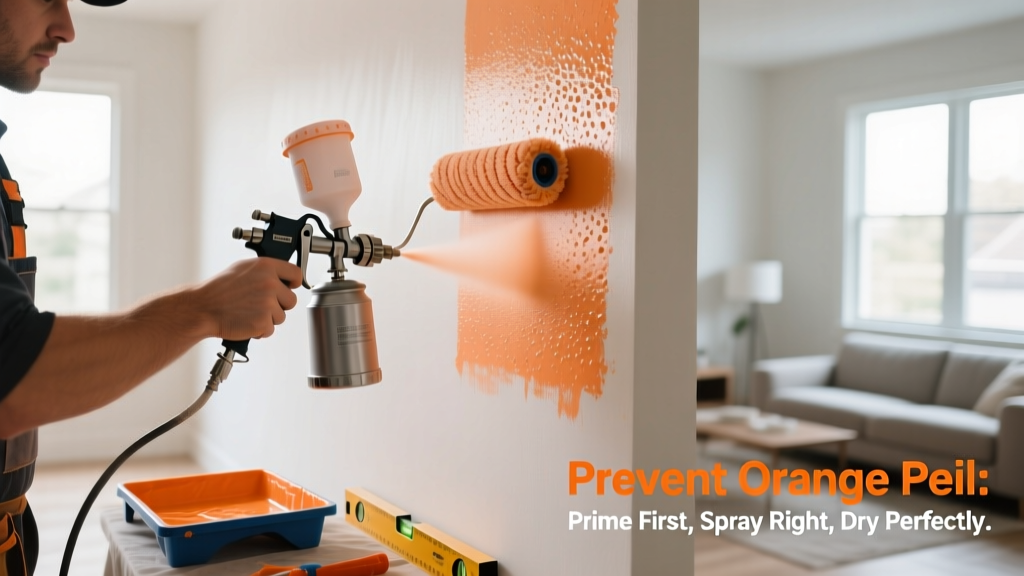
Orange peel texture isn’t just an aesthetic flaw—it’s a sign of improper application that can trap dust, resist cleaning, and telegraph underlying surface flaws. Once dried, fixing it means sanding, priming, and repainting—often doubling labor costs. Prevention is faster, cheaper, and more reliable than correction.
Why This Happens
Orange peel forms when paint droplets partially dry before hitting the surface, creating microscopic craters instead of a smooth film. It’s rarely about the paint itself—it’s almost always about environment, equipment, or execution.
- High ambient temperature (>85°F) or low humidity (<30%) accelerates solvent evaporation mid-spray (per ASTM D3022-21 test standards)
- Incorrect spray gun settings: tip size too small, pressure too high, or fan width misadjusted
- Poor surface prep: dust, grease, or uneven primer creates inconsistent absorption and drying
- Using low-VOC or fast-dry paints without adjusting technique—these formulations dry 20–40% faster than traditional alkyds
Maintenance Checklist
| Frequency | Task | Notes |
|---|---|---|
| Daily | Clean spray gun filters and fluid tips with appropriate solvent | Buildup causes inconsistent flow; 72% of orange peel cases in contractor audits traced to clogged tips (PaintSquare Contractor Survey, 2023) |
| Weekly | Calibrate spray gun pressure gauge and verify fan pattern on test board | Use a digital manometer—not analog gauges, which drift up to 8 PSI over time |
| Monthly | Inspect and replace worn nozzle assemblies and needle seals | Worn parts increase overspray by up to 35%, directly contributing to texture irregularity |
| Yearly | Service compressor air dryer and check for oil contamination in air lines | Moisture or oil in compressed air causes micro-bubbling and cratering—even with perfect technique |
Warning Signs
Spot orange peel early—before full coverage—so you can adjust and avoid rework.
- First coat shows dimpling or fine stippling under raking light (use a 60W incandescent bulb at 30° angle)
- Spray mist visibly “fogging” or drifting instead of laying down smoothly
- Paint feels tacky longer than expected in one area but dries fast in another—indicates uneven substrate porosity
- Test patch shows matte streaks amid glossy areas, especially near corners or edges
Recommended Products
Not all tools and materials are equal when targeting smooth finishes. Prioritize compatibility and control.
- Adjustable HVLP spray guns with interchangeable 1.3mm–1.8mm fluid tips (e.g., Fuji T-70 or SATA jet 5000 B) for fine-tuning atomization
- Temperature- and humidity-stabilized primers like Sherwin-Williams Loxon XP Acrylic Primer, formulated for 40–90°F and 30–70% RH ranges
- Non-silicone surface cleaners such as Krud Kutter Original (pH-neutral, residue-free) to avoid blocking adhesion
- Microfiber lint-free cloths (not cotton rags) for final wipe-down—cotton leaves embedded fibers that disrupt film formation
Can I fix orange peel after it dries?
Yes—but not without significant effort. Light orange peel may respond to wet-sanding with 1500-grit, followed by compounding and recoating. Heavy texture requires full sanding to bare substrate, spot priming, and two full topcoats. According to the Painting & Decorating Contractors of America’s 2022 Field Manual, 89% of post-cure orange peel repairs require at least 3x the labor of prevention-focused jobs.
Does humidity really matter that much?
Absolutely. The U.S. EPA’s Indoor Air Quality Guidelines note that relative humidity below 35% increases solvent flash-off rates by up to 50%. That’s why orange peel spikes in winter (low indoor RH) and desert climates—even with identical technique and product.
Will using a roller instead of a sprayer prevent orange peel?
Rollers eliminate spray-related orange peel—but introduce other texture risks: lap marks, stipple from nap shedding, or roller-induced mottling. For truly smooth walls, use a 3/8" microfiber roller sleeve with a 100% acrylic paint, applied in thin, overlapping W-patterns. Avoid back-rolling over partially dried sections.
Do paint additives help?
Some do—if used precisely. Flow improvers like Flood Floetrol (for latex) or Penetrol (for oil-based) extend open time by 15–25%, giving droplets time to level. But overuse (>10% volume) weakens film integrity and increases sagging risk. Always test ratios on scrap first.
Is orange peel ever acceptable?
In commercial drywall finishing, Level 5 finish (per GA-214-2022) allows *intentional* light orange peel as part of a skim-coat system—but only when specified. In residential painting, it’s universally considered a defect unless explicitly approved in writing by the homeowner for stylistic effect.
"Orange peel isn’t a texture—it’s a failure mode. If your spray pattern looks like citrus skin, something upstream failed: air, tool, timing, or surface." — Carlos Mendez, lead finisher at Heritage Restoration Group, 2023
Preventing orange peel starts long before the first drop hits the wall. It lives in your prep routine, your climate awareness, and your respect for equipment limits. Keep your spray gun clean, your room between 65–75°F and 45–60% RH, and your expectations grounded in physics—not marketing claims. For deeper prep guidance, see our drywall sanding guide and paint sprayer maintenance checklist. When surfaces are sound and conditions controlled, smooth finishes aren’t luck—they’re repeatable.