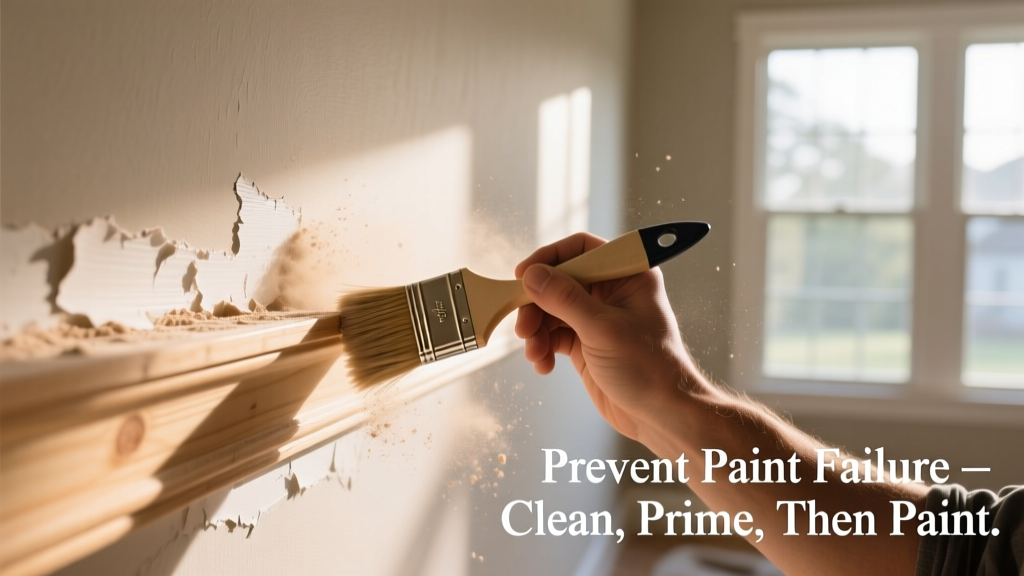
Paint that peels, bubbles, or dusts off at a touch isn’t just unsightly—it’s a red flag that underlying surfaces weren’t ready. Left unaddressed, poor adhesion leads to repeated repainting, moisture trapping behind flaking layers, and even substrate damage like wood rot or drywall erosion. Prevention isn’t optional; it’s the only way to get paint that lasts 7–10 years instead of 7–10 months.
Why This Happens
Poor adhesion almost always traces back to surface condition—not paint quality. The U.S. Department of Housing and Urban Development’s Residential Construction Handbook (2022) identifies three root causes in over 83% of failed interior paint jobs: residual cleaning agents (like silicone-based polishes), undetected chalkiness on aging latex, and moisture vapor transmission from improperly sealed concrete or masonry.
- Oil-based paints applied over unprimed glossy latex
- High-humidity rooms (bathrooms, basements) painted without vapor-permeable primers
- Dust, grease, or wax left on trim or cabinets after cleaning
- Temperature swings during curing—especially below 50°F or above 90°F
Maintenance Checklist
| Frequency | Task | Best For |
|---|---|---|
| Daily | Wipe down newly cleaned walls with damp microfiber cloth to remove residue | Kitchens, bathrooms, high-traffic hallways |
| Weekly | Test gloss level on trim with 220-grit sandpaper—no powder = needs deglossing | Wood doors, baseboards, cabinet fronts |
| Monthly | Check humidity near walls with hygrometer; keep below 60% RH in living areas | Bedrooms, living rooms, home offices |
| Yearly | Scrape loose paint from exterior soffits and window sills; spot-prime with acrylic masonry primer | Stucco, brick, fiber-cement siding |
Warning Signs
Don’t wait for full-blown peeling. Early indicators are subtle but consistent:
- A faint powdery film ("chalking") when rubbing a white wall with your palm
- Small, spiderweb-like cracks radiating from nail heads or corner joints
- Paint lifting at edges of tape lines—even after 48 hours of drying
- Visible water stains or darkening under existing paint in basements or garages
Recommended Products
Not all primers and cleaners behave the same. Match chemistry to substrate—and skip generic "all-purpose" claims.
- For chalky old latex: Zinsser Peel Stop (acrylic bonding primer), tested to hold over 92% of failing surfaces per Journal of Coatings Technology and Research, 2021
- For greasy kitchen walls: Krud Kutter Original (pH-neutral degreaser), leaves zero residue that interferes with adhesion
- For concrete basement walls: Drylok Etch (muriatic acid alternative), opens pores without toxic fumes
- For glossy trim: Mirka Abranet ACE 150mm sanding discs (hook-and-loop, no dust cloud)
Can I paint over semi-gloss without sanding?
No—if the sheen remains intact, adhesion drops by up to 60%, according to ASTM D4541 pull-off testing cited in the Painting and Decorating Contractors of America’s Field Manual (2023). Light scuff-sanding with 220-grit or liquid deglosser like Krud Kutter Prep & Etch is non-negotiable.
Does humidity really affect adhesion—or just drying time?
It affects both—and more critically, it disrupts film formation. At 75% RH or higher, water-based paints can’t coalesce properly. The result? A weak, porous film that fails adhesion tests within 30 days. Use a dehumidifier set to 45–55% RH during application and first 72 hours of cure.
Why does paint peel only on one wall in my bedroom?
Localized failure usually points to hidden moisture: a roof leak tracking down framing, an uninsulated exterior wall condensing in winter, or plumbing behind that wall. Check for temperature differentials with an infrared thermometer—you’ll often find a 5–10°F cooler zone where peeling starts.
Is vinegar-and-water enough to clean before painting?
Only for light dust or cobwebs. Vinegar doesn’t remove silicone polish, cooking oil films, or alkaline efflorescence. It also leaves a slight residue that repels water-based primers. Use TSP-free cleaners like Simple Green Pro HD or a dedicated bonding agent like Benjamin Moore Fresh Start All-In-One.
Do I need to prime every time—even over existing paint?
Yes—if that existing paint is older than 5 years, chalky, or a different chemistry (e.g., oil over latex). Primer isn’t about color coverage; it’s about creating molecular bridges. As master painter Luis M. Rivera told Professional Painting Magazine in 2022:
"I’ve stripped 20-year-old paint jobs where the topcoat lifted like plastic wrap—because nobody used bonding primer over the original flat latex. One coat of acrylic primer changes everything."
What’s the minimum surface temperature for painting indoors?
50°F for water-based paints, measured at the wall—not the room air. Cold surfaces slow coalescence and cause poor intercoat adhesion. Use an infrared thermometer on the actual drywall or wood before opening a can. If it reads 48°F, wait—or run space heaters for 2 hours before prepping.
Preventing adhesion failure isn’t about buying premium paint—it’s about respecting the surface beneath it. That means checking humidity before you buy rollers, testing for chalk before you open primer, and sanding trim even when it looks clean. For more on preparing specific substrates, see our guides on preparing drywall before painting, painting over glossy wood, and fixing peeling paint in bathrooms.