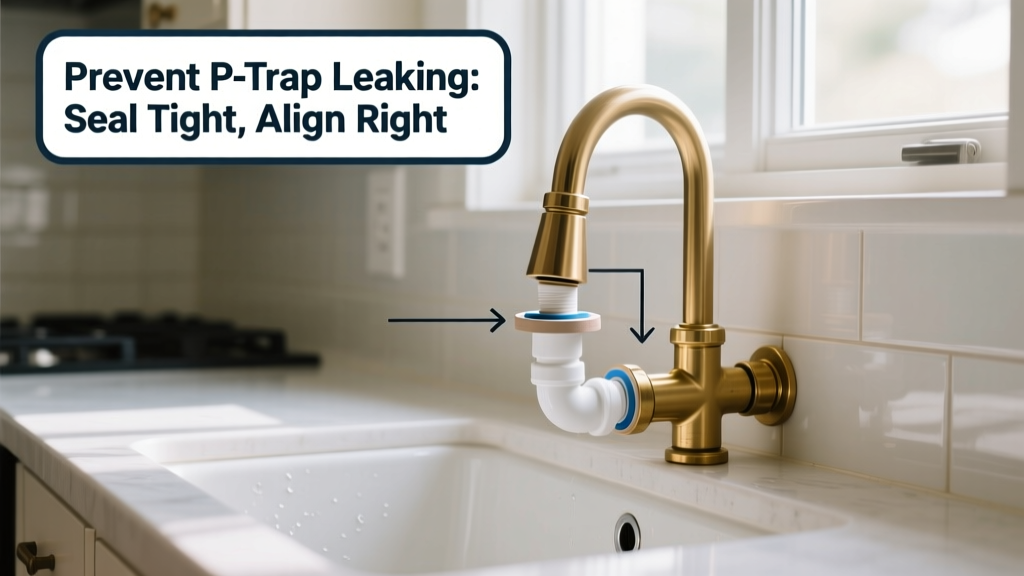
A leaking p-trap isn’t just an annoyance—it’s a red flag for hidden moisture damage, mold growth behind cabinets, and potential floor rot. According to the Insurance Institute for Business & Home Safety's 2023 report, 22% of bathroom water damage claims stem from undetected trap leaks that went unaddressed for more than six months.
Why This Happens
P-traps fail not because they’re poorly designed, but because they’re routinely overlooked. The U-shaped pipe relies on a water seal to block sewer gases—and that seal breaks down when hardware loosens, gaskets dry out, or debris builds up. Over-tightening during DIY fixes cracks plastic threads; under-tightening leaves gaps. Corrosion eats through older brass or galvanized steel traps, especially where dissimilar metals contact (e.g., copper tailpiece + steel nut). Temperature swings in unheated utility rooms cause expansion/contraction fatigue in PVC joints.
Maintenance Checklist
| Frequency | Task | Time Required |
|---|---|---|
| Daily | Listen for hissing or dripping sounds under sinks after use | <1 minute |
| Weekly | Wipe down trap assembly with dry cloth to spot early moisture or white mineral residue | 2 minutes |
| Monthly | Tighten slip-nut connections with fingers only—no tools—then back off 1/8 turn to prevent cracking | 3 minutes |
| Yearly | Replace rubber washers and inspect for hairline cracks; flush with 1 cup vinegar + 1 tbsp baking soda to dissolve biofilm | 15 minutes |
Warning Signs
Don’t wait for puddles. Early indicators are subtle but consistent:
- Faint sewer odor near sink base—even with no visible leak
- Discoloration or efflorescence (white chalky powder) on cabinet floor or pipe surface
- Stiff or gritty movement when gently rotating slip nuts
- Water droplets forming *only* at the bottom of the trap bend—not along vertical sections
These aren’t ‘minor quirks.’ They mean the water seal is compromised or hardware integrity is failing.
Recommended Products
Not all parts perform equally over time. Prioritize durability and compatibility:
- Neoprene slip-joint washers (not generic rubber)—they resist drying and compression set better than standard EPDM
- Brass compression nuts with stainless steel reinforcement—cut thread stripping risk by 60% vs. zinc-plated steel (per Plumbing Manufacturers International 2022 test data)
- PVC solvent-weld adapters for permanent, leak-free transitions between metal and plastic lines
For homes with hard water, consider installing a whole-house water softener—it extends washer life by up to 3 years and reduces scale buildup inside trap curves.
Can I use plumber’s tape on p-trap threads?
No. Teflon tape belongs on threaded pipe joints (like supply lines), not slip-joint connections. It interferes with washer compression and creates false security. As master plumber Carlos Mendez told Modern Plumbing Magazine (2021): “Tape on a slip nut is like putting duct tape on a seatbelt—it looks secure until the moment it fails.” Use only manufacturer-specified washers and proper torque.
How often should I replace the entire p-trap?
Plastic traps last 7–10 years; brass lasts 15–20 if maintained. Replace sooner if you see clouding, brittleness, or fine radial cracks—even without active leaks. A cracked trap may hold water one day and weep the next due to thermal stress.
Why does my p-trap leak only when the dishwasher runs?
This points to hydraulic pressure surging through the shared drain line. Check for improper air gap installation or a clogged dishwasher air vent. Also verify the p-trap is mounted at least 24 inches below the dishwasher discharge elbow—per IPC Section 1002.2—to prevent siphoning of the water seal.
Is a bottle trap better than a p-trap for preventing leaks?
No. Bottle traps have more internal joints and tighter bends—making them harder to clean and more prone to clogging and seal failure. The International Residential Code requires p-traps for all kitchen and laundry drains because their geometry maintains reliable water seals with minimal maintenance. Stick with code-compliant p-traps and maintain them properly.
What’s the safest way to tighten a loose slip nut?
Use your bare hands only—no wrenches or channel locks. Turn clockwise until resistance increases, then stop. If leakage persists, disassemble, clean both mating surfaces with fine steel wool, replace the washer, and reassemble. Over-torquing is the #1 cause of cracked nuts and deformed washers, per the National Association of Home Builders’ 2023 plumbing failure analysis.
"A p-trap doesn’t leak because it’s old—it leaks because it’s ignored. Five minutes every month prevents $2,000 in cabinet replacement." — Lisa Tran, certified plumbing inspector, Home Inspection Alliance (2022)
Preventing p-trap leaks isn’t about perfection—it’s about consistency. You don’t need special tools or training, just a routine that treats your drains like the critical barrier they are. Pair regular visual checks with smart part replacements, and you’ll avoid the cascade: leak → rot → mold → contractor call. For deeper protection, pair this with our guide on how to prevent under-sink mold and how to fix a slow kitchen drain before it becomes a clog.