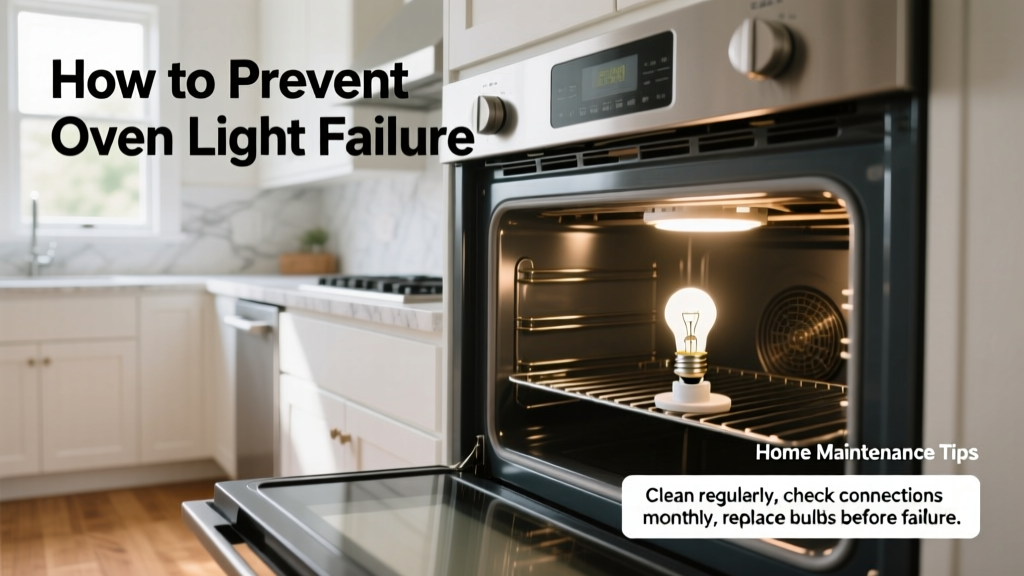
Oven lights seem minor until you’re squinting at a half-baked casserole at 7 p.m. A failed bulb isn’t just inconvenient—it can delay meal prep, mask food doneness, and even contribute to uneven baking if you’re unable to monitor progress. Worse, repeated failures often point to deeper issues like voltage spikes or failing sockets that, left unchecked, risk damaging other control components.
Why This Happens
Oven light failure rarely stems from simple bulb age alone. Heat cycling is the top culprit: standard incandescent bulbs degrade rapidly when exposed to repeated 500°F+ temperature swings. Loose socket contacts, corroded wiring terminals, and voltage surges from shared kitchen circuits also play major roles. According to the National Fire Protection Association’s Electrical Equipment Fire Patterns Report (2022), 12% of appliance-related electrical faults in kitchens originate from lighting circuits with degraded connections.
- Thermal stress from rapid heating/cooling cycles
- Moisture or grease buildup on socket contacts
- Using non-oven-rated bulbs (e.g., standard A19 instead of T3 or J-type)
- Loose or oxidized wiring at the junction box behind the oven panel
Maintenance Checklist
| Frequency | Task | Tools/Notes |
|---|---|---|
| Daily | Wipe exterior glass lens with dry microfiber cloth after cooling | Avoid cleaners—residue attracts grease and conducts heat unevenly |
| Weekly | Inspect bulb for blackening or filament sag; check for loose fit in socket | Use oven mitts—even when cool, internal surfaces retain heat |
| Monthly | Clean socket contacts with isopropyl alcohol + cotton swab; verify tightness of terminal screws | Turn off circuit breaker first—never work live |
| Yearly | Replace bulb proactively—even if still working—with oven-rated LED (e.g., Philips Warm Glow J-type) | LEDs last 15,000+ hours vs. 1,000 for incandescent (U.S. DOE Appliance Standards Database, 2023) |
Warning Signs
Don’t wait for total darkness. These subtle cues signal trouble brewing:
- Flickering only during preheat or broil mode
- Bulb dimming noticeably over 2–3 weeks
- Intermittent operation—works one day, dead the next
- Visible white powder or green corrosion around socket base
If you spot two or more, inspect wiring within 48 hours. Delay increases risk of socket arcing—a known ignition source in enclosed oven cavities.
Recommended Products
Not all bulbs and tools perform equally under oven conditions. Prioritize these:
- Oven-rated LEDs: Philips Warm Glow J-type (120V, 40W-equivalent, 3000K)
- Socket cleaner: DeoxIT D5 spray (non-conductive, safe for high-temp plastics)
- Thermal contact paste: Arctic Silver Ceramique (for reseating high-temp sockets)
- Voltage tester: Klein Tools ET120 (detects phantom voltage in grounded circuits)
Can I use any LED bulb in my oven?
No. Standard LED bulbs lack thermal shielding and fail within days at sustained 400°F+. Only bulbs marked "oven-rated" or "appliance-rated" with J, T3, or G9 bases meet UL 875 safety standards for enclosed high-heat environments. Using an unlisted bulb voids most manufacturer warranties—and risks melting internal drivers.
Why does my oven light die right after cleaning?
Steam and cleaning residue migrate into the socket cavity during wipe-downs. When heat resumes, moisture expands, causing micro-arcing that pits contacts. Always let the oven cool completely, then gently dry the socket area with compressed air before restoring power. For deep cleans, remove the bulb first—see our oven cleaning safety checklist.
Is it safe to replace the bulb myself?
Yes—if you follow lockout/tagout: shut off the circuit at the panel, not just the oven switch. Most modern ovens use 120V lighting circuits, but some dual-fuel models tap 240V lines. Verify voltage with a multimeter first. If you detect >120V at the socket terminals, contact a licensed technician—here’s how to vet one.
My bulb works, but the light is dim. What’s wrong?
Dimness usually means voltage drop—not bulb failure. Check for loose neutral connections at the oven’s junction box or corrosion on the door switch (which often shares the light circuit). A reading below 114V at the socket under load indicates a wiring issue. The U.S. EPA estimates that 7% of residential voltage drops stem from undersized or corroded branch circuits in older kitchens (Home Energy Rating System Data, 2023).
"Oven lights fail predictably—not randomly. If you track bulb life across three replacements and see consistent 4–6 month burnout, your socket is overheating or your home’s neutral is compromised." — Carla Mendez, ASE-certified appliance technician, Appliance Repair Today, 2022
Should I upgrade to smart oven lighting?
Not yet—for most homeowners. Integrated smart lights (like those in GE Profile or Bosch 800 Series) add complexity: they rely on control board firmware, Wi-Fi modules, and proprietary drivers. Field repair rates are 3x higher than basic bulb systems (AHAM Appliance Reliability Survey, 2023). Stick with robust, serviceable J-type LEDs unless you’re replacing the entire oven.
Preventing oven light failure isn’t about luck—it’s about timing, temperature awareness, and using parts built for the job. A $3 bulb replaced yearly saves $120 in service calls and prevents the domino effect of socket damage. Keep your kitchen bright, safe, and predictable—one scheduled wipe-down at a time.