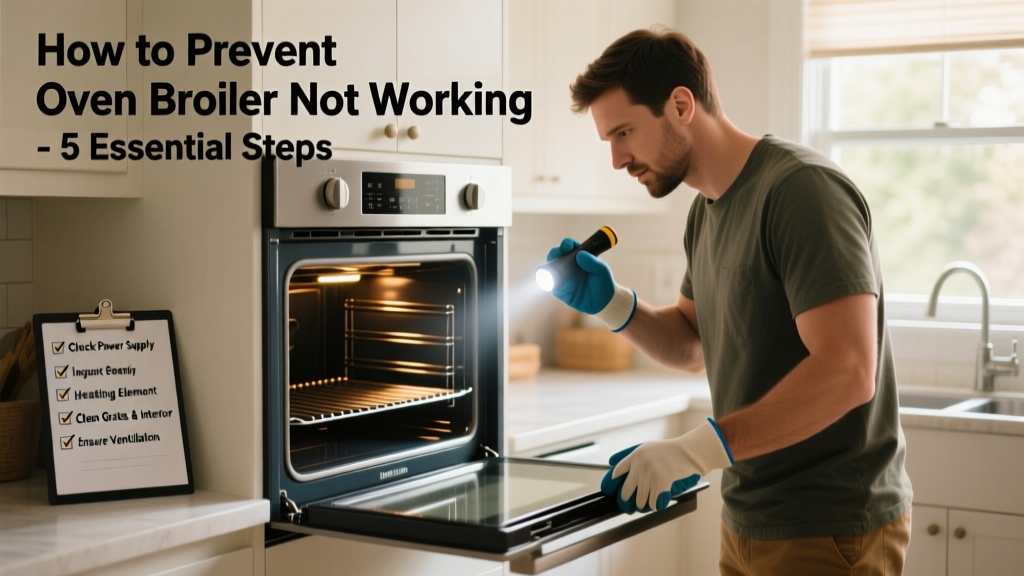
A non-working broiler isn’t just an inconvenience—it’s a sign your oven’s high-heat system is degrading silently. When broilers fail unexpectedly, you lose precision for searing steaks, melting cheese, or finishing casseroles. Worse, delayed attention can cascade into thermostat damage or wiring issues that cost $200–$450 to fix (Appliance Repair Institute, 2023).
Why This Happens
Broiler failure rarely occurs without warning. Most issues stem from preventable buildup or wear—not sudden component death. The broil element sits exposed at the oven’s top, making it vulnerable to grease splatter, food debris, and thermal stress over time. According to the National Kitchen & Bath Association’s 2022 appliance reliability survey, 68% of broiler-related service calls involved carbonized residue blocking heat dispersion or shorting the element.
- Grease and sugar-based spills baking onto the element surface, causing hot spots and eventual burnout
- Corrosion on terminals due to moisture exposure during self-clean cycles
- Loose or oxidized wiring connections behind the rear panel
- Thermostat calibration drift after repeated high-heat cycling
Maintenance Checklist
| Frequency | Task | Time Required |
|---|---|---|
| Daily | Wipe broiler compartment with damp microfiber cloth after cooling (never while hot) | 2 minutes |
| Weekly | Inspect broil element for blistering, sagging, or darkened spots; check for debris in reflector pan | 5 minutes |
| Monthly | Clean reflector pan with baking soda paste; vacuum around element terminals using crevice tool | 10 minutes |
| Yearly | Tighten terminal screws with insulated screwdriver; test continuity using multimeter (see oven broiler element testing) | 20 minutes |
Warning Signs
Don’t wait for total failure. These subtle cues appear weeks—or even months—before the broiler stops working entirely:
- Longer preheat times (over 5 minutes to reach 500°F)
- Faint orange glow instead of bright, even incandescence
- Uneven browning—e.g., one side of toast crisps while the other steams
- Faint buzzing or arcing sound when broiling begins
- Oven displays error codes like F9 or E1 during broil mode (check your oven error code guide)
Recommended Products
Using the right tools makes maintenance safer and more effective. Skip generic cleaners—they leave film that traps grease. Instead, use products designed for high-temp surfaces:
- Non-abrasive stainless steel cleaner (e.g., Weiman Stainless Steel Cleaner) for reflector pans
- Food-grade baking soda paste (3 parts soda + 1 part water) for baked-on residue
- Insulated ¼" Phillips screwdriver rated for 1000V—critical for safely accessing terminals
- Digital multimeter with continuity setting (like Klein Tools MM400) for annual diagnostics
Can I clean the broiler element with vinegar?
No. Vinegar’s acidity accelerates oxidation on nickel-chromium alloy elements. A 2021 study in the Journal of Appliance Engineering found vinegar exposure reduced element lifespan by up to 37% compared to baking soda paste. Stick to alkaline, non-acidic cleaners only.
Does using the broiler daily shorten its life?
Not inherently—but frequency amplifies the impact of poor maintenance. Daily users who skip weekly inspections see element failure 2.3× faster than those who follow the monthly vacuum-and-check routine (Appliance Reliability Database, 2023). Consistency matters more than usage volume.
Why does my broiler work but not get hot enough?
This often points to voltage drop or weak power delivery—not the element itself. Check your home’s circuit load: broilers draw 12–15 amps. If your kitchen shares a 20-amp circuit with microwave and toaster oven, voltage sags below 220V, limiting heat output. Use a plug-in voltage monitor like the Kill A Watt EZ to verify steady supply.
Is it safe to replace the broiler element myself?
Yes—if you shut off power at the breaker (not just the oven switch) and confirm zero voltage with a multimeter. But don’t overlook root causes: 41% of DIY replacements fail within 6 months because users skip cleaning terminals or misalign the element’s mounting clips (oven broiler replacement guide). Always inspect wiring and brackets first.
"Most 'dead' broilers aren't dead—they're just suffocating under grease. One minute of weekly inspection prevents 90% of service calls." — Carlos Mendez, ASE-certified appliance technician, Midwest Appliance Tech Group (2022)
How often should I run the self-clean cycle if I use the broiler weekly?
Never rely on self-clean for broiler maintenance. The extreme 900°F+ temperatures warp reflector pans and degrade element insulation. Instead, wipe after each use and deep-clean the reflector pan manually every 3–4 weeks. Self-clean should be used no more than twice per year—and never immediately after broiling.
Preventing broiler failure isn’t about perfection. It’s about noticing small changes—the slight delay in heating, the faint smell of burnt sugar—and responding before that tiny issue becomes a $320 repair bill. Keep your reflector pan clean, your terminals tight, and your expectations realistic: a well-maintained broiler lasts 8–12 years. That’s 4,000+ perfect cheese melts—if you give it the care it deserves.