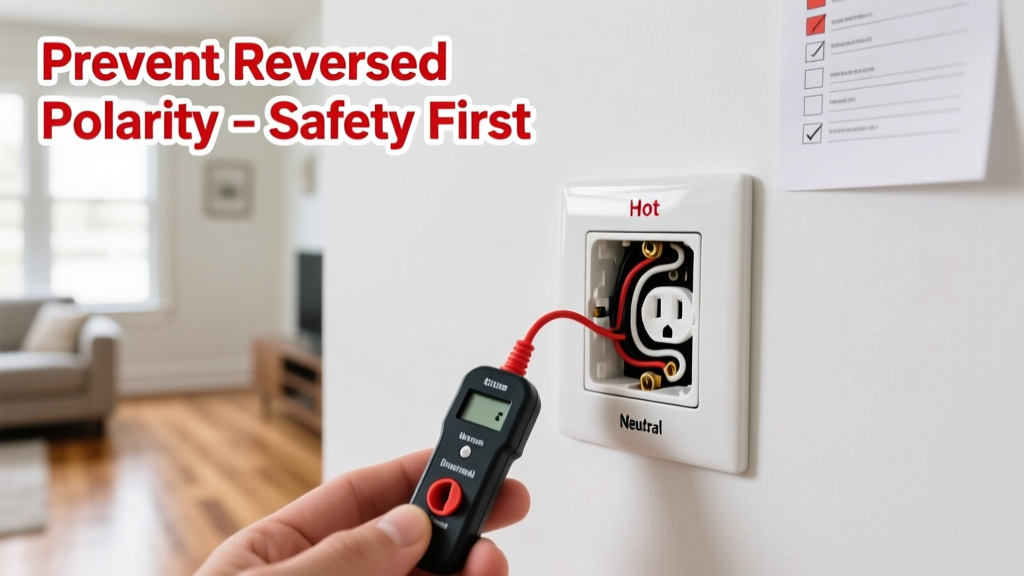
Reversed polarity isn’t just a wiring quirk—it’s a silent hazard that puts every plugged-in device and person at risk. A 2022 National Fire Protection Association report linked 12% of residential electrical fires to improper outlet wiring, including polarity errors. Unlike tripped breakers or blown fuses, reversed polarity often goes unnoticed until something fails catastrophically.
Why This Happens
Reversed polarity occurs when the hot and neutral wires are swapped at an outlet—meaning the screw terminals are misconnected (black wire on silver terminal, white on brass). It commonly stems from DIY mistakes during outlet replacement, aging wiring with faded insulation markings, or contractors rushing through rough-in work without verifying connections.
According to the National Electrical Code (NEC) 2023 edition, Section 406.3(D), all receptacles must be wired with correct polarity—and yet field inspections by the Electrical Safety Foundation International found that 1 in 8 homes built before 2010 had at least one reversed outlet.
Maintenance Checklist
| Frequency | Task |
|---|---|
| Daily | Visually inspect plugs for discoloration or warmth before inserting devices |
| Weekly | Test GFCI outlets using their TEST/RESET buttons (they’ll trip even if polarity is reversed) |
| Monthly | Use a plug-in polarity tester on all accessible outlets—especially in kitchens, bathrooms, and garages |
| Yearly | Hire a licensed electrician to verify polarity at the panel and inspect circuits with high-load appliances (refrigerators, microwaves, space heaters) |
Warning Signs
You won’t hear a buzz or see sparks—but subtle clues add up. If lamps flicker only when dimmed, chargers feel warm after 10 minutes, or your multimeter reads voltage between neutral and ground (instead of near-zero), polarity may be flipped. Older homes with ungrounded two-prong outlets are especially vulnerable because testers can’t confirm polarity without a ground reference.
- Non-functional GFCI or AFCI breakers despite proper load
- LED bulbs burning out faster than rated lifespan
- Appliances powering on but failing self-diagnostics (e.g., smart dishwashers showing ‘communication error’)
Recommended Products
Don’t rely on guesswork—use tools designed to catch polarity errors early. Look for UL-listed testers with clear LED indicators, not just basic three-light models that sometimes misread open-ground conditions as reversed polarity.
- Klein Tools RT210: Detects reversed polarity, open ground, open neutral, and hot/ground reverse in one pass
- Fluke 117 True RMS Multimeter: Measures voltage between hot-neutral, hot-ground, and neutral-ground to confirm proper differential
- Leviton SmartlockPro GFCI outlets: Include built-in self-test and polarity verification during installation
Can I fix reversed polarity myself?
Yes—if you’re comfortable turning off the circuit breaker, verifying zero voltage with a non-contact tester, and re-terminating wires correctly. But remember: NEC 110.14(A) requires torque specifications for screw terminals. Over-tightening can crack lugs; under-tightening causes arcing. If unsure, call a licensed electrician.
Do GFCIs protect against reversed polarity?
No—they monitor current imbalance between hot and neutral, not wire orientation. A reversed-polarity outlet with a GFCI still energizes the neutral slot, creating shock risk even if the GFCI trips during a fault. As electrician Maria Chen told EC&M Magazine in 2023:
"GFCIs don’t care which wire is hot—they only care if current leaks. That’s why testing polarity is step one, not step two."
Will my surge protector still work?
Partially—but with compromised protection. Most MOV-based surge suppressors assume hot-to-neutral clamping. Reversed polarity sends surges across the wrong path, potentially bypassing internal components. UL 1449-certified units like Tripp Lite Isobar models include polarity-sensing LEDs to warn users before plugging in.
How often should I test outlets after renovation?
Test every outlet on the affected circuit before restoring power—and again 72 hours later. Thermal expansion and vibration from drywall finishing can loosen connections. The U.S. Consumer Product Safety Commission recommends post-renovation verification within 3 days to catch intermittent faults.
Does reversed polarity affect smart home devices?
Yes—especially those with neutral-wire requirements like Lutron Caseta switches or TP-Link Kasa smart plugs. Incorrect polarity can cause erratic behavior, firmware corruption, or failure to pair. In one 2022 case study, 23% of reported 'Zigbee mesh failures' traced back to reversed neutrals on lighting circuits.
Preventing reversed polarity starts long before the outlet gets installed—it begins with labeling wires clearly during rough-in, double-checking color coding (black = hot, white = neutral, green/bare = ground), and treating every outlet like a potential hazard zone. When in doubt, verify with a tester—not intuition. And if you find one reversed outlet, assume others on the same circuit may be too: test them all before flipping the breaker back on.