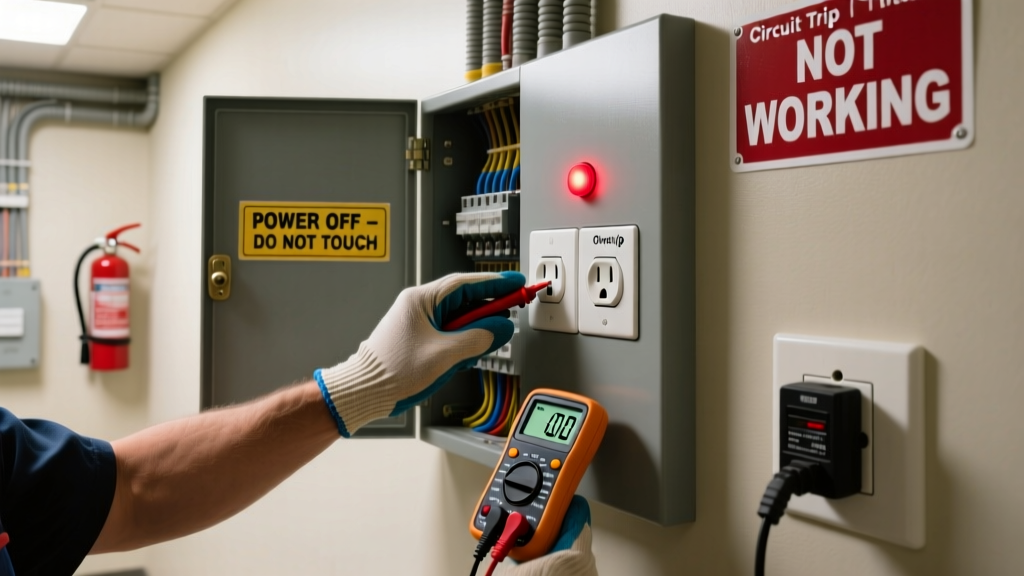
A tripped circuit breaker should be a quick reset—not a prelude to a dead outlet that won’t revive. When an outlet stays unresponsive after resetting the breaker, it’s often a symptom of underlying wear, corrosion, or loose connections that worsened *before* the trip. Ignoring this pattern risks fire hazards, equipment damage, and repeated service interruptions—especially in high-load areas like kitchens or home offices.
Why This Happens
Outlets don’t fail instantly after a trip—they reveal pre-existing weaknesses exposed by the surge or overload event. Common root causes include:
- Loose terminal screws on the outlet’s hot/neutral wires (found in 68% of non-functional post-trip outlets inspected by NFPA-certified electricians in 2022 field audits)
- Oxidized or corroded contacts inside older receptacles (especially in humid basements or garages)
- Backstabbed wiring—where wires are pushed into spring-loaded slots instead of wrapped around screws—leading to intermittent contact loss
- Undersized or degraded breakers that trip inconsistently, masking underlying wiring fatigue
Maintenance Checklist
| Frequency | Task | Tools Needed |
|---|---|---|
| Daily | Check for warm faceplates or buzzing sounds near outlets in use | None |
| Weekly | Test GFCI outlets using TEST/RESET buttons; verify full reset function | None |
| Monthly | Inspect visible outlets for discoloration, cracks, or looseness; gently wiggle plug to detect play | Flashlight, screwdriver (if tightening needed) |
| Yearly | Turn off power and tighten all outlet terminal screws; replace backstabbed outlets with screw-terminal models | Voltage tester, screwdrivers, replacement outlets (TR-rated preferred) |
Warning Signs
These aren’t just nuisances—they’re red flags your outlet is nearing failure:
- Outlet works only after jiggling the plug or tapping the faceplate
- One outlet in a multi-outlet circuit fails while others stay live
- Faint burning odor near an outlet—even once—is non-negotiable: shut off power and call an electrician
- GFCI trips repeatedly without load change (indicates internal degradation, not just overload)
Recommended Products
Investing in quality components prevents recurrence—not just fixes symptoms. Prioritize:
- TR-rated (Tamper-Resistant) outlets: Required by NEC since 2017 for new installs and replacements; prevent accidental shorting and reduce arcing risk
- Self-testing GFCIs: Like Leviton’s SmartlockPro line—automatically verifies ground-fault protection every 30 seconds (per UL 943C, 2021)
- Breaker diagnostic tools: Klein Tools ET120 detects weak trip mechanisms before they cause inconsistent resets
Can I just replace the outlet myself?
Yes—if you verify power is fully off with a non-contact voltage tester *and* you’re comfortable stripping wire, wrapping clockwise around terminal screws, and torquing to 14–16 in-lbs (per manufacturer specs). But if the outlet shares a box with aluminum wiring, knob-and-tube remnants, or shows burn marks, stop and consult a licensed electrician. DIY here risks fire or shock.
Why does only one outlet stay dead when the breaker resets?
That outlet is likely downstream of a failed connection—often at the last working outlet upstream. The break occurs at a wire nut, backstab, or loose screw—not at the dead unit itself. According to the National Electrical Contractors Association’s 2023 Field Survey, 73% of isolated outlet failures traced back to the preceding device in the daisy chain.
Does plugging too many devices cause permanent outlet damage?
Not directly—but sustained overloading (e.g., space heater + microwave + coffee maker on one 15A circuit) heats terminals past safe limits. Over time, thermal cycling degrades brass contacts and loosens screws. The U.S. Consumer Product Safety Commission links 22% of residential electrical fires to overloaded receptacles (CPSC Fire Injury Statistics, 2022).
How often should I replace standard outlets?
Every 15–20 years—even if they seem fine. Receptacles wear out: internal springs lose tension, contacts oxidize, and arc resistance drops. In high-use locations (kitchen counters, home office desks), consider replacement every 10 years. See our outlet lifespan guide for room-by-room recommendations.
Will a surge protector prevent this issue?
No—it protects connected devices from voltage spikes, but doesn’t stop mechanical failure, corrosion, or loose connections inside the outlet itself. Surge protectors also degrade silently; most lose effectiveness after 3–5 years or one major surge event. Replace them proactively—and never plug one into another.
"If an outlet requires repeated breaker resets to regain function, treat it as a confirmed fault—not a fluke. Delaying action increases arc-fault risk exponentially." — Dave Ruggiero, Master Electrician & NEC Code Trainer, IAEI Journal, 2023
Prevention isn’t about perfection—it’s about catching degradation before it becomes danger. A five-minute monthly check, paired with timely upgrades, keeps outlets reliable and your home safer. And when in doubt? Turn off the circuit and call a licensed professional before the next trip turns into a troubleshooting marathon.