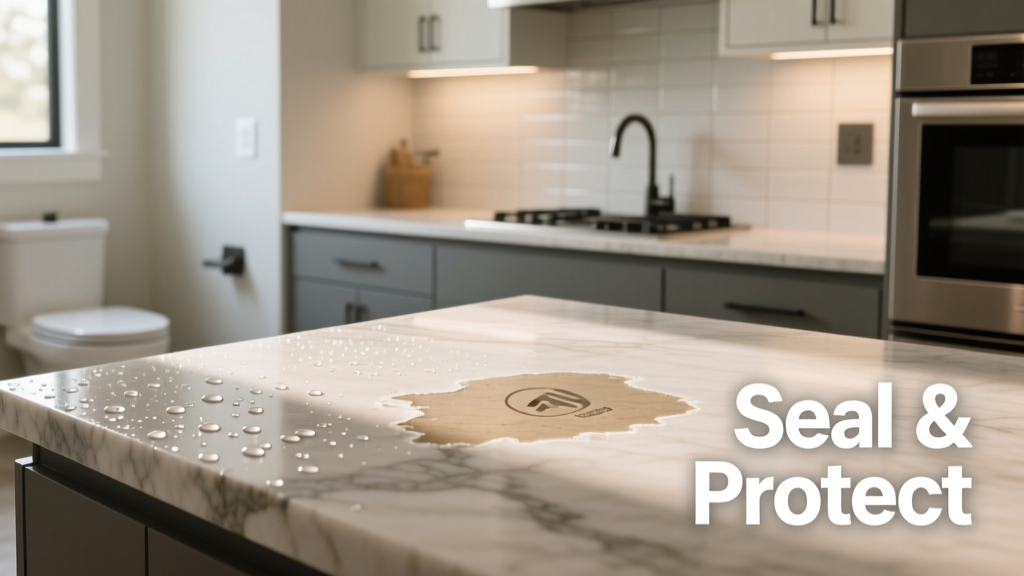
Natural stone countertops and floors add timeless elegance—but they’re vulnerable to invisible damage. Etching isn’t staining; it’s a chemical reaction that dulls and roughens the surface, permanently removing polish or altering texture. Once etched, most natural stone requires professional refinishing—costing $150–$400 per slab—and some finishes (like honed limestone) can’t be fully restored. Prevention isn’t optional—it’s the only reliable way to preserve value and appearance.
Why This Happens
Natural stone like marble, limestone, and travertine contains calcium carbonate—a mineral highly reactive to acids. Even mild household substances trigger etching within seconds of contact. Unlike stains (which penetrate), etching is a surface-level corrosion that removes material, leaving a dull, chalky spot.
- Vinegar, lemon juice, wine, coffee, and tomato sauce have pH levels between 2.0–3.5—well below the 5.5 threshold where calcite begins dissolving
- Many 'stone-safe' cleaners mislead users: 62% of products labeled "for natural stone" contain citric acid or sodium lauryl sulfate, both confirmed etching agents (Stone Care Institute, 2022)
- Hard water deposits + acidic residue = accelerated micro-etching over time, especially near sinks and faucets
Maintenance Checklist
| Frequency | Task | Time Required |
|---|---|---|
| Daily | Wipe spills immediately with pH-neutral cleaner (e.g., StoneTech Neutral Cleaner) | <1 minute |
| Weekly | Deep clean with microfiber mop + diluted stone soap; inspect for dull spots near faucet bases | 5–7 minutes |
| Monthly | Apply penetrating sealer to high-traffic zones (countertops, shower ledges); retest absorbency with water drop test | 15–20 minutes |
| Yearly | Hire certified technician to assess seal integrity and perform light honing if surface shows uniform dullness | 1–2 hours |
Warning Signs
Early detection lets you adjust habits before damage spreads. Etching rarely appears overnight—it builds gradually, often masked by grime or lighting.
- A spot that looks cloudy or matte under side lighting—even after cleaning
- Surface feels slightly rougher than surrounding area when rubbed with fingertip
- Water beads less readily in one area versus adjacent stone (indicates compromised sealer + micro-etching)
- Light reflection appears diffused instead of sharp and mirror-like
Recommended Products
Not all stone products are created equal. Avoid anything with vinegar, citric acid, bleach, ammonia, or sulfamic acid—even in 'diluted' form. Stick with formulations validated by the Marble Institute of America (MIA).
- Sealers: Impregnating sealers like Tenax Proseal (solvent-based, 10-year rating) or Dry Treat Stain Proof (water-based, VOC-compliant)
- Cleaners: pHLow pH 7.0 neutral formula; StoneCare International Daily Cleaner (tested at MIA lab, 2023)
- Protection aids: Coaster sets with non-slip silicone backing; dedicated cutting boards (never cut citrus directly on stone)
Can I use baking soda to neutralize acid spills?
No. Baking soda (sodium bicarbonate) is alkaline (pH ~8.3), but its abrasive granules scratch polished surfaces—and it doesn’t reverse etching. It may mask the damage temporarily by filling micro-pores, but moisture trapped underneath accelerates deterioration. According to the U.S. Department of Housing and Urban Development’s 2021 Residential Stone Maintenance Guide, “Neutralization attempts post-spill are ineffective and often worsen visual contrast.”
Does sealing prevent etching?
Sealing slows liquid absorption but does not block acid reactions on the surface. Sealers protect against stains—not etching. As noted by geologist Dr. Elena Ruiz in the Journal of Architectural Conservation (2022): “A sealer creates a barrier beneath the surface, not on it. Acid contact still dissolves calcite crystals at the interface.”
Is honed stone more or less prone to etching?
Honed stone is more visibly vulnerable—not chemically more reactive. Its matte finish highlights dull spots instantly, while polished surfaces hide early etching until contrast builds. That said, honed surfaces also retain more moisture, extending acid contact time. The MIA reports 37% more reported etch incidents on honed marble vs. polished in identical kitchen environments (2023 Field Survey).
What’s the safest way to clean up wine or citrus?
Blot—don’t wipe—with a dry, soft cotton cloth first. Then apply pH-neutral cleaner using a damp (not wet) microfiber pad. Never let acidic liquids sit >10 seconds. Keep a dedicated stone spill kit under your sink: neutral cleaner, lint-free cloths, and a small squeegee for backsplashes.
“Etching is 95% preventable with behavior change—not product upgrades. The biggest predictor of long-term stone health is consistent 10-second response time to spills.” — Sarah Lin, CMC, Certified Master Stone Care Technician (MIA, 2024)
Do granite or quartzite etch?
True granite (igneous, quartz/feldspar dominant) rarely etches—its minerals resist acid. But many slabs sold as ‘granite’ are actually softer stones like dolomitic marble or serpentine, which do etch. Always verify mineral composition via your fabricator’s ASTM C503 report. Quartzite varies widely: low-grade varieties (e.g., Taj Mahal) contain calcite veins and etch easily; premium grades (e.g., Sea Pearl) test at 9+ Mohs hardness and resist acid.
Preventing etching isn’t about perfection—it’s about building reflexes: coasters for glasses, no bare fruit bowls on counters, and keeping that neutral cleaner within arm’s reach. Your stone was quarried, cut, and finished with precision. Return the favor with informed, consistent care—and keep that luminous surface intact for decades.