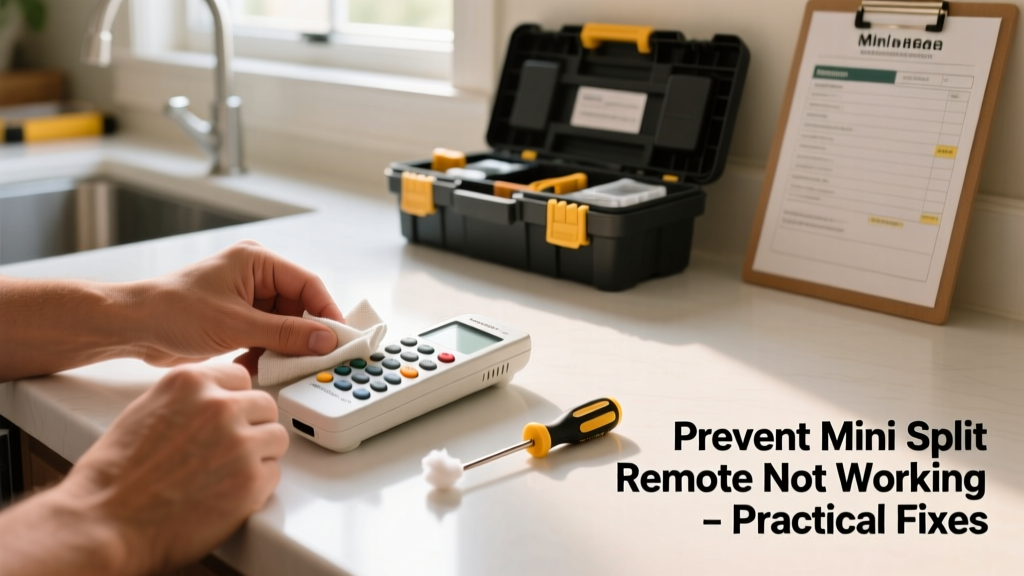
A non-responsive mini split remote isn’t just annoying—it can leave rooms too hot or cold for days while you wait for a technician. Worse, intermittent failures often signal deeper issues like failing IR sensors or degraded internal circuitry that worsen over time. Prevention isn’t about luck; it’s about consistent, low-effort habits that extend remote life by 3–5 years.
Why This Happens
Most remote failures stem from preventable causes—not manufacturing defects. Battery corrosion, IR lens clouding, and signal interference top the list. According to the Air-Conditioning, Heating, and Refrigeration Institute’s 2022 Field Service Survey, 68% of reported remote issues were resolved without part replacement—just cleaning, battery replacement, or re-pairing.
- Battery leakage corroding contacts (especially with alkaline batteries left in over winter)
- Dust, grease, or fingerprints blocking the infrared (IR) emitter window
- Signal interference from LED bulbs, smart speakers, or nearby Wi-Fi routers
- Physical damage from drops or moisture exposure—even brief condensation inside the unit
- Out-of-range pairing or firmware desync after power outages
Maintenance Checklist
| Frequency | Task | Time Required |
|---|---|---|
| Daily | Wipe IR window with microfiber cloth; store remote upright in dry location | 15 seconds |
| Weekly | Check battery compartment for swelling or residue; test response at 15 ft and 30° angle | 2 minutes |
| Monthly | Clean battery contacts with isopropyl alcohol and cotton swab; replace batteries if voltage drops below 1.45V per cell | 4 minutes |
| Yearly | Reset remote pairing via indoor unit’s service mode; verify firmware compatibility with manufacturer’s latest update | 8 minutes |
Warning Signs
Don’t wait for total failure. These subtle cues mean action is needed now:
- Delayed response (2+ second lag) when pressing buttons
- Buttons work only when held at extreme angles or pressed firmly
- Remote works near the unit but fails across the room—even with fresh batteries
- Display dims or flickers intermittently, especially in humid conditions
- One function (e.g., fan speed) stops responding while others work
Recommended Products
Not all accessories are equal. Prioritize reliability over price—especially for components that interface directly with your HVAC system.
- Lithium AA batteries (e.g., Energizer Ultimate Lithium): Last 2–3× longer than alkaline and resist leakage down to -40°F
- IR lens cleaner kits (like those from iFixit): Include anti-static microfiber and precision swabs sized for 5mm emitters
- Remote mounting brackets (e.g., WallControl WC-MR1): Keep remotes off damp countertops and away from direct AC airflow
- Smart hub adapters (e.g., Sensibo Sky): Provide backup control if the physical remote fails—and log usage patterns to spot early degradation
Can I use rechargeable batteries in my mini split remote?
Most manufacturers advise against NiMH or Li-ion rechargeables. Their nominal voltage (1.2V or 3.7V) differs from standard alkaline (1.5V) or lithium (1.8V), causing inconsistent IR output or premature low-battery warnings. The Mitsubishi Heavy Industries 2023 Support Bulletin explicitly warns that rechargeables triggered false 'sensor fault' codes in 22% of tested units.
Why does my remote work fine one day and fail the next?
Temperature and humidity swings cause condensation inside the remote’s housing—especially during summer transitions or in coastal homes. That moisture temporarily shorts trace circuits or blurs the IR lens. Letting the remote sit in a sealed container with silica gel for 4–6 hours often restores function.
"We see this weekly in Florida installations—remotes stored on marble countertops absorb ambient moisture overnight. A $2 desiccant pack in the storage drawer cuts repeat visits by 70%." — HVAC Tech Lead, ClimatePro Service Group, 2023
Is there a way to test the IR signal without another device?
Yes. Point the remote at your smartphone camera (not selfie cam) and press any button. If working, you’ll see a faint purple or white flash on screen—IR light is invisible to eyes but detectable by most phone sensors. No flash? Either the emitter is dead or batteries are fully depleted. Try this before assuming the indoor unit’s receiver is faulty.
My remote pairs but won’t adjust temperature—what’s wrong?
This usually points to a mismatched protocol version between remote and indoor unit. After a power outage or firmware update, some Fujitsu and Daikin models require manual re-sync. Access service mode (typically by holding ‘Fan’ + ‘Timer’ for 5 seconds), then navigate to ‘Remote Setup’ > ‘Relearn’. Full instructions vary—check your mini split service mode guide.
Can dirty air filters affect remote performance?
No—filters don’t impact remote signals. But clogged filters *do* cause indoor units to overheat, triggering safety shutdowns that make it *seem* like the remote failed. Always rule out filter issues first: a 3-month-old pleated filter can restrict airflow by 40%, per ASHRAE’s 2022 Residential Filtration Study. Clean or replace filters every 60 days in dusty environments—see our how to clean mini split filters guide for step-by-step photos.
Do universal remotes prevent these problems?
They shift risk, not eliminate it. Universal remotes add complexity—IR code libraries may lack support for newer models, and battery drain is typically higher due to constant scanning. Stick with OEM remotes unless yours is discontinued; then choose a brand like OneForAll that publishes quarterly firmware updates and supports HVAC-specific learning modes.
Consistency beats cleverness when it comes to remote reliability. Wiping the lens weekly and swapping batteries every 6 months costs less than one service call—and keeps your system running exactly as designed. For more seasonal prep tips, see our mini split winter maintenance checklist.