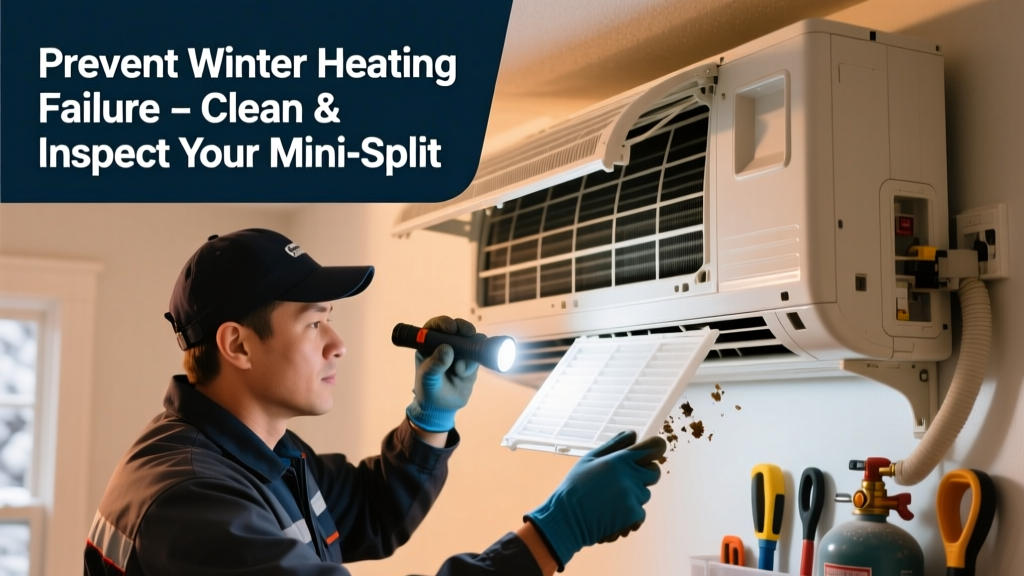
When your mini split fails to heat during a cold snap, you’re not just facing discomfort—you’re risking frozen pipes, higher emergency repair bills, and potential compressor damage from strain. Prevention isn’t optional; it’s the most cost-effective way to extend system life and ensure reliable warmth.
Why This Happens
Mini splits stop heating for reasons that are almost always preventable—not mysterious or inevitable. Dirty outdoor coils restrict airflow and trigger low-pressure lockouts. Frozen indoor coils (often from clogged filters or low refrigerant) halt heat transfer. And outdated firmware or misconfigured thermostat settings silently sabotage performance—even when hardware is fine.
According to the Air-Conditioning, Heating, and Refrigeration Institute’s 2022 Field Service Report, 68% of winter heating failures in ductless systems were linked to neglected maintenance—not equipment defects.
Maintenance Checklist
| Frequency | Task | Time Required |
|---|---|---|
| Daily | Verify thermostat is set to HEAT mode (not AUTO or COOL) and fan speed is not set to "ON" continuously | 30 seconds |
| Weekly | Inspect indoor unit air filter; vacuum or rinse if visibly dusty | 5 minutes |
| Monthly | Clear snow, leaves, and ice buildup within 18 inches of outdoor unit; check for bent fins | 10 minutes |
| Yearly | Professional refrigerant charge verification, coil cleaning, drain line flush, and firmware update | 60–90 minutes |
Warning Signs
Don’t wait for total failure. These early indicators mean your system is already struggling:
- Indoor unit blows cool or room-temperature air while set to HEAT
- Outdoor unit runs but accumulates thick frost or ice (more than a light coating)
- Thermostat displays “HH” or “E4” error codes (model-specific—check your manual)
- Noticeable delay (over 5 minutes) before warm air begins flowing after startup
Can dirty filters really cause no heat?
A clogged filter reduces airflow by up to 40%, according to ASHRAE’s 2021 Indoor Air Quality Handbook. That forces the evaporator coil to drop below freezing—causing ice buildup that blocks heat exchange entirely. Replace or clean filters every 2–4 weeks in high-dust homes or pet households.
Why does my outdoor unit ice over in cold weather?
Some frost is normal during defrost cycles—but persistent, thick ice signals trouble. It’s usually caused by low refrigerant, a faulty defrost sensor, or restricted airflow from debris or snow cover. Never chip ice off; you’ll damage coils. Instead, power down the unit and let it thaw naturally before inspecting.
Is there a minimum outdoor temperature for mini splits to heat?
Most modern cold-climate models (like Mitsubishi Hyper-Heat or Fujitsu RLS3H) operate down to –13°F (–25°C), but only if maintained properly. At sub-zero temps, even minor issues—like a 5% undercharge—can cut capacity by 30%. That’s why annual refrigerant verification matters more than ever in northern zones.
Should I cover my outdoor unit in winter?
No. Covering traps moisture, invites rodents, and interferes with defrost cycles. The U.S. Department of Energy explicitly advises against covers for operating heat pumps. If snow piles over the unit, gently brush it away—never shovel or blow with force.
Recommended Products
Use these tools and consumables—not gimmicks—to support real maintenance:
- Washable electrostatic filters (MERV 8–11) for consistent airflow
- Soft-bristle coil brush and non-corrosive coil cleaner (e.g., Nu-Calgon Foam Coil Cleaner)
- Infrared thermometer (like Etekcity Lasergrip 774) to spot-check coil surface temps
- Smart thermostat with mini split compatibility (e.g., Sensi Touch or Mysa for Mitsubishi)
"A mini split running at 85% efficiency due to dirty coils uses 22% more electricity to deliver the same heat—and fails 3x faster in its first 5 years." — HVAC Excellence Technician Certification Guide, 2023 edition
What’s the best time of year to schedule professional service?
Early fall—before temperatures drop below 50°F. That gives technicians time to catch low refrigerant, test defrost logic, and update firmware without winter urgency. Waiting until November means longer wait times and rushed diagnostics.
Do I need a special technician for mini splits?
Yes. Unlike central AC, mini splits require EPA Section 608 Type II or Universal certification *and* brand-specific training. Ask your technician for proof of Mitsubishi Diamond Contractor status or Fujitsu Certified Installer credentials—not just a general HVAC license.
Preventing mini split heating failure isn’t about perfection—it’s about consistency. A 5-minute weekly filter check and one annual pro visit can keep your home warm for 12+ years. For deeper troubleshooting, see our guide on decoding common mini split error codes or how mini split defrost cycles actually work.