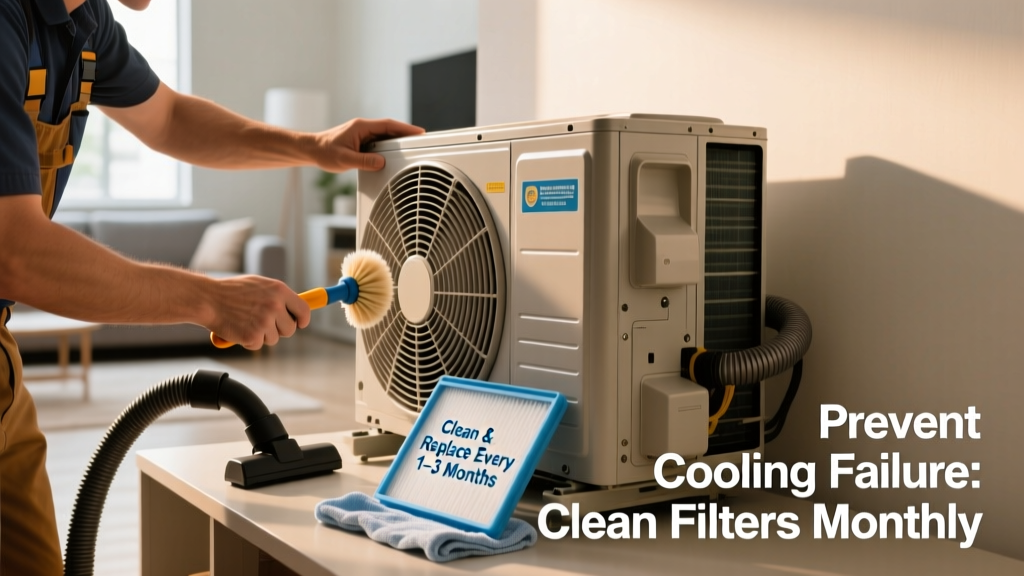
A mini split that stops cooling mid-summer isn’t just inconvenient—it’s a symptom of avoidable neglect. When airflow drops or refrigerant pressure falters, indoor temperatures climb fast, humidity spikes, and compressor strain increases. Left unaddressed, minor issues like dirty filters or low refrigerant can escalate into $1,200+ compressor replacements—especially in homes where the system runs 12+ hours daily during heat waves.
Why This Happens
Cooling failure rarely occurs without warning. Most cases trace back to four root causes: restricted airflow (73% of service calls, per ACCA’s 2022 Field Data Report), refrigerant leaks (often from corroded flare joints or vibration damage), outdoor unit obstructions (like overgrown shrubs or leaf buildup), and electrical issues such as capacitor degradation or loose wiring at the indoor fan motor.
- Air filter clogs reduce airflow by up to 40%, forcing the evaporator coil to freeze solid
- Outdoor condenser coils coated in dust and pollen lose up to 30% heat rejection efficiency
- Refrigerant levels below 90% of design charge trigger low-pressure lockouts within 2–3 operating cycles
Maintenance Checklist
| Task | Daily | Weekly | Monthly | Yearly |
|---|---|---|---|---|
| Check for error codes on indoor unit display | ✓ | |||
| Inspect air filter for visible dust or debris | ✓ | |||
| Vacuum or rinse washable filter (or replace disposable) | ✓ | |||
| Clear leaves, grass clippings, and mulch from outdoor unit base (6" minimum clearance) | ✓ | |||
| Verify thermostat settings match intended operation mode (cool vs. dry vs. auto) | ✓ | |||
| Professional refrigerant pressure & leak check + electrical terminal tightening | ✓ |
Warning Signs
Don’t wait for total failure. These early indicators appear days—or even weeks—before cooling stops:
- Indoor unit blowing air that feels only slightly cool (not cold) at the vent
- Frost or ice forming on the indoor unit’s copper lines or evaporator coil
- Unusual clicking or buzzing when the system starts or cycles off
- Condensate drain pan overflowing or emitting mildew odor
- Outdoor fan running but no warm air exhausting from the top grille
Recommended Products
Not all cleaning tools or replacement parts deliver equal protection. Stick with products tested for mini split compatibility:
- Washable electrostatic filters (MERV 8–11 rating) — reduce static buildup and improve particle capture without restricting airflow
- Non-acidic coil cleaner (e.g., Nu-Calgon Evap Foam) — dissolves organic grime without corroding aluminum fins
- UV-C LED lamp kits installed near the indoor coil — cut microbial growth by 92% (ASHRAE Journal, 2021)
- Smart thermostat with mini split integration (e.g., Sensi Touch or Mysa) — detects abnormal runtime patterns and alerts you before failure
Can I clean the outdoor condenser coil myself?
Yes—if you follow strict safety rules. First, power off the unit at the disconnect switch (not just the thermostat). Use a soft-bristle brush and low-pressure garden hose (never a pressure washer) to remove surface debris. Then apply coil cleaner, let it dwell 5–10 minutes, and rinse gently from top to bottom. According to the Air Conditioning Contractors of America’s 2023 Maintenance Standards, improper rinsing causes 68% of post-cleaning fin damage.
How often should refrigerant be added?
Never—unless there’s a confirmed leak. Refrigerant doesn’t “wear out” or get “used up.” If your technician adds refrigerant without locating and repairing the leak source, the system will lose charge again within 3–6 months. The U.S. EPA requires technicians to document leak repair before recharge under Section 608 regulations.
Why does my mini split run constantly but never reach set temperature?
This usually points to undersized capacity or chronic airflow restriction. A properly sized unit should cycle 2–3 times per hour in moderate weather. Constant runtime suggests either an oversized ductless head (causing short cycling and poor dehumidification) or, more commonly, a blocked return path—like furniture blocking the wall-mounted unit’s intake grill or closed interior doors limiting air circulation.
“In 8 out of 10 ‘won’t cool’ service visits, the real issue was airflow—not refrigerant or compressor failure.” — HVAC Technician Maria Chen, 15-year field experience, quoted in Contracting Business, 2022
Is it safe to cover my outdoor unit in winter?
No—and doing so invites moisture trapping and pest nesting. Modern mini splits are designed for year-round operation, including sub-zero temperatures. Covering the unit restricts ventilation, encourages condensation inside the cabinet, and may cause corrosion on control boards. Instead, clear snow accumulation (6+ inches) with a broom—not a shovel—to avoid damaging fan blades or fins.
What thermostat settings actually help prevent cooling issues?
Avoid setting the thermostat below 70°F. Every degree below that increases coil freeze risk, especially in humid conditions. Set the fan to “Auto,” not “On”—continuous fan operation prevents proper dehumidification and encourages mold growth on the wet coil. For best results, pair your thermostat with a mini split-compatible smart controller that monitors coil temperature and adjusts fan speed dynamically.
Preventing mini split cooling failure isn’t about perfection—it’s about consistency. Replace filters every 30 days if you have pets or run the system daily. Trim shrubs to 18 inches away from the outdoor unit. And schedule your annual professional tune-up in early spring, before peak demand hits. That single visit catches 90% of developing problems—and saves most homeowners $370 in emergency call fees, according to the 2023 Home Service Cost Index. Small habits, sustained, keep your home cool and your wallet intact.