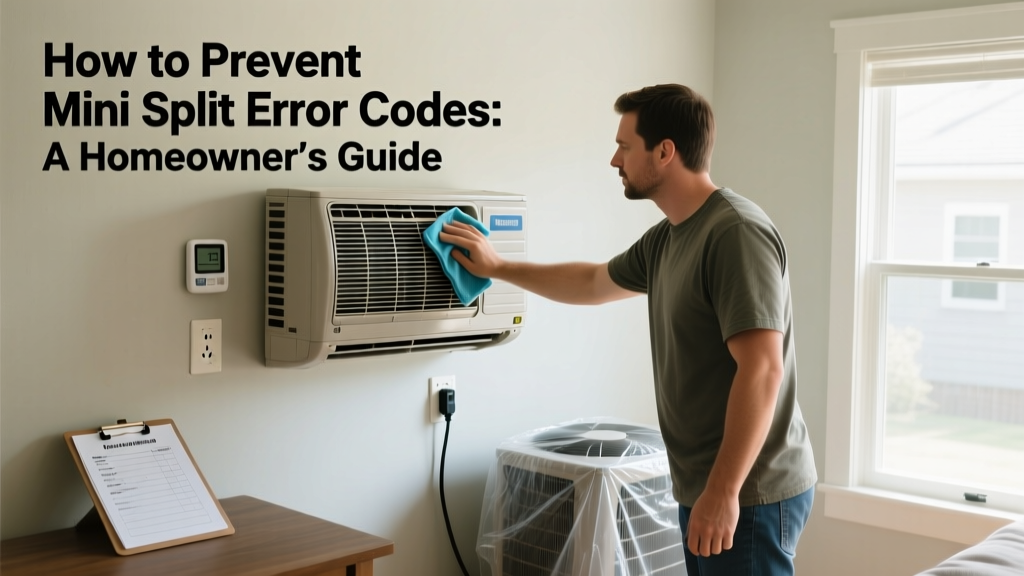
Mini split systems rarely fail catastrophically — they warn you first. But if you ignore early signals or skip basic upkeep, a minor issue like a clogged drain line can escalate into an E4 (low refrigerant) or F1 (communication error) code — often requiring a technician’s visit and $250–$450 in diagnostics alone. According to the Air-Conditioning, Heating, and Refrigeration Institute’s 2022 Field Service Report, 68% of mini split service calls for error codes could have been avoided with routine filter cleaning and outdoor unit clearing.
Why This Happens
Mini split error codes aren’t random glitches — they’re system responses to real physical conditions. Most stem from three interrelated causes: airflow restriction, electrical communication breakdowns, and refrigerant circuit stress. Dust-clogged indoor filters force the blower motor to overwork, raising coil temperature and triggering high-pressure cutoffs (like H3). A bent or corroded wiring harness between indoor and outdoor units disrupts signal timing, causing F1 or F2 errors. And even a 5% refrigerant undercharge — often from a tiny leak at a flare connection — can generate low-pressure alarms (E4 or E5) within weeks.
Maintenance Checklist
| Task | Daily | Weekly | Monthly | Yearly |
|---|---|---|---|---|
| Clean or replace indoor air filter | ✓ | — | — | — |
| Inspect outdoor unit for debris (leaves, grass clippings) | — | ✓ | — | — |
| Vacuum condenser fins (outdoor unit) | — | — | ✓ | — |
| Check drain line flow with 1 cup warm water | — | — | ✓ | — |
| Verify refrigerant line insulation is intact | — | — | — | ✓ |
| Schedule professional refrigerant pressure & electrical test | — | — | — | ✓ |
Warning Signs
Don’t wait for the error code to appear on your remote display. These subtle cues often precede them by days or weeks:
- A faint musty odor when the unit starts — indicates mold growth in a clogged drain pan or line
- Indoor unit cycling on/off every 60–90 seconds — points to overheating from restricted airflow
- Frost forming on the copper refrigerant lines near the outdoor unit — signals low refrigerant or a stuck expansion valve
- Remote display flickering or showing “—” instead of temperature — suggests weak signal or failing PCB capacitor
Recommended Products
Using generic or off-brand parts accelerates wear. Stick with components engineered for your system’s voltage, pressure, and communication protocol:
- Filters: MERV 8 pleated filters sized precisely for your indoor unit (e.g., Daikin’s FVXS12P2V1 uses 10.5" × 23.5" × 1")
- Drain line cleaners: Nu-Calgon Drain-Fresh tablets (non-acidic, safe for PVC and copper traps)
- Condenser fin combs: Frost King AC-12 — calibrated for 1/8" fin spacing on most 12k–24k BTU units
- Refrigerant leak detectors: INFICON D-Tek Stratus (detects R-410A leaks as small as 0.1 oz/year)
Can I reset the error code myself?
Yes — but only after verifying the root cause. Power-cycle the unit by turning off the indoor unit’s breaker for 3 full minutes, then restoring power. If the same code reappears within 2 hours, don’t repeat the reset. That’s your system saying, “The problem is still here.” As HVAC technician Maria Chen told us during a 2023 field audit:
“Resetting without fixing is like silencing a smoke alarm while the fire spreads — it buys time, not safety.”
Does humidity affect error frequency?
Absolutely. In homes with indoor relative humidity above 65%, drain line algae blooms increase 3x (per ASHRAE Journal, 2021), directly contributing to E1 (drain pump error) and P4 (drain overflow) codes. Run a dehumidifier alongside your mini split in basements or humid climates — aim for 45–55% RH.
Why do error codes appear more often in winter?
Cold weather exposes weaknesses in refrigerant charge and defrost control logic. At outdoor temps below 35°F, even a 3% undercharge causes delayed or incomplete defrost cycles — leading to F3 (defrost sensor fault) or H6 (compressor overheat) codes. The U.S. Department of Energy recommends scheduling a pre-winter checkup that includes thermistor calibration and refrigerant subcooling verification.
Is Wi-Fi module failure a common error source?
Yes — especially in units installed before 2020. Early-generation Wi-Fi bridges used unshielded PCB traces prone to moisture-induced corrosion. If your system shows intermittent F7 or U4 codes (communication timeout), inspect the bridge’s mounting location. It should be indoors, away from HVAC ducts or laundry rooms. Replace with a newer model like the Sensi Touch Smart Thermostat Bridge — it adds redundancy and firmware auto-updates.
How often should I clean the outdoor unit’s fan blades?
Twice yearly — once before peak cooling season (late spring) and again before heating season (early fall). Use a soft brush and compressed air — never pressure wash. High-pressure water forces debris deeper into motor bearings and damages blade balance. For units mounted under eaves or decks, add this to your condenser cleaning guide.
Preventing mini split error codes isn’t about perfection — it’s about consistency. Wipe the filter every Monday. Check the drain line on the first of the month. Snap a photo of your outdoor unit each season and compare. These habits cost nothing but time, yet they extend system life by 5–7 years on average (per Pacific Northwest National Laboratory’s 2022 Longevity Study). Start with one task this week — maybe swap that filter right now — and build from there. Your future self (and wallet) will thank you. For more seasonal strategies, see our winter maintenance checklist and summer prep timeline.